
Blade Application Guides / Application Guide / Technical films
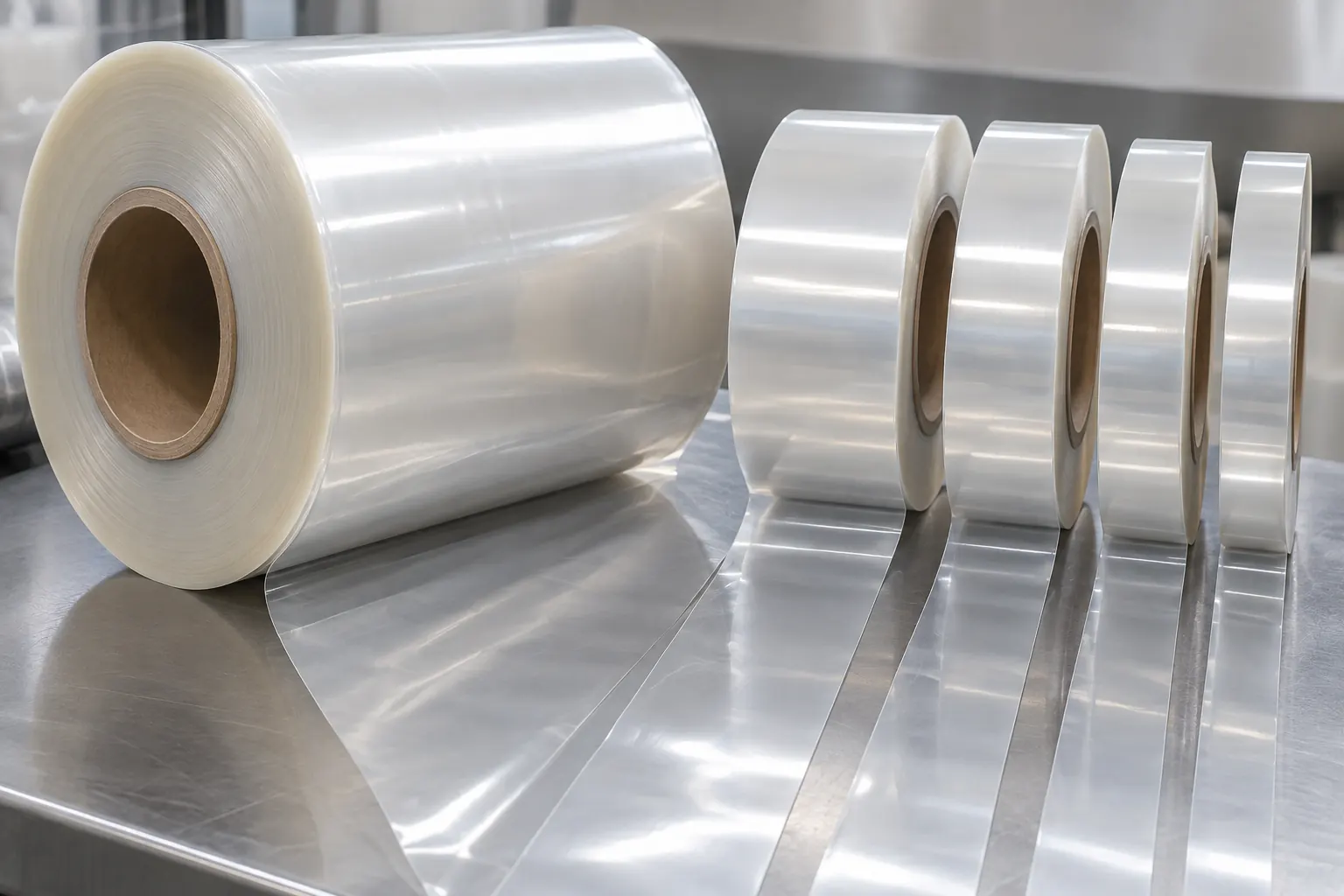
Anti-Fog Packaging Film Roll Slitting
Anti-fog packaging film may use a surface coating or migrating additive to spread condensation into a transparent layer. Slitting must preserve the treated face and avoid edge contamination, blocking or debris that can affect sealing and product visibility. The film resin, treatment mechanism and storage state should be documented.
Updated
Where This Cutting Application Appears
Fresh-produce lidding reels
Convert anti-fog film into widths used for tray sealing and clear product display.
Meat and prepared-food packaging
Prepare reels where edge cleanliness and seal compatibility support hygienic conversion.
Flow-wrap anti-fog web
Slit treated flexible film for cold-chain packs requiring stable tracking and visibility.
Roll Slitting process boundary
Roll slitting divides a master roll longitudinally into narrower rolls; it does not separate the web transversely into sheets or fixed lengths.
Roll Slitting setup checkpoint
Confirm unwind and rewind tension, slit widths, knife positions, core alignment, trim removal and the winding behavior of every daughter roll.
Roll Slitting acceptance checkpoint
Inspect roll width, edge condition, telescoping, interleaving, debris and whether each rewound roll remains stable at the required diameter.
Define the Required Cut Result
- Preserve the anti-fog-treated surface and optical clarity.
- Hold slit width and flat reel edges.
- Limit edge curl, blocking and loose fragments.
- Maintain clean material suitable for sealing and food-contact workflows.
Problems to Diagnose Before Changing the Knife
Anti-fog face becomes streaked near the edge
- Identify treated face and contact path.
- Check additive migration and storage age.
- Compare incoming and slit samples.
Slit rolls block at the edge
- Review surface chemistry and winding pressure.
- Record temperature and storage time.
- Inspect raised lips or contamination.
Edge curls toward one side
- Map layer and treatment asymmetry.
- Review web tension and thermal history.
- Measure after conditioning.
Loose edge particles enter seal area
- Identify polymer versus coating debris.
- Check extraction and cleanliness.
- Test downstream seal contamination.
Knife Forms That May Be Considered
| Possible knife form | When it may be considered | What must be confirmed |
|---|---|---|
| Circular shear slitting arrangement | For supported anti-fog film or multilayer lidding structures. | Confirm resin stack, treatment face, overlap, side load, holder, rotation and hygiene requirements. |
| Razor slitting arrangement | For compatible thin films on purpose-designed clean razor-slitting lines. | Confirm support, treatment sensitivity, exposure, speed, holder and debris control. |
Information to Send for Technical Review
You do not need to know the exact blade name. Send the available workpiece, machine, current-knife and cut-result information so the application can be reviewed against a drawing or sample.
- Film resin, layer stack, gauge and anti-fog mechanism
- Treated-face orientation and any food-contact declaration
- Master-roll dimensions, core, target widths and tolerance
- Speed, tension, temperature, humidity and static conditions
- Winding direction, roll hardness and storage age
- Existing slitting form, holder and used sample
- Limits for streaks, particles, curl, blocking and edge wave
- Downstream sealing, cold-chain conditions, packing and production volume
Questions About This Cutting Application
Can anti-fog treatment change cutting behavior?
Yes. Surface coatings or migrating additives can alter friction, tack, contamination and blocking behavior.
Why identify the treated face?
Contact and rubbing on that face may change optical performance or transfer material to guides and adjacent layers.
Can edge particles affect sealing?
Loose fragments in a seal area can reduce consistency and cleanliness, so downstream seals should be tested.
Why does storage age matter?
Migrating additives and winding pressure can change surface condition over time.
What should a trial evaluate after chilling?
Check fog performance, clarity, reel blocking, edge condition and seal results under intended cold-chain conditions.
Related product and service information
- Anti-Fog Packaging Film Edge Trimming - anti-fog packaging film · width edge trimming
- Window Tint Film Roll Slitting - window tint film · roll slitting
- Holographic Transfer Film Roll Slitting - holographic transfer film · roll slitting
Request a Custom Cutting-Knife Review
Send the workpiece details, machine or holder information, current knife photos or sample, required quantity and examples of the present cut problem. Final dimensions, material, edge geometry and tolerances are confirmed from the approved requirements.