
Blade Application Guides / Application Guide / Electronic metal converting
Aluminum Battery-Tab Stock Precision Blanking Blades
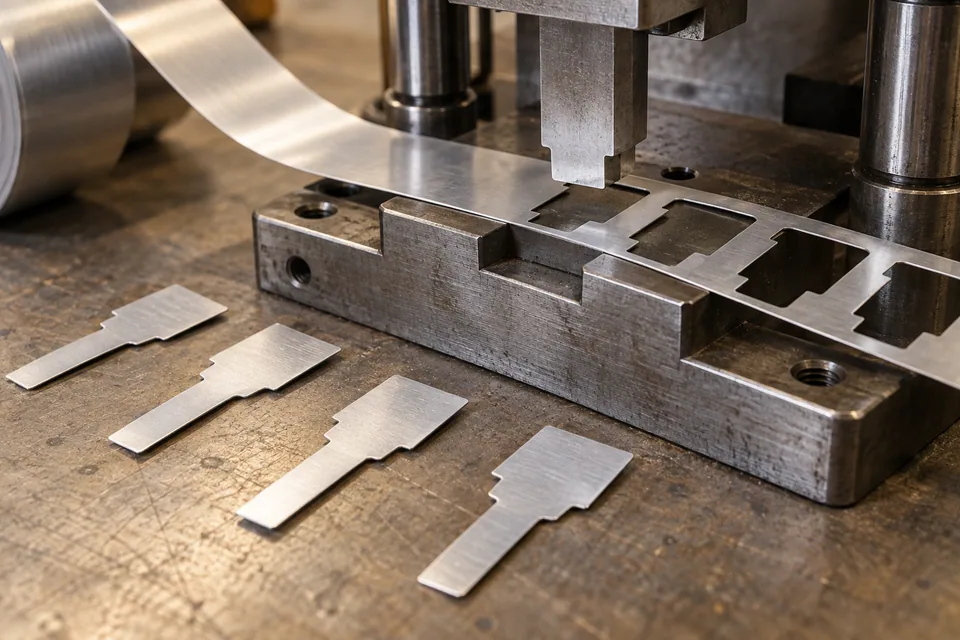
Iwatani identifies aluminum foil as cathode lead material, while Xnergy documents a die cutter for aluminum foil with a defined sample body and projecting tab profile. That equipment example establishes a shaped cut in thin aluminum sheet; it does not approve a production cell design or arbitrary high-speed blanking. This page concerns a buyer-drawn flat tab or development blank punched from separate, uncoated aluminum lead stock. The operation should not be confused with laser notching of an active-material-coated electrode, even though both can create a tab-shaped outline. The alloy, gauge, die support and later welding location must be supplied by the cell maker. Part dimensions, burrs and metal fines are converting acceptance points; joint and cell performance require later tests.
Updated
Where This Cutting Application Appears
Define a tab outline and its joining zones
Receive the approved body, shoulder, tongue and any hole drawing. Mark the aluminum face and area that will be welded or folded. Decide whether the blank remains attached to a carrier during feed or ejects as a loose part; that choice governs bridge and scrap design.
Pilot the sharpest corner in a real die
Test a small quantity with the specified punch, die, stripper and backing condition. Inspect shoulder roots, narrow tongues and pierced holes for folds, burrs or tearing. Compare both die-entry and exit faces; the side that later contacts a weld fixture may require a different burr orientation.
Control slugs and broad-face damage
Measure the contour and hole-to-edge positions on a supported fixture. Inspect skeleton scrap and ejected slugs for incomplete separation. Look for aluminum particles, press oil or die scuffs on the future weld land, since a shape can be dimensionally correct while its surface is unsuitable for joining.
Qualify downstream assembly separately
Pack flat blanks so tongues do not bend into adjacent parts and keep lot and orientation labels. The buyer trials its actual weld, fold and cell build, then evaluates resistance and mechanical integrity under its own plan. A die-cut coupon or tab outline alone is not a cell-safety approval.
Define the Required Cut Result
- Make the released flat aluminum tab contour.
- Control narrow-feature burr, folds and metal fines.
- Keep designated weld lands clean and oriented.
- Retain part and skeleton evidence through trial.
Problems to Diagnose Before Changing the Knife
A tab shoulder tears
- Check incoming foil condition and corner support.
- Compare punch and die edge wear.
A pierced slug remains attached
- Review stripper and die clearance.
- Inspect whether it scratches the joining face.
Loose tongues bend during ejection
- Review part support and receiving tray.
- Check deformation before packing.
Knife Forms That May Be Considered
| Possible knife form | When it may be considered | What must be confirmed |
|---|---|---|
| Matched punch and die set | For a released standalone aluminum lead-tab profile with a successful material trial. | Check outline, both-face edge, particles and weld-land condition. |
Information to Send for Technical Review
You do not need to know the exact blade name. Send the available workpiece, machine, current-knife and cut-result information so the application can be reviewed against a drawing or sample.
- Confirmation of separate uncoated lead stock
- Aluminum alloy, temper, gauge and lot
- Body, tongue, hole and carrier drawing
- Weld land and burr-side orientation
- Die support, stripping and slug plan
- Allowed particle, tear and fold criteria
- Flat-part handling and packaging
- Joining, sealing and finished-cell test owner
Questions About This Cutting Application
Is this the same as notching a coated electrode?
No. This page addresses separate aluminum lead material before assembly.
Does a lab die profile qualify mass production?
No. It establishes a possible cut form; the actual tool and lot require process trials.
Why inspect the skeleton?
It exposes torn carrier bridges and slugs that may damage good tabs.
Can a clean tab profile certify a weld?
No. The cell maker tests the actual joint after cutting.
What should accompany an RFQ?
Send the material sample, profile drawing, weld-land map and edge limits.
Public references and scope
These public sources provide material, cutting-method or safety context for this guide. Supplier pages describe their own materials or equipment; they do not establish a MEIRENTE blade specification or performance claim. Confirm the actual grade, machine setup and required cut with a drawing or sample.
Related product and service information
- Aluminum Battery-Tab Stock Precision Coil Slitting Blades - aluminum battery-tab stock · precision coil slitting
- Rolled-Annealed Copper Foil Precision Blanking Blades - rolled-annealed copper foil · precision blanking
- Ultra-Thin Stainless-Steel Foil Precision Blanking Blades - ultra-thin stainless-steel foil · precision blanking
Request a Custom Cutting-Knife Review
Send the workpiece details, machine or holder information, current knife photos or sample, required quantity and examples of the present cut problem. Final dimensions, material, edge geometry and tolerances are confirmed from the approved requirements.