
Blade Application Guides / Application Guide / Electronic metal converting
Ultra-Thin Stainless-Steel Foil Precision Blanking Blades
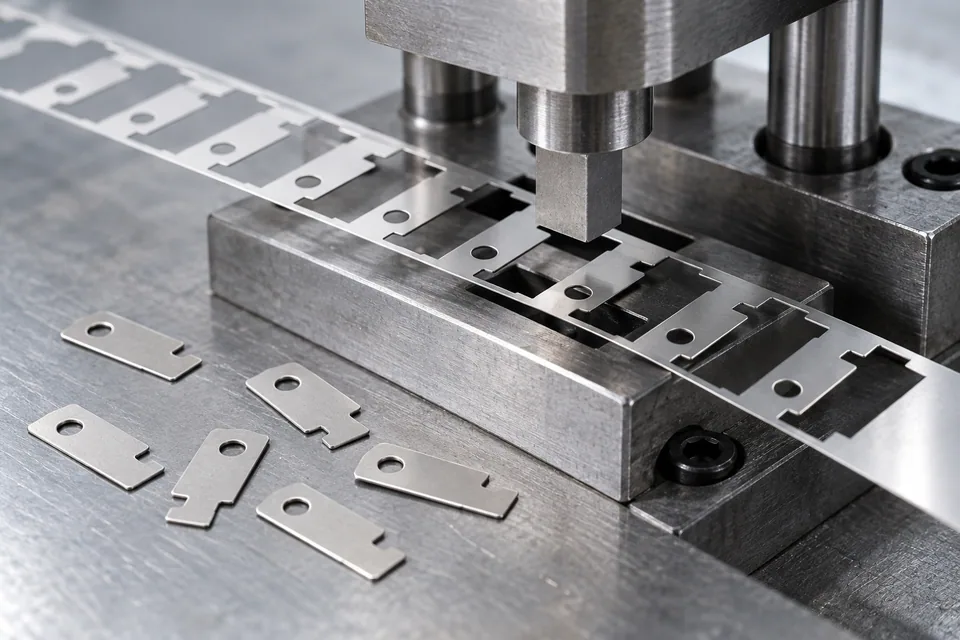
Nippon Steel Chemical & Material explicitly describes its ultrathin stainless foil as having press formability and lists electronic springs and circuit-board reinforcement among applications. Ulbrich supplies stainless foil at controlled finished gauge and temper. These sources support a precision-press trial on a named foil grade, but they do not prescribe one universal punch clearance or certify every small feature. This guide covers shaped, discrete blanks from loose stainless foil before forming or assembly. If the desired part is only a straight rectangle, transverse sheeting is a separate, simpler operation. Thin metal may bow during ejection and slugs can cling to useful parts, making part support and scrap removal as important as the visible outline.
Updated
Where This Cutting Application Appears
Define the part geometry and temper
Collect holes, narrow bridges, bend lines and rolling-direction marks from the released drawing. Identify whether the part becomes a spring, a board stiffener or another electronic component. The accepted edge and flatness may differ even with the same nominal stainless grade.
Pilot the die on actual foil stock
Support the web through registration and punch entry; measure setup on the specified gauge and temper. Inspect both faces at a straight edge and at tight corners for rollover, burr and microcracks. Do not transfer settings from thick sheet metal without a foil trial.
Watch ejection and scrap flow
Check that small slugs, pierced holes and skeletal web separate cleanly. A clinging slug can mark the next blank, while a narrow bridge can tear when lifted. Record samples at the start and after sustained strokes to reveal tool buildup or wear.
Validate final geometry and use
Measure flatness, contour and hole position after ejection and stacking. Package parts so fragile tabs cannot interlock. The device maker should test spring action, electrical contact or reinforcement behavior after any forming and assembly steps; die inspection alone cannot establish those functions.
Define the Required Cut Result
- Make accurate, supported foil contours.
- Limit burr, cracks and tab distortion.
- Keep slugs and skeletal scrap out of parts.
- Preserve grade, temper and direction traceability.
Problems to Diagnose Before Changing the Knife
Narrow tabs bend on ejection
- Review stripper support and part pickup.
- Compare soft and hard foil temper.
Burr rises at a pierced hole
- Inspect punch wear and local clearance.
- Compare both foil faces and run positions.
A slug sticks to the next blank
- Review slug retention and scrap takeoff.
- Inspect stack surfaces for transfer marks.
Knife Forms That May Be Considered
| Possible knife form | When it may be considered | What must be confirmed |
|---|---|---|
| Matched punch and die | For a specified foil contour with approved support. | Confirm holes, tab shape, burr and scrap evacuation. |
Information to Send for Technical Review
You do not need to know the exact blade name. Send the available workpiece, machine, current-knife and cut-result information so the application can be reviewed against a drawing or sample.
- Stainless alloy, temper and gauge
- Part contour, holes and direction drawing
- Allowed burr, crack and flatness limits
- Feed pilot and foil support plan
- Punch, die, stripper and ejection setup
- Slug and skeleton scrap control
- Safe part stack and packaging
- Final spring or reinforcement test owner
Questions About This Cutting Application
Does every ultrathin stainless foil blank need a die?
No. A simple rectangle may be sheared.
Why specify temper?
It affects die cutting, ejection and later forming.
Why inspect tiny slugs?
They can cling to or scratch a useful part.
Can cut quality prove spring force?
No. The formed part needs its own test.
What belongs in the RFQ?
Send grade certificate, feature drawing and edge examples.
Public references and scope
These public sources provide material, cutting-method or safety context for this guide. Supplier pages describe their own materials or equipment; they do not establish a MEIRENTE blade specification or performance claim. Confirm the actual grade, machine setup and required cut with a drawing or sample.
Related product and service information
- Ultra-Thin Stainless-Steel Foil Precision Coil Slitting Blades - ultra-thin stainless-steel foil · precision coil slitting
- Rolled-Annealed Copper Foil Precision Blanking Blades - rolled-annealed copper foil · precision blanking
- Nickel-Clad Copper Strip Precision Blanking Blades - nickel-clad copper strip · precision blanking
Request a Custom Cutting-Knife Review
Send the workpiece details, machine or holder information, current knife photos or sample, required quantity and examples of the present cut problem. Final dimensions, material, edge geometry and tolerances are confirmed from the approved requirements.