
Blade Application Guides / Application Guide / Aerospace composite manufacturing
Aircraft-Interior Flame-Barrier Laminate Precision-Trimming Blades
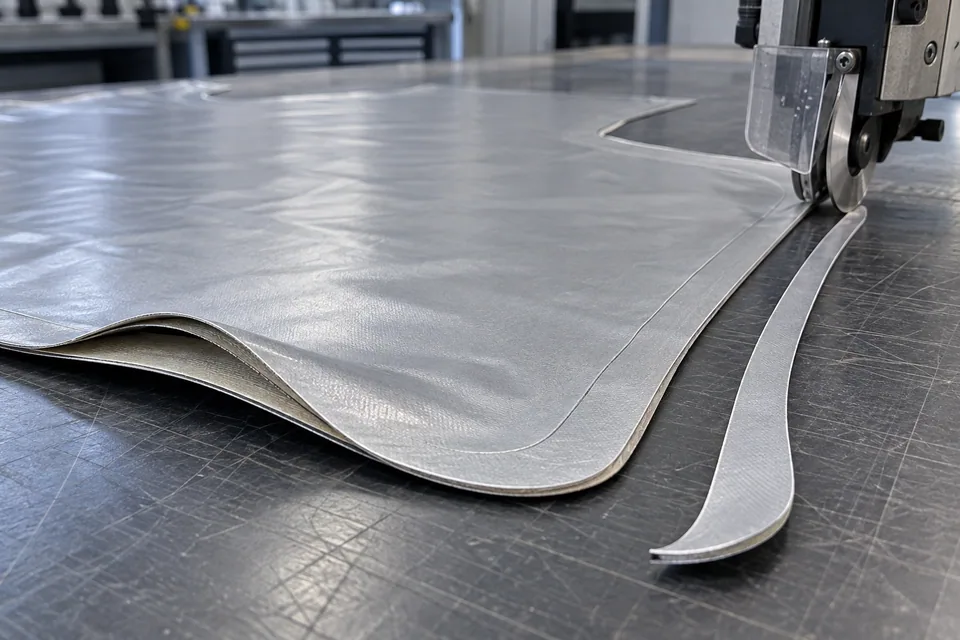
Brook One identifies a flexible laminated fire-barrier cover film that is heat or ultrasonically sealable for aircraft fuselage insulation blankets. That supports handling and cutting unassembled cover film, but does not grant arbitrary trimming after assembly. This guide concerns a narrow final correction on a pre-cut laminate blank before it is joined into the blanket. The trim must be explicitly allowed by the released pattern; shortening the sealing margin for appearance alone could compromise the eventual joint. H-O Products documents aircraft barrier-film conversion to drawings, but that does not authorize rework on any individual Brook One cover blank. The blanket fabricator must release the specific trim allowance.
Updated
Where This Cutting Application Appears
Establish the trim allowance
Compare the current shaped blank with the approved flat pattern. Mark the narrow stock to be removed and distinguish a free edge from a seam edge. If the existing blank has no allowable stock, request an engineering disposition instead of shaving into the intended seal. Register the piece from stable pattern datums, not from a curled or frayed edge being corrected.
Support the previous shape
Lay the film so the retained piece is flat without stretching. A narrow strip can cling to melt-adhesive material or break into metallic slivers on a reinforced grade. Plan waste capture and tool direction before cutting. Trial on the actual metallic or non-metallic construction and inspect both sides of the laminate after each pass.
Check the final edge and seam zone
Measure the revised edge relative to the original datums and any upcoming seam. Look for fresh delamination, pulled reinforcement, lifted foil, adhesive smear and fragments. Compare before/after images at corners and transitions where a trim can leave an abrupt step. Record whether the remaining seal land still meets the fabricator’s drawing.
Release only a qualified cover piece
Identify the grade and correct sealing face, package the trimmed piece without creasing, and send any edge anomaly for disposition. Subsequent heat or ultrasonic sealing, insulation integration and burnthrough performance belong to the blanket maker’s approved process. Cutting accuracy alone is insufficient to accept the final barrier.
Define the disposition of an overtrim
Keep a measured pre-trim record so a final dimension can be traced to actual stock removed. If the cutter crosses the approved limit, segregate the piece and ask the blanket design authority whether it can be reworked or must be rejected. Do not restore a lost sealing edge with unapproved tape or an extra patch. A documented stop rule is particularly important at corners, where a tiny local overcut can enter the future welded or heat-sealed path. Retain that disposition with the part lot for assembly traceability.
Define the Required Cut Result
- Remove only buyer-authorized edge stock.
- Keep original contour registration and seal allowance.
- Capture narrow film or metallic waste.
- Deliver an intact laminate edge for joining.
Problems to Diagnose Before Changing the Knife
Thin offcut adheres to sealable face
- Review waste-removal direction.
- Check adhesive contact with tool and bed.
- Inspect retained surface for residue.
Trim creates a step at a contour transition
- Check tool entry and exit geometry.
- Measure from pattern datum, not the old edge.
- Review remaining seam land locally.
Knife Forms That May Be Considered
| Possible knife form | When it may be considered | What must be confirmed |
|---|---|---|
| Guided edge trimmer | For a straight allowed margin on supported film. | Confirm retained layer alignment and scrap capture. |
| Programmed profile trim | For a curved approved allowance on an existing contour. | Verify smooth transitions and preserved seam width. |
Information to Send for Technical Review
You do not need to know the exact blade name. Send the available workpiece, machine, current-knife and cut-result information so the application can be reviewed against a drawing or sample.
- Current and final approved flat patterns
- Specified allowable trim stock
- Film grade, metallic layer and seal-face details
- Seam or weld land drawing
- Debris, layer-lift and dimensional criteria
Questions About This Cutting Application
How does this differ from initial contour cutting?
A trim removes limited excess from a part whose shape already exists.
May a narrow seal land be made narrower?
Only if the approved blanket drawing explicitly permits it.
Why collect the strip?
Thin film or metallic remnants can contaminate later blanket assembly.
Does the new edge confirm burnthrough resistance?
No. The complete blanket system requires separate qualification.
Public references and scope
These public sources provide material, cutting-method or safety context for this guide. Supplier pages describe their own materials or equipment; they do not establish a MEIRENTE blade specification or performance claim. Confirm the actual grade, machine setup and required cut with a drawing or sample.
Related product and service information
- Cyanate-Ester Prepreg Contour Cutting Blades - cyanate-ester prepreg · contour cutting
- Thermoplastic PEEK Composite Tape Precision Trimming Blades - thermoplastic PEEK composite tape · precision trimming
- Lightning-Strike Protection Mesh Precision-Trimming Blades - lightning-strike protection mesh · precision trimming
Request a Custom Cutting-Knife Review
Send the workpiece details, machine or holder information, current knife photos or sample, required quantity and examples of the present cut problem. Final dimensions, material, edge geometry and tolerances are confirmed from the approved requirements.