
Blade Application Guides / Application Guide / Aerospace composite manufacturing
Aircraft-Interior Flame-Barrier Laminate Cut-To-Size Blades
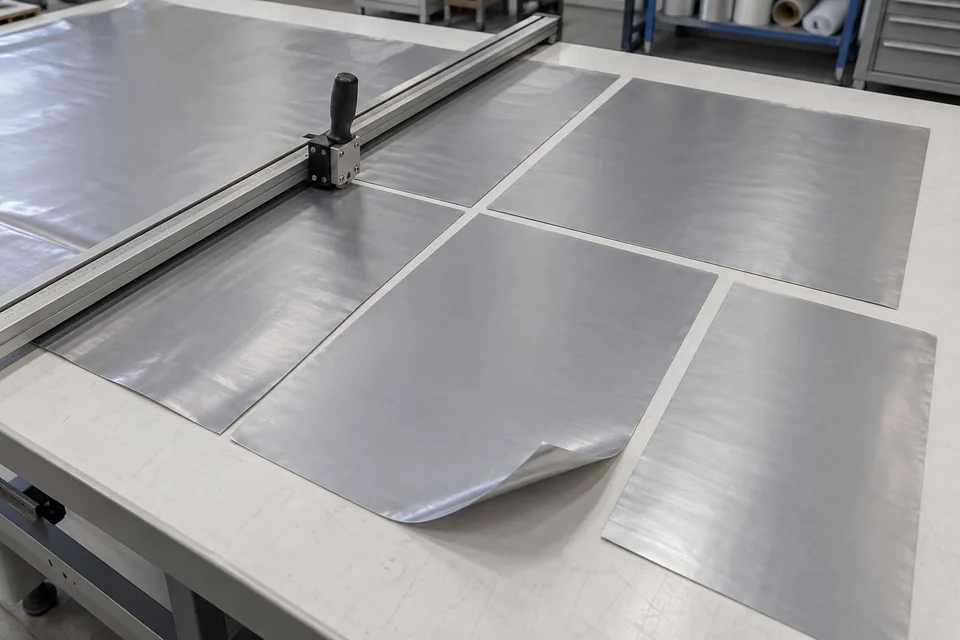
Brook One’s aircraft fire-barrier cover film is a flexible laminate used to fabricate thermal/acoustic fuselage insulation blankets. The product may be metallic or non-metallic and includes a sealable face. A cut-to-size route is relevant when the buyer receives oversized flat stock and needs simple rectangular blanks for a blanket kit or a later shaped cut. It does not form a finished blanket. Stock delivery format and cut allowances must come from the fabricator rather than being inferred from this material example. H-O Products separately describes converting aircraft insulation barrier-film stock to released drawings. The Brook One grade and its actual delivery format still require fabricator confirmation.
Updated
Where This Cutting Application Appears
Lay out simple stock blanks
Take rectangle length and width from the approved blanket cut list. Note film orientation, seal side, printed lot marks and any region reserved for a later seam. Nest blanks so identification survives the cut, and preserve any buyer-specified edge stock for subsequent contouring. Do not confuse this stock-sizing operation with the final shaped perimeter or field repair.
Choose the full-stack cut method
Support the laminate flat across the intended straight path. Trial actual grade, including metallic barrier and reinforcement layers where present. An upper layer may part while a lower adhesive film stretches; inspect the underside during setup. If a stack is cut in multiple layers, demonstrate that inner layers do not shift or fuse; otherwise cut single sheets.
Accept the blank as material, not an assembly
Measure length, width, squareness and visible curl after release. Examine all four edges for fray, delamination, film lifting, adhesive stringing and any metallic debris. Inspect corners where two straight cuts meet. Record the grade and orientation so downstream personnel can form the correct seams and cover the proper blanket surface.
Hand off to fabrication
Package flat blanks to protect the melt-adhesive surface. The blanket maker later integrates insulation media, seals cover film and tests the required fire barrier configuration. A well-sized rectangle only proves it can proceed to that process; burnthrough performance is a system-level property that a blade cannot establish.
Check the later pattern against the blank
Use one accepted rectangle in a downstream layout exercise before freezing the stock dimensions. The fabricator should be able to place the intended shaped pattern, seam allowance and identification within the blank without approaching a damaged edge. If an apparently square blank curls or twists after cutting, measure it again under the specified flatness condition. Record whether a carrier is needed for transport, while ensuring it does not mark the sealable side. This comparison catches undersized blanks before any irreversible shaping or seam operation begins.
Define the Required Cut Result
- Produce rectangular laminate blanks from oversize stock.
- Maintain orientation and seal-face traceability.
- Avoid layer lift or incomplete cut at corners.
- Retain any later contour or seam allowance.
Problems to Diagnose Before Changing the Knife
Adhesive layer stretches at the exit
- Check blade support and cut direction.
- Examine the underside, not only the top face.
- Review supplier-approved handling state.
Cut corners delaminate
- Inspect start/stop overlap.
- Check clamping near corners.
- Compare single-sheet and stacked cuts.
Knife Forms That May Be Considered
| Possible knife form | When it may be considered | What must be confirmed |
|---|---|---|
| Guided straight blade | For flat sheet blanks on a supported bed. | Verify full-layer cut and square corners. |
| Matched rectangular die | For repeated approved rectangle dimensions. | Prove ejection without film stretch or coating transfer. |
Information to Send for Technical Review
You do not need to know the exact blade name. Send the available workpiece, machine, current-knife and cut-result information so the application can be reviewed against a drawing or sample.
- Approved film grade and construction
- Incoming stock format and dimensions
- Rectangular blank schedule and allowances
- Sealing-face orientation and marking rules
- Delamination, debris and dimensional criteria
Questions About This Cutting Application
Is a rectangular blank the final cover?
Usually not; the fabricator may still contour, seam and assemble it.
Can the metallic version share settings with the non-metallic version?
Only after separate grade-specific trials.
Why retain a seam allowance?
The downstream blanket drawing may require material for joining and sealing.
What is checked after the cut?
Dimensions, orientation, all layer edges, corners and surface condition.
Public references and scope
These public sources provide material, cutting-method or safety context for this guide. Supplier pages describe their own materials or equipment; they do not establish a MEIRENTE blade specification or performance claim. Confirm the actual grade, machine setup and required cut with a drawing or sample.
Related product and service information
- Aircraft-Interior Flame-Barrier Laminate Precision-Trimming Blades - aircraft-interior flame-barrier laminate · precision trimming
- Thermoplastic PEEK Composite Tape Cut-to-Size Blades - thermoplastic PEEK composite tape · cut to size
- Cyanate-Ester Prepreg Cut-to-Size Blades - cyanate-ester prepreg · cut to size
Request a Custom Cutting-Knife Review
Send the workpiece details, machine or holder information, current knife photos or sample, required quantity and examples of the present cut problem. Final dimensions, material, edge geometry and tolerances are confirmed from the approved requirements.