
Blade Application Guides / Application Guide / Aerospace composite manufacturing
Aircraft-Interior Flame-Barrier Laminate Contour-Cutting Blades
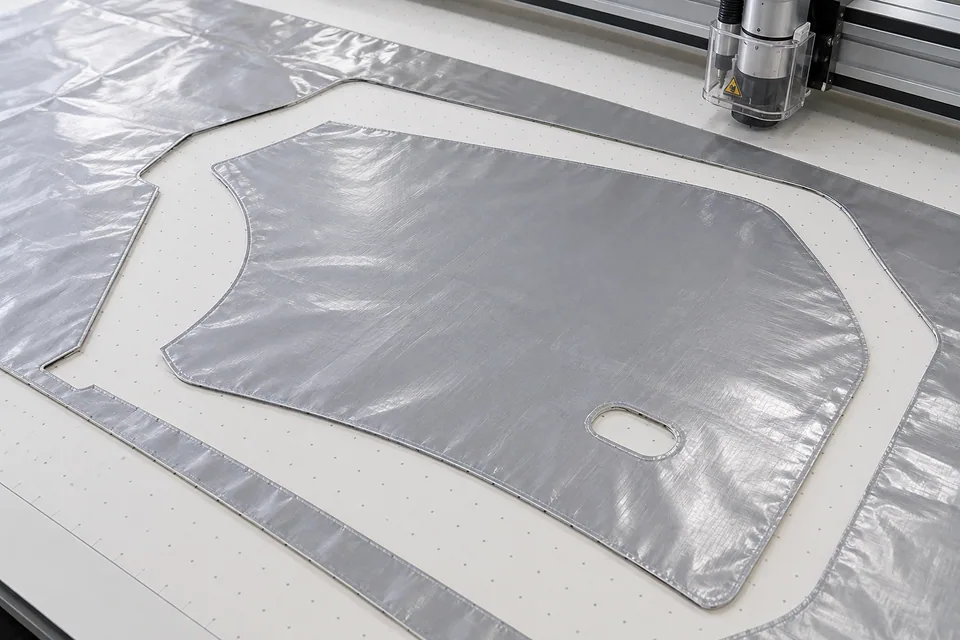
Aircraft fuselage thermal/acoustic insulation blankets can use Brook One’s flexible laminated fire-barrier cover films, available in distinct metallic and non-metallic versions. The blanket maker may need shaped cover pieces for its approved kit. Contour cutting means forming those curved perimeters and drawing-defined reliefs from flat laminate, not merely making rectangles and not cutting the already installed blanket. Public material data establishes the workpiece; the exact pattern and cut route require the buyer’s drawing and tests. H-O Products separately documents converting barrier-film stock into drawing-defined aircraft blanket plies. Whether the supplied Brook One grade follows that route must be confirmed by the fabricator.
Updated
Where This Cutting Application Appears
Resolve the blanket-cover pattern
Start with the fabricator’s released flat pattern, installed orientation and intended seam or weld margins. Distinguish real holes and reliefs from temporary alignment marks. A cutout that removes sealing land can defeat the later blanket joint even if the shape seems to fit. If the pattern is developed from a curved aircraft cavity, verify it against the flat-film nesting datum rather than directly tracing the installed surface.
Trial curves on the delivered laminate
Hold the film flat while keeping its sealable face clean. Run samples at the smallest radius, narrow bridge and most acute corner of the actual contour. Metallic and non-metallic grades may require different tool approaches; neither is assumed to tolerate the same die or oscillating blade. Evaluate whether the multilayer edge follows the intended path without upper-layer drag, film necking or local adhesive pickup.
Inspect retained shape and waste
Measure features from the pattern datum after relaxation. Examine curved edges, notches and enclosed cutouts for delamination, reinforcement fray, metallic chips or hanging film tabs. Check that small waste islands are removed without tearing the retained part. Capture a photo showing the seal margin, because later seam quality depends on both contour location and edge integrity.
Prepare for blanket integration
Mark the correct face and grade, protect the shaped blank in transfer, and keep its lot with the blanket traveler. The fabricator must validate seams, insulation integration, burnthrough and installation on its qualified assembly. A contour cut is a dimensional preparation step, not independent approval of the fire-barrier system.
Trial the narrowest sealable region
Select a coupon that reproduces the pattern’s closest cut-to-seam distance, a tight relief and the actual laminate layer sequence. Cut and remove the internal waste using the intended handling method. Examine the remaining margin after relaxation and after a representative downstream seam trial run by the blanket maker. An edge acceptable for dimensions may still create a poor joint if a layer lifted during waste extraction.
Define the Required Cut Result
- Form released cover-film outlines and local reliefs.
- Maintain sealing land around the shaped edge.
- Separate all laminate layers without loose fragments.
- Preserve grade, face and lot identity for assembly.
Problems to Diagnose Before Changing the Knife
Tight relief leaves hanging film tabs
- Inspect full stack at narrow features.
- Review tool support and path closure.
- Compare metallic and non-metallic grade trials.
Sealing margin narrows after relaxation
- Measure from approved datum after release.
- Check contour compensation and handling tension.
- Review flat pattern against blanket seam drawing.
Knife Forms That May Be Considered
| Possible knife form | When it may be considered | What must be confirmed |
|---|---|---|
| Programmed contour cutter | For variable approved patterns on flat supported stock. | Confirm small features, edge lamination and seal clearance. |
| Matched profile die | For repeated stable patterns after grade trials. | Verify waste removal and unmarked adhesive face. |
Information to Send for Technical Review
You do not need to know the exact blade name. Send the available workpiece, machine, current-knife and cut-result information so the application can be reviewed against a drawing or sample.
- Released flat pattern and seam-width requirements
- Exact film grade and layer architecture
- Part face, orientation and lot-trace rules
- Smallest feature and cutout-removal method
- Edge, debris and dimensional acceptance
Questions About This Cutting Application
Is the contour a cut in the installed blanket?
No. It shapes an unassembled laminate cover piece.
Why preserve seal land?
The blanket maker needs that material for its approved joining process.
Can small internal cutouts be left in place?
No, if the drawing requires removal; retained waste can tear the cover later.
Can the shaped piece claim fire qualification?
No. Qualification applies to the specified completed blanket system.
Public references and scope
These public sources provide material, cutting-method or safety context for this guide. Supplier pages describe their own materials or equipment; they do not establish a MEIRENTE blade specification or performance claim. Confirm the actual grade, machine setup and required cut with a drawing or sample.
Related product and service information
- Aircraft-Interior Flame-Barrier Laminate Cut-To-Size Blades - aircraft-interior flame-barrier laminate · cut to size
- Thermoplastic PEEK Composite Tape Contour Cutting Blades - thermoplastic PEEK composite tape · contour cutting
- Cyanate-Ester Prepreg Contour Cutting Blades - cyanate-ester prepreg · contour cutting
Request a Custom Cutting-Knife Review
Send the workpiece details, machine or holder information, current knife photos or sample, required quantity and examples of the present cut problem. Final dimensions, material, edge geometry and tolerances are confirmed from the approved requirements.