
Blade Application Guides / Application Guide / Aerospace composite manufacturing
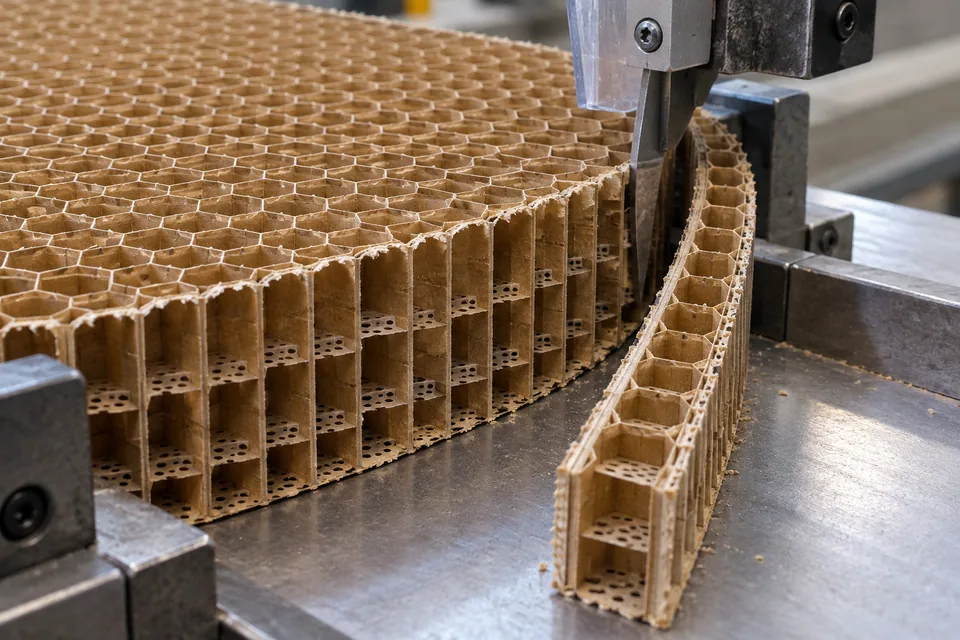
Aerospace Acoustic Honeycomb Sheet Precision-Trimming Blades
Hexcel describes sheets and blocks of honeycomb as material for shaped, machined aerospace components; its Acousti-Cap family adds permeable caps within the cells. These sources justify precision trimming only as a controlled final stock-removal step on a previously sized or profiled acoustic core. The operation is not the first cut from parent stock and should not be treated as a cosmetic shave without a released allowance. Final position of septa, bonding edges and acoustic area remain drawing-controlled.
Updated
Where This Cutting Application Appears
Confirm remaining stock before machining
Measure the shaped blank against its released datums, then mark only the specified trim allowance. Check whether the edge will bond to a face sheet, meet another core segment or form a free perimeter. A small nominal removal can cut through the last wall of a cell; the drawing must state which edge condition is acceptable. Stop if the requested correction would enter protected cap or seal regions.
Stabilize the existing shape
Use a fixture that conforms to the preformed core rather than flattening it. Avoid clamp loads that distort the profile being measured. Trial the trim on a representative edge with the same cell direction and cap arrangement. Separate metal and non-metallic variants when selecting tool geometry and chip collection.
Measure and inspect the retained core
Check the final edge location relative to the part datum and through-thickness profile. Search for thin unsupported wall remnants, torn septa, smeared adhesive and loose fragments. Compare edge-cell pattern before and after the pass; a blade can remove the right amount of stock yet leave a damaged bonding interface.
Record the final handoff condition
Document the amount removed, the tooling and any local cell damage disposition. Protect the edge while transferring to bonding or assembly. Core acoustic response, skin adhesion and nacelle structural performance require the owner’s qualification; a precise trim supports those processes but does not replace them.
Use a before-and-after record
Keep a mapped image of the current profile and the requested final boundary. After trimming, overlay dimensional measurements and mark any cells opened by the pass. This makes it possible to distinguish a pre-existing crushed wall from fresh damage. If a correction would require multiple passes, reassess support and allowance first; repeated light cuts can still shed cap fragments or alter the bonding edge. Any rework limit should be defined by the core owner. A hold point is useful when the remaining cell wall is too thin for reliable measurement after the pass.
Define the Required Cut Result
- Remove only specified final stock from shaped acoustic core.
- Hold the original contour and depth datums.
- Preserve adjacent caps, cell walls and bonding faces.
- Deliver debris-controlled core to assembly.
Problems to Diagnose Before Changing the Knife
Thin wall remnant folds over
- Review cut position against cell intersections.
- Check tool support at the edge.
- Inspect both faces and full core depth.
Profile shifts under fixture
- Measure before and after clamping.
- Adjust support to the existing shape.
- Recheck datum after release.
Knife Forms That May Be Considered
| Possible knife form | When it may be considered | What must be confirmed |
|---|---|---|
| Light-pass profile machining tool | For controlled stock removal on a supported edge. | Verify final datum and absence of cell-wall smearing. |
| Guided edge trim tool | For a straight local correction allowed by the drawing. | Check cap and bonding-region clearance. |
Information to Send for Technical Review
You do not need to know the exact blade name. Send the available workpiece, machine, current-knife and cut-result information so the application can be reviewed against a drawing or sample.
- Current and final core drawings with trim allowance
- Core grade, cell geometry and cap layout
- Bonding-face and protected acoustic zones
- Fixture datum scheme
- Edge-wall and foreign-debris limits
Questions About This Cutting Application
How much material may be trimmed?
Only the allowance authorized by the released drawing or engineering disposition.
Why examine the core after unclamping?
A crushed or distorted core can appear dimensionally correct in the fixture.
Could trimming damage acoustic features?
Yes. Embedded caps close to a cut need inspection.
Does final edge accuracy equal finished-part acceptance?
No. Bond, acoustic and structural checks remain downstream.
Public references and scope
These public sources provide material, cutting-method or safety context for this guide. Supplier pages describe their own materials or equipment; they do not establish a MEIRENTE blade specification or performance claim. Confirm the actual grade, machine setup and required cut with a drawing or sample.
Related product and service information
- Aircraft-Interior Flame-Barrier Laminate Contour-Cutting Blades - aircraft-interior flame-barrier laminate · contour cutting
- Thermoplastic PEEK Composite Tape Precision Trimming Blades - thermoplastic PEEK composite tape · precision trimming
- Cyanate-Ester Prepreg Precision Trimming Blades - cyanate-ester prepreg · precision trimming
Request a Custom Cutting-Knife Review
Send the workpiece details, machine or holder information, current knife photos or sample, required quantity and examples of the present cut problem. Final dimensions, material, edge geometry and tolerances are confirmed from the approved requirements.