
Blade Application Guides / Application Guide / Aerospace composite manufacturing
Aerospace Acoustic Honeycomb Sheet Cut-To-Size Blades
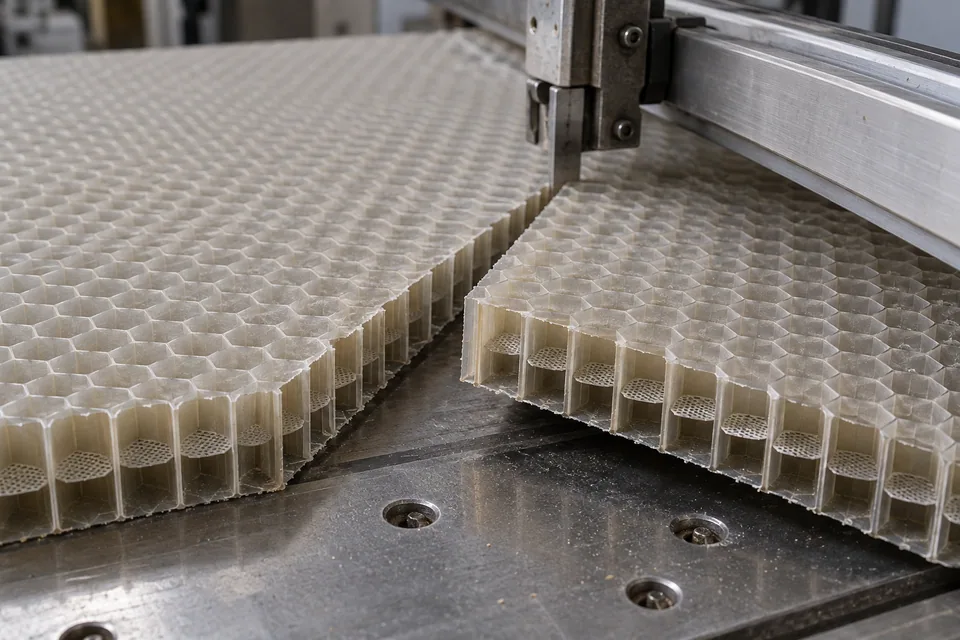
Hexcel describes Acousti-Cap as a honeycomb core with permeable caps embedded in cells for aircraft engine acoustic structures. Its resources discuss honeycomb sheets or blocks being shaped and machined. That establishes a cellular core workpiece, not a thin fabric web. Cut-to-size in this guide is the first rectangular or otherwise simple stock blank from a larger qualified sheet or block; later nacelle-specific profiling is a different operation. Material-specific methods must be confirmed for non-metallic and aluminum variants.
Updated
Where This Cutting Application Appears
Map the blank on the source core
Use the buyer’s sheet map and required core orientation to locate a simple blank. Mark acoustic-cap distribution, handling zones and the faces that will eventually bond to skins. Where the source has a marked cell direction or density region, preserve the identification on the blank. Avoid assuming that all cells contain caps in the same position without reviewing the product drawing.
Support the cellular structure
Fixture the core without crushing walls or forcing a flexible sheet to buckle. Select the cut approach against the actual substrate and thickness: an aluminum core may call for a different cutter and chip control than a non-metallic core. Trial entrance, exit and corners on sacrificial stock. A stock-sizing cut should leave enough material for later contour or bonding preparation if the process plan calls for it.
Inspect the new stock edges
Check cut length, width and squareness together with edge-cell opening. Look for bent walls, adhesive debris, torn cap material, smeared or crushed septa and loose chips. Inspect the core depth at the edge because a clean top face can hide damage farther through the thickness. Record the face and orientation used during measurement.
Hand off a clearly identified blank
Mark the blank so later profiling preserves the intended acoustic-core region. Separate dimensional acceptance of the blank from flow-resistance or noise-performance validation. Hexcel notes that customers specify cap depth, count and resistance; those properties belong to the qualified core and finished acoustic structure, not to a blade-only inspection.
Qualify a representative stock edge
Do not judge the tool using a shallow, un-capped scrap if the production core contains embedded septa. Ask for representative stock with the same cell direction and cap configuration. Photograph an edge at the start, middle and end of a sizing cut, then section or inspect through thickness where permitted. Compare cleanliness after the approved debris-removal step. The stock blank should enter later machining without hidden cap fragments or fragile walls at its datums.
Define the Required Cut Result
- Create identified stock blanks for subsequent nacelle core processing.
- Keep cell walls and embedded permeable caps intact near edges.
- Preserve orientation and machining allowance.
- Differentiate dimensional checks from acoustic qualification.
Problems to Diagnose Before Changing the Knife
Cells collapse near the straight cut
- Review fixturing pressure and tool support.
- Compare entry and exit damage.
- Inspect through the full core thickness.
Cap debris remains inside open cells
- Check tool and chip-extraction approach.
- Examine sacrificial test cuts under magnification.
- Confirm the buyer’s cleaning restrictions.
Knife Forms That May Be Considered
| Possible knife form | When it may be considered | What must be confirmed |
|---|---|---|
| Core-compatible straight blade or saw | For simple stock sizing after grade and thickness trials. | Confirm no wall crushing, cap tearing or trapped debris. |
| Programmed straight machining path | When the blank is sized on an approved core fixture. | Check orientation and full-depth edge condition. |
Information to Send for Technical Review
You do not need to know the exact blade name. Send the available workpiece, machine, current-knife and cut-result information so the application can be reviewed against a drawing or sample.
- Core manufacturer grade and aluminum or non-metallic version
- Sheet/block dimensions, thickness and cell orientation
- Cap depth and protected acoustic region
- Blank size and later machining allowance
- Cell-wall, debris and cap-damage criteria
Questions About This Cutting Application
Is acoustic honeycomb a thin sheet to slit?
No. It is a cellular core with thickness and embedded cap structure.
Is this the final nacelle shape?
No. It is a simple blank for later profile work.
Can aluminum and non-metallic cores use one tool setting?
No. The actual core construction must be trialed separately.
Does a square blank verify noise reduction?
No. Finished core and assembly performance require separate tests.
Public references and scope
These public sources provide material, cutting-method or safety context for this guide. Supplier pages describe their own materials or equipment; they do not establish a MEIRENTE blade specification or performance claim. Confirm the actual grade, machine setup and required cut with a drawing or sample.
Related product and service information
- Aerospace Acoustic Honeycomb Sheet Precision-Trimming Blades - aerospace acoustic honeycomb sheet · precision trimming
- Thermoplastic PEEK Composite Tape Cut-to-Size Blades - thermoplastic PEEK composite tape · cut to size
- Cyanate-Ester Prepreg Cut-to-Size Blades - cyanate-ester prepreg · cut to size
Request a Custom Cutting-Knife Review
Send the workpiece details, machine or holder information, current knife photos or sample, required quantity and examples of the present cut problem. Final dimensions, material, edge geometry and tolerances are confirmed from the approved requirements.