
Blade Application Guides / Application Guide / Hydrogen equipment manufacturing
AEM Electrolyzer Membrane Contour-Cutting Blades
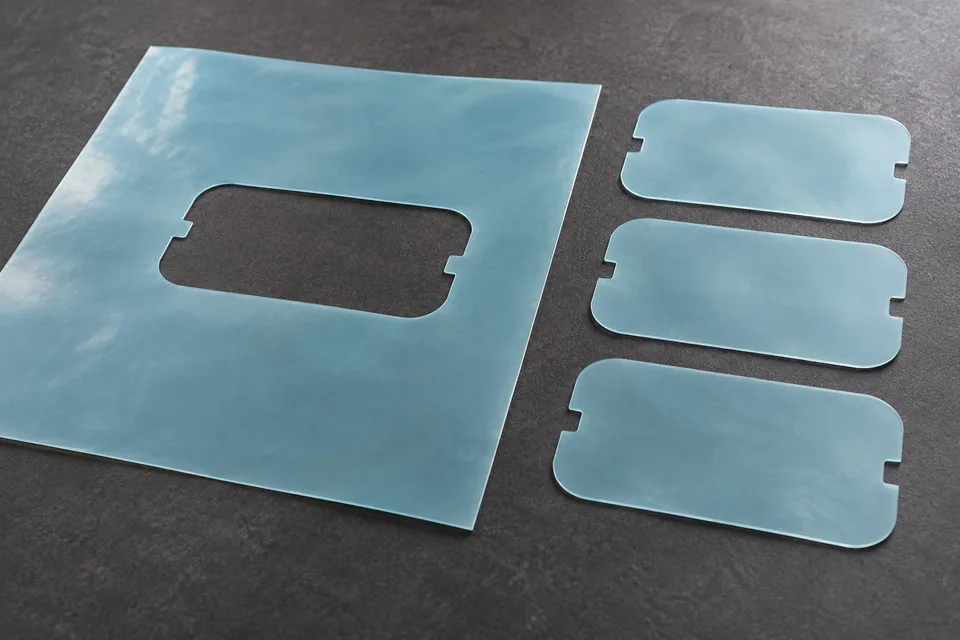
Contour cutting makes individual AEM membrane pieces with a defined perimeter and possibly internal openings. This differs from straight strip conversion: narrow bridges, corners and slug removal create local tear and puncture risks. AEM suppliers describe membranes with different reinforcement and handling states, so the finished drawing must say whether dimensions are checked dry or after conditioning. Trial the buyer’s stock on smooth clean support and inspect the part after release. A sound outline is only dimensional evidence, not a verification of electrolyzer operation.
Updated
Where This Cutting Application Appears
Map functional boundaries on the drawing
Identify outer gasket overlap, ports, registration features and any keep-out zone without assuming a universal stack design. Mark the membrane face orientation and the minimum material left between an internal opening and the outside edge.
Trial support and cut order
Use clean, smooth backing and a sharp edge as the supplier handling guidance recommends. Compare a cut sequence that releases small openings before the perimeter with the installed method; retained material can shift or tear when the final bridge is cut.
Inspect after slug removal
Check all internal openings for retained slugs, nicks and punctures. Measure the finished profile in the buyer-defined dry or conditioned state, then examine both faces for contact marks and reinforcement exposure around corners.
Transfer without creasing
Record how the shaped membrane is lifted and packaged. A flat part can pass at the cutting table yet acquire a crease during peel-off or stacking; retain samples from both checkpoints and reject damaged pieces under the buyer standard.
Define the Required Cut Result
- Meet the complete part drawing in the specified condition.
- Release holes and perimeter without tearing narrow bridges.
- Prevent punctures, creases and foreign particles.
- Keep part orientation and lot identity through transfer.
Problems to Diagnose Before Changing the Knife
A port hole has a torn lip
- Check the smallest bridge and cut order.
- Inspect blade condition at the hole.
- Compare backing and slug removal method.
The released blank changes dimensions
- Verify dry versus conditioned measurement state.
- Review hold-down and lifting strain.
- Compare with an uncut control from the same lot.
A clear face shows contact marks
- Inspect backing, tools and transfer films.
- Review operator handling and stacking.
- Check whether marks existed before cutting.
Knife Forms That May Be Considered
| Possible knife form | When it may be considered | What must be confirmed |
|---|---|---|
| Profile die and supported counter-surface | For repeat shapes on a compatible press with controlled part and slug release. | Confirm alignment, clean backing and damage-free release on the actual membrane. |
| Programmable knife cutting head | For a line designed to follow the buyer’s contour on supported sheet. | Confirm smallest radius, edge quality, registration and trial throughput without assuming suitability. |
Information to Send for Technical Review
You do not need to know the exact blade name. Send the available workpiece, machine, current-knife and cut-result information so the application can be reviewed against a drawing or sample.
- AEM grade and supplier handling sheet
- Drawing with all ports, bridges and datums
- Specified measurement state and conditioning procedure
- Accepted nicks, particles and face marks
- Support, hold-down and transfer arrangement
- Knife or die mounting drawing
- Slug and skeleton collection route
- Buyer post-cut functional inspection
Questions About This Cutting Application
Why inspect internal ports separately?
A membrane can have a correct outer size yet tear around a small hole or retain a slug.
Should parts be measured before or after conditioning?
Use the condition written in the buyer drawing and supplier handling instructions; record it with every measurement.
Can a membrane profile be accepted on the table?
Final inspection must include the normal release and transfer steps, which can introduce folds or punctures.
Does a contour knife guarantee gas separation?
No. Cutting quality and stack functional testing are separate buyer acceptance activities.
What sets the trial’s hardest feature?
Use the smallest radius, narrowest bridge or most difficult opening on the actual drawing and material.
Public references and scope
These public sources provide material, cutting-method or safety context for this guide. Supplier pages describe their own materials or equipment; they do not establish a MEIRENTE blade specification or performance claim. Confirm the actual grade, machine setup and required cut with a drawing or sample.
Related product and service information
- AEM Electrolyzer Membrane Edge-Trimming Blades - AEM electrolyzer membrane · edge trimming
- Titanium Porous Transport Layer Contour Cutting Blades - titanium porous transport layer · contour cutting
- Electrolyzer Catalyst Decal Film Contour Cutting Blades - electrolyzer catalyst decal film · contour cutting
Request a Custom Cutting-Knife Review
Send the workpiece details, machine or holder information, current knife photos or sample, required quantity and examples of the present cut problem. Final dimensions, material, edge geometry and tolerances are confirmed from the approved requirements.