
Blade Application Guides / Application Guide / Zinc foil converting
Zinc Metal Foil Coil Slitting Blades
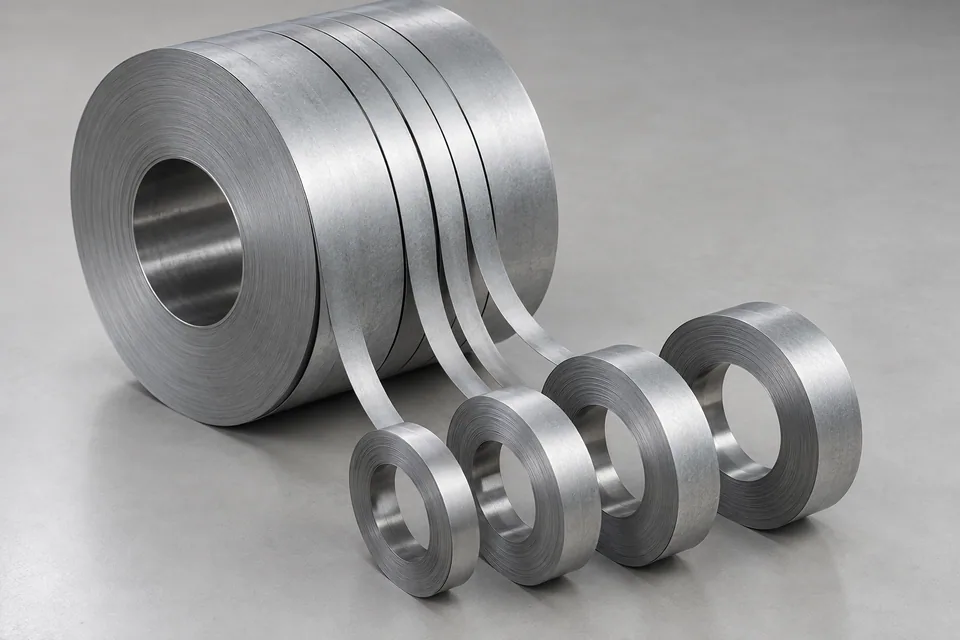
A zinc metal foil slitting line makes continuous strips from a parent coil. The useful knife setup depends on the actual zinc grade and temper, foil thickness, surface condition and downstream winding arrangement. Define both the width schedule and acceptable edge condition before selecting a circular knife pair. During a trial, compare each lane at the cut and after rewinding so that a guide or separator mark is not mistaken for a knife defect.
Updated
Where This Cutting Application Appears
Strip schedule across the master coil
Lay out finished lanes and outside trim from the master width. Measure every lane at agreed run intervals and note whether deviation follows one knife position or the whole feed path.
Knife, spacer and arbor setup
Check the paired circular knives and spacer stack together. Record measured clearance, overlap and runout for the approved sample instead of assuming a universal setting for zinc foil.
Edge and surface inspection
Inspect both slit sides for burr, tearing or edge wave. Compare surface marks with incoming foil and sample again after the separator and rewind; the accepted strip is the delivered product.
Trim movement
Observe narrow outside trim at start-up, steady running and stopping. A trim strip that snags or winds onto a shaft can upset nearby finished strips; agree the takeoff path during the trial.
Define the Required Cut Result
- Produce every finished width within the buyer’s specified range.
- Meet the accepted burr, tear and edge-wave limits.
- Protect the specified zinc foil surface through winding.
- Take off trim without contact damage to finished strips.
Problems to Diagnose Before Changing the Knife
Edge wave is concentrated in one lane
- Inspect knife position, support and spacer stack at that lane.
- Compare measured side clearance and overlap with accepted trial records.
- Review local foil thickness and tension.
Burr increases after an otherwise stable start
- Inspect tool wear and edge deposits.
- Measure runout and seating after the temperature or speed change.
- Compare actual stock condition with the approved lot.
Marks appear on the rewound strip
- Locate the first downstream contact point that leaves the mark.
- Inspect guide and separator surfaces.
- Review strip tension and winding build.
Knife Forms That May Be Considered
| Possible knife form | When it may be considered | What must be confirmed |
|---|---|---|
| Matched circular slitter knife pair | For lengthwise conversion of zinc foil to narrow continuous coils. | Confirm line geometry, mounting and edge by actual-stock trial. |
| Edge-trim circular knife pair | When an outside strip must be removed to establish the finished edge. | Confirm trim width, takeoff and accepted outside-edge condition. |
Information to Send for Technical Review
You do not need to know the exact blade name. Send the available workpiece, machine, current-knife and cut-result information so the application can be reviewed against a drawing or sample.
- Zinc foil grade, temper, thickness and surface condition
- Master-coil dimensions and finished lane widths
- Burr, edge wave, flatness and cosmetic criteria
- Accepted and rejected edge samples
- Knife, arbor and spacer drawings
- Measured side clearance, overlap and runout
- Feed support, separator and rewind details
- Trim takeoff and trial sampling plan
Questions About This Cutting Application
Can the same slitter setting be used for all zinc foil?
No. The actual grade, temper, gauge, line geometry and accepted edge must be tested together.
Why inspect all strip lanes?
A local spacer or knife-pair issue can affect one lane while neighboring lanes remain acceptable.
When should surface marks be checked?
At incoming stock, knife exit and after rewinding so the first source of damage can be identified.
What operation makes separate zinc foil blanks?
An enclosed-profile blanking station makes separate parts; longitudinal slitting makes continuous strips.
Public references and scope
These public sources provide material, cutting-method or safety context for this guide. Supplier pages describe their own materials or equipment; they do not establish a MEIRENTE blade specification or performance claim. Confirm the actual grade, machine setup and required cut with a drawing or sample.
Related product and service information
- AGM Battery Separator Mat Edge-Trimming Blades - AGM battery separator mat · edge trimming
- Magnesium Alloy Foil Coil Slitting Blades - magnesium alloy foil · coil slitting
- Inconel Alloy Foil Coil Slitting Blades - Inconel alloy foil · coil slitting
Request a Custom Cutting-Knife Review
Send the workpiece details, machine or holder information, current knife photos or sample, required quantity and examples of the present cut problem. Final dimensions, material, edge geometry and tolerances are confirmed from the approved requirements.