
Blade Application Guides / Application Guide / Semiconductor assembly
UV-Release Wafer Dicing Tape Cross Cutting Blades
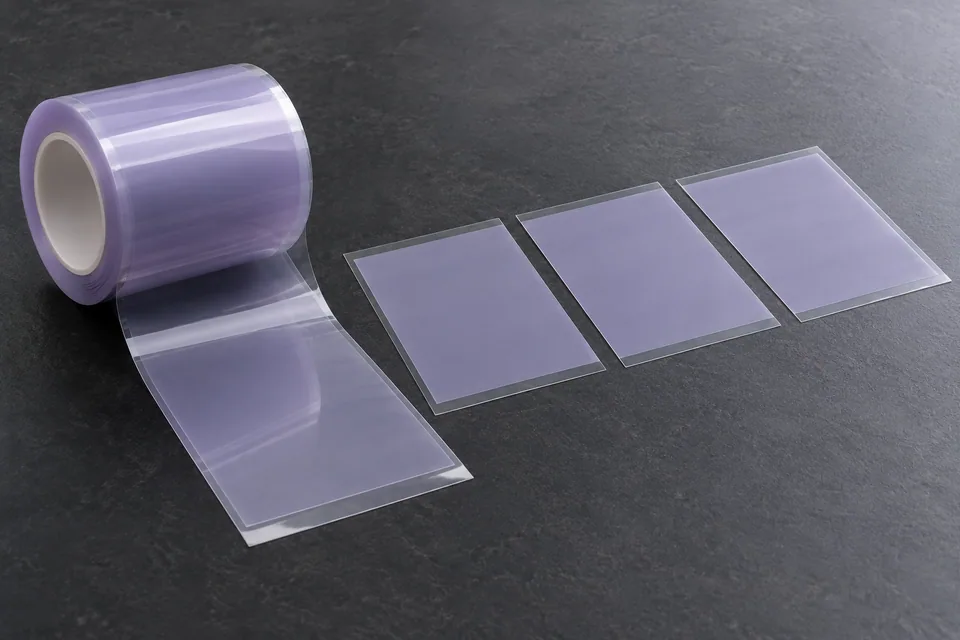
UV-release dicing tape holds a wafer during dicing and is designed to reduce adhesion after a specified UV step. Cross cutting here prepares finite tape lengths from an incoming web before wafer application; it is separate from wafer dicing itself. The tape may have a polymer backing, adhesive and release liner, so the cut must be evaluated as a layered construction. Confirm whether the buyer applies the cut piece to a ring frame or another fixture, and keep the coating and liner protected during cutting and collection. The later UV response must be validated by the tape supplier or process owner, not inferred from a clean cut edge.
Updated
Where This Cutting Application Appears
Prepare the specified application length
Mark the piece length and orientation from the wafer or frame application drawing. Measure both ends after the piece relaxes; do not confuse this with die singulation on the wafer.
Keep the liner intact
Inspect whether the blade lifts or fractures the release liner at the transverse edge. A loose liner can expose adhesive before controlled lamination and collect particles.
Protect adhesive and backing
Minimize contact with the adhesive face and check for stringing, adhesive smear or backing curl. Verify that the cut edge does not leave debris near the wafer-facing area.
Trial the application sequence
Apply sample lengths on the intended fixture under the buyer’s procedure, then inspect wrinkles, trapped particles and clean release after the prescribed UV step. Keep the cut-edge evaluation separate from UV-dose qualification.
Define the Required Cut Result
- Produce the agreed tape piece length and squareness.
- Preserve liner and adhesive integrity until application.
- Avoid particles, exposed adhesive and backing curl.
- Keep the cut piece suitable for the buyer’s lamination and UV-release sequence.
Problems to Diagnose Before Changing the Knife
Liner lifts from the cut end
- Review blade penetration and backing support.
- Check unwind tension and liner orientation.
- Inspect the edge after handling, not only at knife exit.
Adhesive strings or smears
- Identify adhesive side and actual tape grade.
- Inspect blade cleanliness and cut temperature.
- Compare accepted edges from the tape supplier.
Piece wrinkles during frame application
- Measure relaxed length and curl.
- Check how the cut piece is carried and aligned.
- Review application tension and support with the process owner.
Knife Forms That May Be Considered
| Possible knife form | When it may be considered | What must be confirmed |
|---|---|---|
| Rotary cross-cut knife and anvil | For timed transverse pieces from a continuous tape web. | Confirm liner, adhesive and backing cut quality on the actual tape grade. |
| Straight supported sheet-cut blade | For intermittent finite lengths before application. | Confirm hold-down contact, clean release and particle condition. |
Information to Send for Technical Review
You do not need to know the exact blade name. Send the available workpiece, machine, current-knife and cut-result information so the application can be reviewed against a drawing or sample.
- Exact tape grade and supplier layer drawing
- Backing, adhesive and release-liner orientation
- Incoming width and thickness range
- Required piece length and frame/wafer application drawing
- Accepted liner-lift, adhesive-edge and particle samples
- Cross-cutter/anvil and handling drawings
- UV exposure and release verification owned by process team
- Representative tape roll and application-trial pieces
Questions About This Cutting Application
Is cutting tape the same as dicing a wafer?
No. This operation prepares tape lengths. Wafer singulation is a later, separate process.
Does a clean edge prove UV release performance?
No. The UV response depends on the tape grade and prescribed exposure; test it under the supplier and process owner’s method.
Why inspect the release liner?
A disturbed liner can expose adhesive early, collect debris and interfere with controlled application.
When should the piece length be measured?
After cutting and relaxation, and again on the intended fixture if application tension changes its effective length.
Public references and scope
These public sources provide material, cutting-method or safety context for this guide. Supplier pages describe their own materials or equipment; they do not establish a MEIRENTE blade specification or performance claim. Confirm the actual grade, machine setup and required cut with a drawing or sample.
Related product and service information
- UV-Release Wafer Dicing Tape Rotary Die-Cutting Blades - UV-release wafer dicing tape · rotary die cutting
- Leadframe Protective Cover Tape Cross Cutting Blades - leadframe protective cover tape · cross cutting
- Semiconductor Molding Release Film Cross-Cutting Blades - semiconductor molding release film · cross cutting
Request a Custom Cutting-Knife Review
Send the workpiece details, machine or holder information, current knife photos or sample, required quantity and examples of the present cut problem. Final dimensions, material, edge geometry and tolerances are confirmed from the approved requirements.