
Blade Application Guides / Application Guide / Pharmaceutical packaging
Unit-Dose Powder Stick-Pack Film Shear Slitting Blades
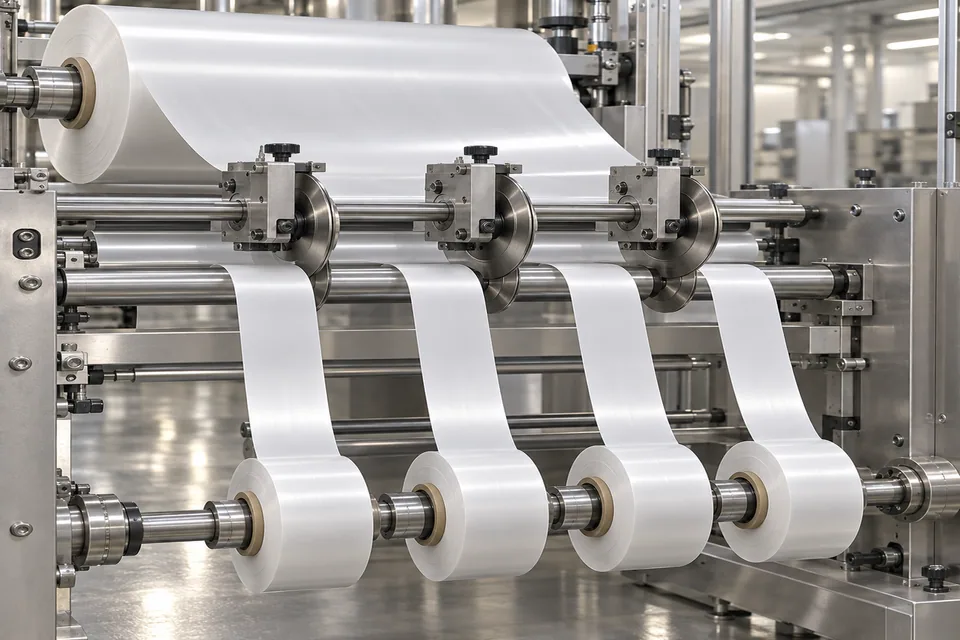
Powder stick packs are narrow sealed packages made from printed flexible web stock. Amcor documents pharmaceutical stick-pack laminates and IMA describes stick filling lines with vertical and horizontal seals. Shear slitting takes the unfilled master web through upper and lower rotating knives to form several continuous lanes. It offers a different contact pattern from a stationary razor; knife overlap, side clearance and winding of narrow lanes can produce defects that do not show in a simple width reading. Confirm the actual film/foil/paper stack, then connect the slit positions to the packer’s forming tubes and seam allowances. The cutting trial yields converted stock, while powder dose accuracy and finished-pack integrity require separate qualification.
Updated
Where This Cutting Application Appears
Balance lane layout across the web
Prepare a schedule of useful lanes, outside trim and centerline positions. Align them with printed panel repeat and the vertical seal positions of the stick machine. Check both edges of outer lanes, which may move differently under lateral web guiding.
Set the paired rotary edges
Record upper and lower knife geometry, arbor and spacer details, overlap and side clearance from the installed line. On a layered film, an overly forceful pair can curl one side or push sealant sideways. Compare samples at startup and after the web reaches steady tension.
Trace contamination by knife station
Inspect both shear faces for polymer lips, foil burr, paper lint and ink or coating rub. Label specimens by lane and knife station before winding. Check the first downstream guide and separator for abrasion that can add particles after a sound cut.
Recheck after narrow-lane winding
Measure width and edge curl on wound or transferred lanes, then run a representative lane through vertical forming and sealing. An accepted knife exit may still become a folded seam or wrinkle at the forming shoulder. Let the pack owner assess finished sticks for leakage and fill integrity.
Define the Required Cut Result
- Match the forming line’s narrow lane plan.
- Leave continuous sealant at each intended vertical seam.
- Limit asymmetrical burr, curl and layer particles.
- Maintain traceability from knife station to packaged trial lane.
Problems to Diagnose Before Changing the Knife
One shear side develops a polymer lip
- Inspect overlap, side clearance and blade condition.
- Check whether upper and lower edges rotate consistently.
- Compare left and right specimens from that knife pair.
Printed panel drifts off center after slitting
- Check registration and lateral guide.
- Measure master-web print pitch.
- Review narrow-lane rewind pull.
Powder-stick seam wrinkles despite correct width
- Inspect lane curl and edge buildup.
- Compare before/after forming-shoulder samples.
- Confirm the seal allowance in the packer drawing.
Knife Forms That May Be Considered
| Possible knife form | When it may be considered | What must be confirmed |
|---|---|---|
| Paired rotary upper/lower shear knives | For a compatible multi-lane powder-stick laminate line. | Confirm overlap, side clearance and accepted sealant/foil edge on real web stock. |
| Rotary outside-trim pair | Where the master web needs a sacrificial selvage removed before lane winding. | Confirm scrap takeoff without pulling the neighboring narrow lane. |
Information to Send for Technical Review
You do not need to know the exact blade name. Send the available workpiece, machine, current-knife and cut-result information so the application can be reviewed against a drawing or sample.
- Stick laminate grade and layer orientation
- Parent width, lane count and outside trim plan
- Vertical/horizontal seal layout and print datums
- Rotary knife, spacer, holder and arbor drawings
- Drive and web-guide configuration
- Accepted curl, burr, lint and sealant-edge samples
- Narrow-lane winding and transfer method
- Buyer assembled-stick leak and fill acceptance plan
Questions About This Cutting Application
What does a shear pair add to the setup?
Both rotating edges and their overlap, clearance, drive and wear must be checked together.
Can a slit edge contaminate a powder seam?
Loose foil, paper or polymer debris may enter the seam; inspect and trace the actual converted lane.
Is the transverse stick length made here?
No. This operation creates longitudinal lanes; the stick machine later forms and cuts doses.
When should width be accepted?
Measure at knife exit and after the intended winding or transfer condition.
Who approves package tightness?
The packer must test its sealed and filled stick packs with its approved methods.
Public references and scope
These public sources provide material, cutting-method or safety context for this guide. Supplier pages describe their own materials or equipment; they do not establish a MEIRENTE blade specification or performance claim. Confirm the actual grade, machine setup and required cut with a drawing or sample.
Related product and service information
- EPDM Roofing Rubber Cut To Size Blades - EPDM roofing rubber · cut to size
- Effervescent Tablet Sachet Laminate Shear Slitting Blades - effervescent tablet sachet laminate · shear slitting
- Unit-Dose Powder Stick-Pack Film Razor Slitting Blades - unit-dose powder stick-pack film · razor slitting
Request a Custom Cutting-Knife Review
Send the workpiece details, machine or holder information, current knife photos or sample, required quantity and examples of the present cut problem. Final dimensions, material, edge geometry and tolerances are confirmed from the approved requirements.