
Blade Application Guides / Application Guide / Pharmaceutical packaging
Unit-Dose Powder Stick-Pack Film Razor Slitting Blades
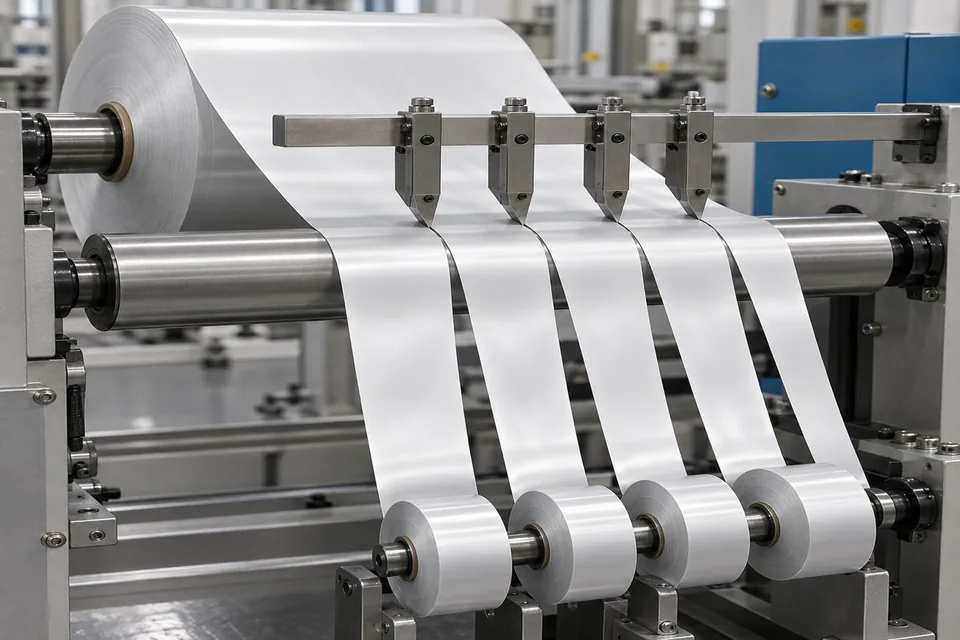
A unit-dose powder stick pack begins as a flexible printed film or laminate web. Amcor identifies pharmaceutical sachet and stick-pack laminate families, while IMA describes powder stick equipment with vertical and horizontal seals. This guide concerns conversion of the unfilled parent web into continuous narrow lanes with stationary razor blades. It does not cut open a filled stick or create the transverse ends. The actual polymer, paper, foil, coating and sealant layers must be supplied by the buyer; a thin-film razor arrangement may not suit every stack. Define widths from the number of forming tubes and longitudinal seal allowances, then inspect edge integrity after lane separation. Dose accuracy and sealed-package barrier belong to the packer’s validation.
Updated
Where This Cutting Application Appears
Derive lanes from the stick machine
List forming-tube positions, lane pitch and longitudinal seal overlap for each narrow stick. Mark print eye marks, ingredient information panels and any tear location. A lane that is nominally wide enough can still lose seal area when the web tracks sideways.
Trial a stationary blade in the real web
Record blade grade, angle, exposed length, backing or grooved-roll support and material face. Cut a production laminate sample under the intended tension and speed. Compare a new edge with the edge after repeated running to reveal resin buildup or paper-fiber drag.
Examine the slender lane edges
Measure each delivered lane; inspect for stretched lips, film curl, loose fibers, foil flake and sealant strings. Narrow powder sticks offer little room for a damaged side seam. Label edge samples by lane and left/right side to pinpoint one faulty blade position.
Check after vertical forming
Run a trial lane through the customer’s normal forming shoulder and heat-seal sequence. Look for edge curl entering the seal and for print shifting toward the seal. Use the packer’s own leak, fill and product-contact methods to judge the assembled dose.
Define the Required Cut Result
- Hold narrow lane widths and intended longitudinal seal overlap.
- Avoid blade-induced film stretch, foil or paper debris and sealant strings.
- Keep print and eye-mark registration through separation.
- Provide repeatable samples for powder-stick forming trials.
Problems to Diagnose Before Changing the Knife
A narrow lane curls before the forming tube
- Compare blade-side lip and backing support.
- Review differential takeoff tension.
- Measure after unwinding and relaxation.
Sealant accumulates on the razor
- Inspect the layer stack and contact face.
- Compare blade replacement intervals.
- Check whether heat or dwell at the guide increases transfer.
One lane loses its printed margin
- Check master-web tracking and knife positions.
- Compare print pitch across the roll.
- Confirm the packer’s actual forming-tube layout.
Knife Forms That May Be Considered
| Possible knife form | When it may be considered | What must be confirmed |
|---|---|---|
| Stationary razor blade in a supported span | For compatible thin powder-stick web that parts cleanly in a material trial. | Confirm support, blade angle and no unacceptable sealant or foil edge damage. |
| Grooved-roll razor arrangement | When the existing slitter supports narrow lanes at fixed groove positions. | Confirm knife-to-groove registration, lane pitch and backside condition. |
Information to Send for Technical Review
You do not need to know the exact blade name. Send the available workpiece, machine, current-knife and cut-result information so the application can be reviewed against a drawing or sample.
- Supplier and exact stick-film layer structure
- Parent-web width, number of lanes and lane pitch
- Forming-tube and vertical seal drawings
- Print/eye-mark repeat and tear-feature position
- Blade holder, backing and web-path drawings
- Accepted left/right edge and particle samples
- Winding or direct-feed tension profile
- Packer leak, fill and product-contact validation plan
Questions About This Cutting Application
Why begin with the stick machine layout?
It determines lane width, seal overlap and print location, which a knife-only dimension cannot establish.
Is a razor always appropriate for stick film?
No. Trial the actual laminate; foil fracture, paper dust or sealant drag may require another method.
Can the blade set the single-dose length?
No. Longitudinal slitting makes lanes; the packaging line forms and separates dose lengths later.
Why examine both edges of a lane?
The two blade contacts or adjacent lane positions can leave different lips and contamination.
Does a clean lane prove powder protection?
No. Finished stick sealing and barrier performance require the packer’s qualification.
Public references and scope
These public sources provide material, cutting-method or safety context for this guide. Supplier pages describe their own materials or equipment; they do not establish a MEIRENTE blade specification or performance claim. Confirm the actual grade, machine setup and required cut with a drawing or sample.
Related product and service information
- Unit-Dose Powder Stick-Pack Film Rotary Die-Cutting Blades - unit-dose powder stick-pack film · rotary die cutting
- Effervescent Tablet Sachet Laminate Razor Slitting Blades - effervescent tablet sachet laminate · razor slitting
- Pharmaceutical Desiccant Lidding Film Rotary Die-Cutting Blades - pharmaceutical desiccant lidding film · rotary die cutting
Request a Custom Cutting-Knife Review
Send the workpiece details, machine or holder information, current knife photos or sample, required quantity and examples of the present cut problem. Final dimensions, material, edge geometry and tolerances are confirmed from the approved requirements.