
Blade Application Guides / Application Guide / Electrical equipment manufacturing
Transformer Crepe Insulation Paper Sheet Slitting Blades
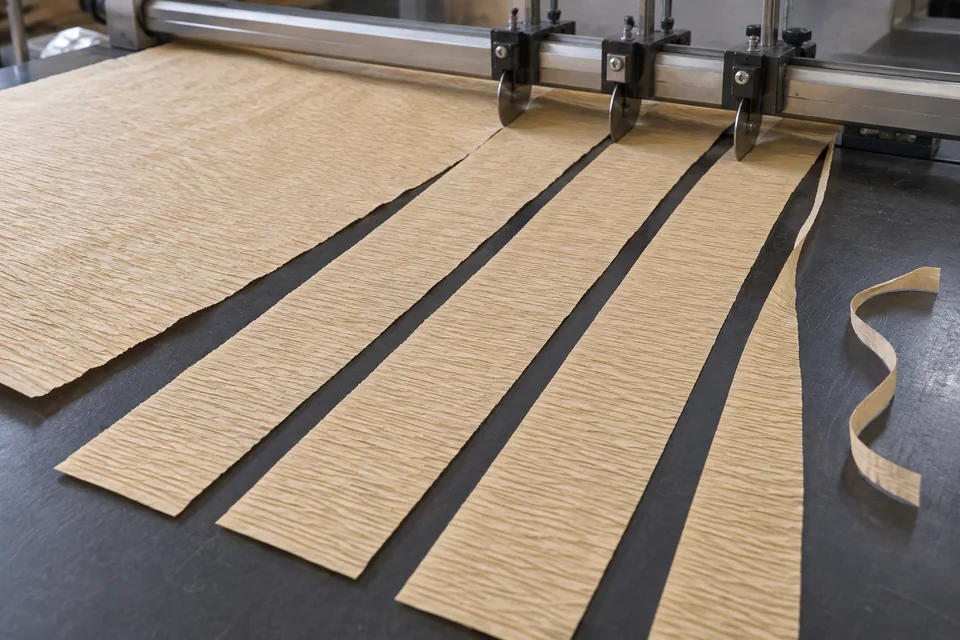
Cindus manufactures transformer insulation crepe paper and lists sheeting, slitting and rewinding among its converting operations. GBS offers custom slit widths, while Weidmann describes crepe paper as flexible cellulose insulation for irregular transformer surfaces. This guide addresses straight lengthwise strip cutting from a flat sheet or flat-fed web section, not cutting a finished tube or deciding winding-wrap length. Creping makes the paper extensible, so measured width can change if the sheet is pulled flat during cutting and released afterward. The actual grade, crepe direction and moisture condition belong to the material specification. A supported sheet slitter or comparable straight cutter requires a sample trial. The transformer builder qualifies the later wrap and electrical performance.
Updated
Where This Cutting Application Appears
Identify the incoming crepe direction
Record whether the feed is a cut sheet or flattened section of a reel. Mark machine direction, crepe ridges, grade and proposed strip widths. Avoid stretching a sample to an arbitrary flat state and then reporting that measurement as the relaxed supplied width.
Trial a low-distortion straight feed
Support the compliant paper on a smooth table and guide it through the selected sheet cutter. Check whether blade drag elongates the crepe on one side or tears the folds. Collect the narrow edge waste without pulling useful strips through the knife.
Measure after relaxation
Check strip width and straightness under the buyer’s defined conditioning and handling method. Look for torn crepe peaks, detached fibers and wrinkles started at the cut. Compare strips from both sides of the original sheet rather than only the central lane.
Keep material ready for lead wrapping
Bundle strips with grade, direction and lot labels in protective packaging. The transformer maker should trial winding around its actual conductor radius and then test the assembled insulation. A neat strip by itself does not prove conformability or dielectric withstand.
Define the Required Cut Result
- Create released crepe-paper strip widths.
- Preserve stretch and avoid torn crepe ridges.
- Limit loose cellulose fibers and edge distortion.
- Maintain lot and direction traceability.
Problems to Diagnose Before Changing the Knife
Strip narrows after leaving the cutter
- Check feed tension and relaxed measurement method.
- Compare cut and uncut controls.
Crepe folds tear along the edge
- Review blade drag and paper support.
- Inspect incoming crepe quality.
Narrow waste wraps a guide
- Review offcut path and static condition.
- Keep scrap out of accepted strips.
Knife Forms That May Be Considered
| Possible knife form | When it may be considered | What must be confirmed |
|---|---|---|
| Supported sheet slitter | For a flat-fed crepe-paper section divided into straight strips. | Confirm relaxed width, ridge integrity and waste control. |
Information to Send for Technical Review
You do not need to know the exact blade name. Send the available workpiece, machine, current-knife and cut-result information so the application can be reviewed against a drawing or sample.
- Named transformer crepe paper grade
- Sheet or reel form and crepe direction
- Relaxed-width inspection method
- Strip layout and waste margins
- Permitted ridge tear and loose fibers
- Feed support and blade trial
- Moisture-controlled packing
- Lead-wrap and dielectric test owner
Questions About This Cutting Application
Is crepe paper the same as flat kraft paper?
No. Its deliberately creped structure provides extensibility for irregular surfaces.
Why measure after relaxation?
Tension during cutting can temporarily change strip dimensions.
Is this a tube-cutting operation?
No. This page covers flat paper before wrapping or tube making.
Does a clean strip certify a transformer winding?
No. The assembled insulation system needs its own tests.
What begins an RFQ?
Send a crepe-paper sample, direction mark, strip layout and relaxed-width method.
Public references and scope
These public sources provide material, cutting-method or safety context for this guide. Supplier pages describe their own materials or equipment; they do not establish a MEIRENTE blade specification or performance claim. Confirm the actual grade, machine setup and required cut with a drawing or sample.
Related product and service information
- Transformer Electrical Pressboard Contour-Cutting Blades - transformer electrical pressboard · contour cutting
- NMN Motor-Insulation Laminate Sheet Slitting Blades - NMN motor-insulation laminate · sheet slitting
- Polyimide-Mica Insulation Laminate Sheet Slitting Blades - polyimide-mica insulation laminate · sheet slitting
Request a Custom Cutting-Knife Review
Send the workpiece details, machine or holder information, current knife photos or sample, required quantity and examples of the present cut problem. Final dimensions, material, edge geometry and tolerances are confirmed from the approved requirements.