
Blade Application Guides / Application Guide / Electrical equipment manufacturing
Transformer Crepe Insulation Paper Precision-Trimming Blades
Crepe transformer paper is made to conform around irregular leads, and converters supply slit widths, sheeted material and die-cut pieces. A precision trim can therefore be considered when an already cut flat wrap blank has a specific extra edge or tail that conflicts with the buyer’s winding layout. It should not be a routine second cut on every blank: removing margin can reduce the overlap needed for electrical insulation. This guide works on flat, unassembled paper and uses a stable fixture datum. The grade’s crepe direction, relaxed measurement state and moisture handling must be known. A small trim trial checks for torn ridges and fiber debris; final lead-wrap coverage and electrical acceptance belong to the transformer maker.
Updated
Where This Cutting Application Appears
Mark the surplus after a fit check
Place the original blank against the customer’s lead-wrap template and record exactly which margin exceeds the drawing. Preserve required turn overlap and end coverage. Use a stable datum instead of a stretched or torn edge to locate the correction.
Support the tiny offcut
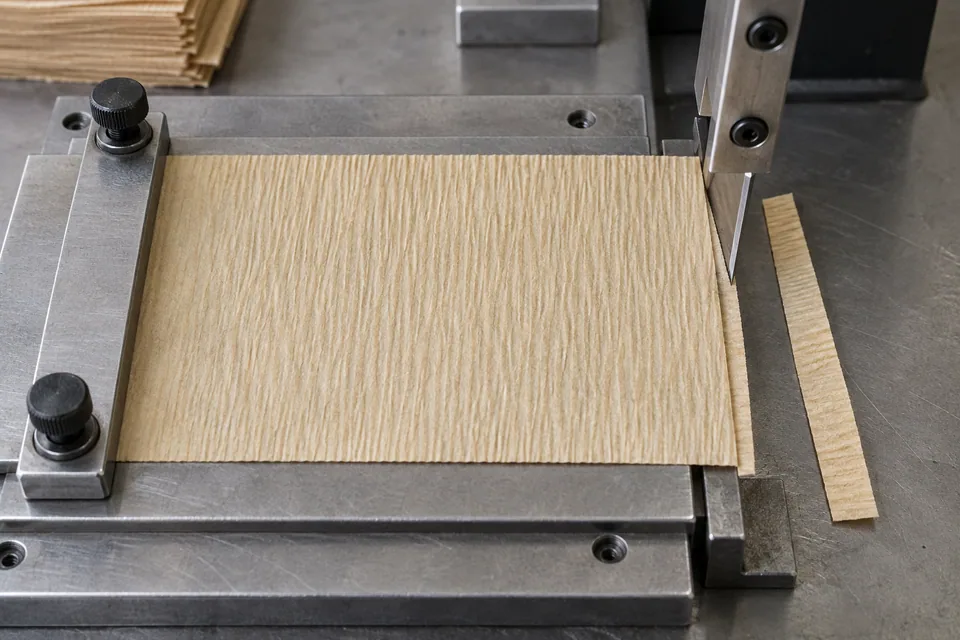
Trial a guided straight or local curved blade while the crepe remains in its defined relaxed state. Capture the thin scrap strip so it cannot pull fibers from the kept edge. Compare a no-trim control if the original blank may already fit.
Inspect both geometry and paper texture
Measure the retained edge and remaining overlap, then examine ridge tears, crushed crepe and detached fibers. A trim that makes the paper visually neater may be unacceptable if it shortens the final wrap or changes local extensibility.
Repeat the conductor trial
Have the buyer wrap trimmed samples around actual geometry and inspect gaps, bunching and end coverage. Label the part lot and trim orientation. The transformer maker remains responsible for drying, impregnation and final equipment tests.
Define the Required Cut Result
- Remove only a documented surplus edge.
- Maintain designed wrap overlap and crepe stretch.
- Prevent torn ridges and loose fibers.
- Demonstrate improved fit on the actual lead.
Problems to Diagnose Before Changing the Knife
Offcut tears the kept margin
- Review blade support and crepe direction.
- Inspect original paper defects.
Trimmed piece loses wrap overlap
- Check developed drawing and template datum.
- Hold parts before winding.
Ridges flatten near the new edge
- Review fixture pressure and handling.
- Compare no-trim controls.
Knife Forms That May Be Considered
| Possible knife form | When it may be considered | What must be confirmed |
|---|---|---|
| Guided straight finishing blade | For a flat excess tail on a verified wrap blank. | Check retained overlap, edge texture and dimensions. |
| Local profile trim tool | For a drawing-defined relief around a lead exit. | Inspect notch tearing after a real wrap trial. |
Information to Send for Technical Review
You do not need to know the exact blade name. Send the available workpiece, machine, current-knife and cut-result information so the application can be reviewed against a drawing or sample.
- Crepe grade and original blank
- Marked surplus and final wrap template
- Crepe direction and relaxed measurement
- Minimum retained overlap
- Allowed ridge tear and fiber debris
- Support and offcut capture
- Before-and-after labels
- Lead-wrap and transformer test owner
Questions About This Cutting Application
Should every crepe blank be trimmed?
No. Trim only a measured excess against the approved wrap.
Can trimming fix a tear inside the retained area?
No. The part needs separate disposition.
Why inspect after wrapping?
A clean flat edge may open or bunch on an irregular lead.
Does a good wrap prove transformer dielectric strength?
No. Equipment-level testing follows assembly.
What sample should be provided?
Send the original blank, lead template and marked edge to remove.
Public references and scope
These public sources provide material, cutting-method or safety context for this guide. Supplier pages describe their own materials or equipment; they do not establish a MEIRENTE blade specification or performance claim. Confirm the actual grade, machine setup and required cut with a drawing or sample.
Related product and service information
- Transformer Crepe Insulation Paper Sheet Slitting Blades - transformer crepe insulation paper · sheet slitting
- NMN Motor-Insulation Laminate Precision-Trimming Blades - NMN motor-insulation laminate · precision trimming
- Polyimide-Mica Insulation Laminate Precision-Trimming Blades - polyimide-mica insulation laminate · precision trimming
Request a Custom Cutting-Knife Review
Send the workpiece details, machine or holder information, current knife photos or sample, required quantity and examples of the present cut problem. Final dimensions, material, edge geometry and tolerances are confirmed from the approved requirements.