
Blade Application Guides / Application Guide / Electronic metal converting
Tin-Plated Copper Strip Precision Coil Slitting Blades
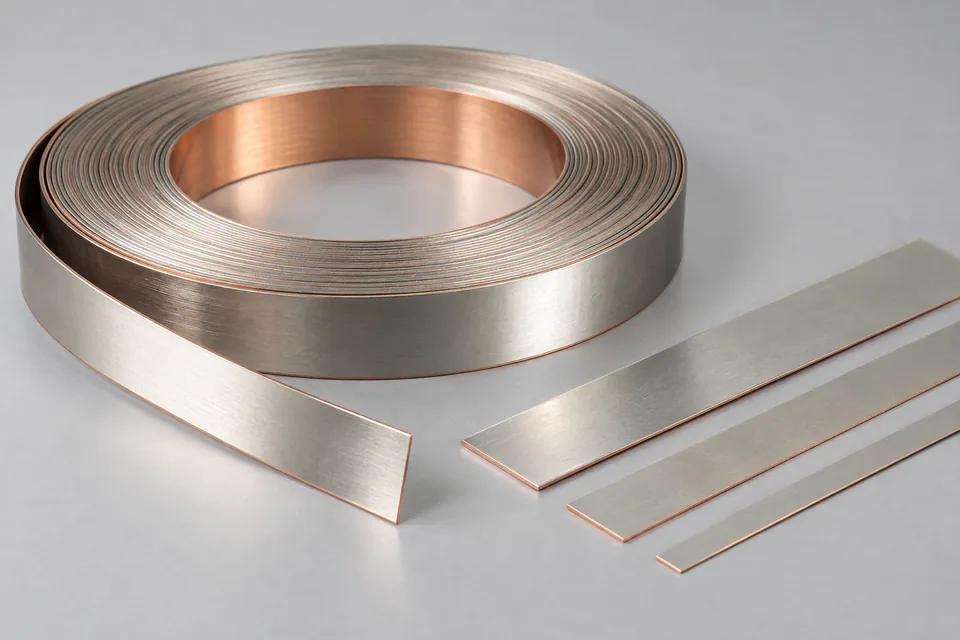
Sumitomo Metal Mining describes tin-plated, reflowed copper strip for terminals and connectors and explicitly says it uses slitting machines dedicated to tin-plated material. That is direct evidence for longitudinal coil conversion, but a specific reel still needs its base copper alloy, tin finish and plating sequence identified. This guide divides a wider plated parent coil into narrower lanes for later contact stamping. It does not cover a loose contact profile or a transverse cut. Paired rotary shear knives are a candidate; the buyer should compare both child edges for copper exposure, coating disturbance, raised metal and debris. Solderability and contact resistance depend on later forming, storage and testing, so blade appearance is only one input.
Updated
Where This Cutting Application Appears
Define lanes from the terminal feed plan
Start with the downstream die pitch and required carrier margin, not just nominal finished contact width. Map coated faces, plated regions and any mill edge exclusion. Lay out every child lane and outside scrap so slit boundaries do not cut through a selectively plated functional contact area.
Trial the plated web on a short reel
Set a matched circular shear pair with the approved strip support and tension. Observe whether tin transfers to a knife, drags across the surface or accumulates near spacers. Keep specimens from both sides of each slit because the upper and lower knife sides can produce different burr directions.
Inspect coating and geometry together
Measure lane width, camber and rewind build at several reel positions. Examine a cut-edge cross section for lifted plating, exposed copper outside the buyer’s allowance and rolled-over burr. Check for loose metallic fragments in the wound coil and for face scuffing from guides.
Hand off to the contact stamper
Label alloy, tin process, slit position, winding direction and burr side for each child coil. The connector maker should run the production punch and later evaluate mating, soldering or resistance using its own acceptance plan. A slit-coil certificate cannot substitute for finished terminal qualification.
Define the Required Cut Result
- Produce specified narrow coils from the correct plated parent lot.
- Limit burr and coating smear at both child edges.
- Preserve coil position and plating-face identity.
- Keep slitting debris from contact surfaces.
Problems to Diagnose Before Changing the Knife
Tin appears on a knife and streaks the strip
- Inspect coating transfer and knife finish.
- Compare feed tension and contact with guides.
One lane has a tall burr
- Check pair engagement, spacer arrangement and tool wear.
- Record which side of each blade made the raised edge.
Coil edges telescope after rewind
- Review lane tension and core alignment.
- Check whether edge curl developed at slitting.
Knife Forms That May Be Considered
| Possible knife form | When it may be considered | What must be confirmed |
|---|---|---|
| Matched rotary shear knives | For a validated tin-plated parent coil divided lengthwise into released widths. | Confirm width, two-edge burr, coating state and rewind integrity. |
Information to Send for Technical Review
You do not need to know the exact blade name. Send the available workpiece, machine, current-knife and cut-result information so the application can be reviewed against a drawing or sample.
- Base copper grade, temper and tin finish
- Plating sequence and coated-face map
- Parent width, gauge and lot
- Lane layout, carrier margin and trim widths
- Allowed burr, copper exposure and tin smear
- Knife pair and spacer trial plan
- Rewind core, tension and packaging
- Terminal stamping and electrical-test owner
Questions About This Cutting Application
Is slitting the same as punching terminals?
No. Slitting makes continuous narrow coils; a separate die creates individual terminal profiles.
Why inspect both edges of a lane?
Opposed shear sides can create different burr and coating conditions.
Must every tin-plated coil be slit again?
No. Sumitomo already offers slit product widths; add a pass only for the approved lane plan.
Can a clean edge prove solderability?
No. The buyer needs the relevant surface and joint tests after handling and forming.
What belongs in the RFQ?
Send a plated sample coil, lane drawing, finish specification and edge acceptance method.
Public references and scope
These public sources provide material, cutting-method or safety context for this guide. Supplier pages describe their own materials or equipment; they do not establish a MEIRENTE blade specification or performance claim. Confirm the actual grade, machine setup and required cut with a drawing or sample.
Related product and service information
- Tin-Plated Copper Strip Edge-Trimming Blades - tin-plated copper strip · strip edge trimming
- Rolled-Annealed Copper Foil Precision Coil Slitting Blades - rolled-annealed copper foil · precision coil slitting
- Ultra-Thin Stainless-Steel Foil Precision Coil Slitting Blades - ultra-thin stainless-steel foil · precision coil slitting
Request a Custom Cutting-Knife Review
Send the workpiece details, machine or holder information, current knife photos or sample, required quantity and examples of the present cut problem. Final dimensions, material, edge geometry and tolerances are confirmed from the approved requirements.