
Blade Application Guides / Application Guide / Advanced solar manufacturing
Thin-Film Solar Encapsulant Cross-Cutting Blades
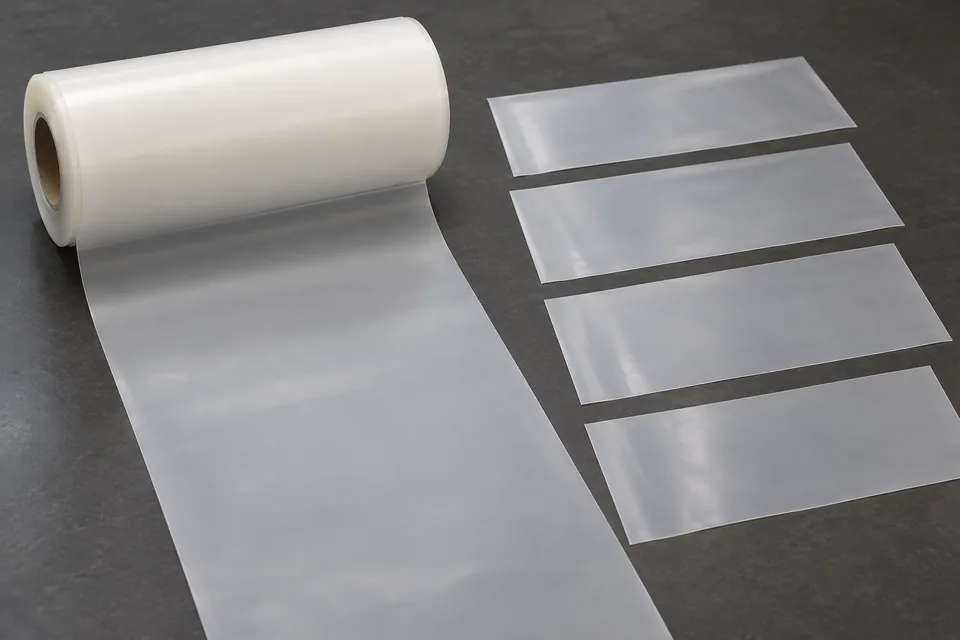
A thin-film solar encapsulant is a polymer film placed in a photovoltaic module stack. Supplier examples include EVA and polyolefin films, with different surface and lamination requirements. Cross cutting severs a moving roll across its feed direction to make separate sheets; it does not trim a module edge or divide the roll into narrow lanes. Define target length, roll orientation and how the soft film will be supported and collected. Check blocked or stretched edges before lamination. A good cut cannot establish module adhesion, weathering or electrical performance.
Updated
Where This Cutting Application Appears
Define the cut sheet, not a module part
Use the buyer’s layup drawing to set width, target length and any required edge margin before lamination. Mark the top and bottom face, release layer if present, and winding direction; a reversed or misidentified sheet can cause handling errors later.
Control indexing and web tension
Measure the distance between feed registration points and the transverse knife. Trial start, steady feed and stop conditions because a soft film may stretch under a nip and then relax after cutting, changing apparent length.
Inspect the complete transverse edge
Check from one side of the roll to the other for uncut tails, curl, wrinkles, particles or blocked layers. Measure length after a defined relaxation interval and compare with a supported sample at the knife exit.
Collect sheets without blocking or scuffing
Use the buyer’s stacking method and any specified interleaf. Reinspect the film after transfer for surface contamination or sticking between cut sheets; the downstream lamination trial needs a clean, correctly oriented input.
Define the Required Cut Result
- Deliver encapsulant sheets at the buyer’s target length.
- Keep both transverse corners fully separated.
- Avoid stretching, curl, particles and surface marks.
- Maintain grade and face orientation through layup.
Problems to Diagnose Before Changing the Knife
Length drifts after the cut
- Compare knife-exit and relaxed sheet measurements.
- Check indexing and nip tension.
- Review the film grade and feed temperature.
A corner remains attached
- Inspect transverse blade alignment and support across width.
- Check whether the edge curl lifts from the backing.
- Compare blade condition at that side.
Cut sheets stick in the stack
- Review interleaf and collection temperature.
- Check whether surface treatment or release layer is present.
- Separate cutting defects from later handling marks.
Knife Forms That May Be Considered
| Possible knife form | When it may be considered | What must be confirmed |
|---|---|---|
| Transverse straight knife and anvil | For a supported film line that cuts the full web width into lengths. | Confirm pressure, knife alignment, clean release and measured length on the actual film. |
| Programmable cross-cutting module | Where the line indexes and cuts according to the layup schedule. | Confirm registration, support, edge quality and no unsupported material claims. |
Information to Send for Technical Review
You do not need to know the exact blade name. Send the available workpiece, machine, current-knife and cut-result information so the application can be reviewed against a drawing or sample.
- Encapsulant maker, grade and actual roll sample
- EVA, POE or other supplied construction
- Face, treatment and release-layer orientation
- Roll width and cut-sheet length drawing
- Length measurement after a specified relaxation
- Allowed edge curl, particles and surface marks
- Feed, nip, knife and anvil details
- Stacking and lamination input requirements
Questions About This Cutting Application
Is cross cutting the same as solar module edge trimming?
No. It makes individual film lengths before layup; module edge trimming occurs later on a different assembled structure.
Why state the film face orientation?
Treatment, release or layup requirements may depend on the supplied grade and which face will contact the next layer.
When should length be measured?
Use the buyer-defined interval and condition after the sheet relaxes, as well as an in-line check for diagnosing stretch.
Does a clean film cut prove encapsulation durability?
No. Adhesion, optical, weathering and module performance require the material supplier’s and buyer’s separate tests.
What sample is needed?
Supply the exact roll grade, layup drawing, accepted cut sheets and the intended collection method.
Public references and scope
These public sources provide material, cutting-method or safety context for this guide. Supplier pages describe their own materials or equipment; they do not establish a MEIRENTE blade specification or performance claim. Confirm the actual grade, machine setup and required cut with a drawing or sample.
Related product and service information
- Thin-Film Solar Encapsulant Rotary Die-Cutting Blades - thin-film solar encapsulant · rotary die cutting
- Perovskite Solar Barrier Film Cross Cutting Blades - perovskite solar barrier film · cross cutting
- Solar Ribbon Cover Film Cross Cutting Blades - solar ribbon cover film · cross cutting
Request a Custom Cutting-Knife Review
Send the workpiece details, machine or holder information, current knife photos or sample, required quantity and examples of the present cut problem. Final dimensions, material, edge geometry and tolerances are confirmed from the approved requirements.