
Blade Application Guides / Application Guide / Advanced solar manufacturing
Solar Ribbon Cover Film Cross Cutting Blades
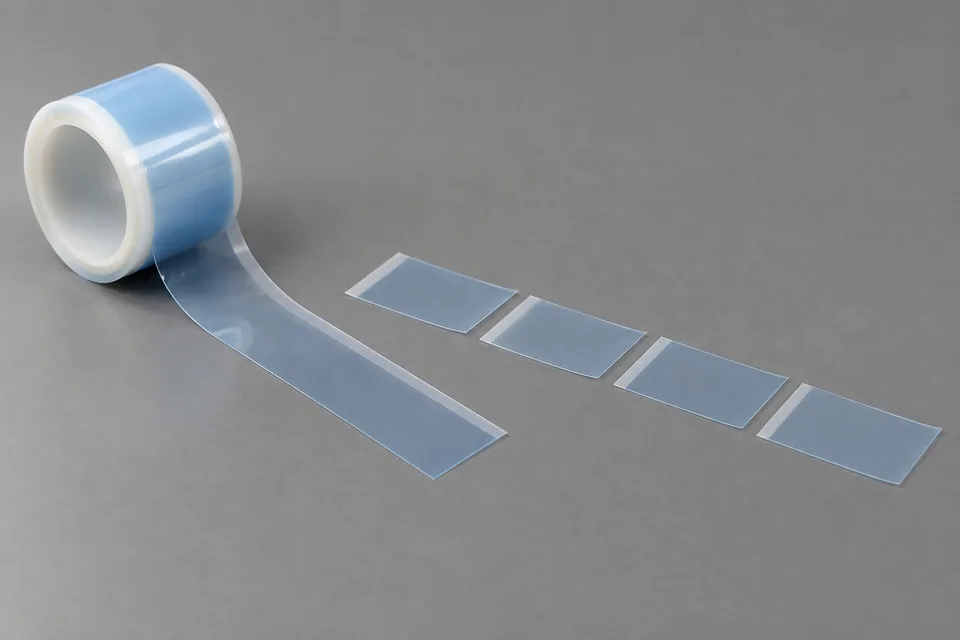
“Solar ribbon cover film” can describe more than one protective or carrier construction used with photovoltaic interconnect material. Before specifying a cut, the buyer should identify whether this is a separate cover sheet, a liner over an adhesive tape, or part of a laminated interconnect. Cross cutting makes finite lengths across the film feed; it does not slit the film into narrower rolls or cut the metal ribbon itself. Use the approved stack drawing to establish the film’s face orientation, required piece length and placement datum, then inspect the transverse edge and liner behavior on real stock.
Updated
Where This Cutting Application Appears
Confirm the cover-film function
Ask where the film sits relative to a copper ribbon or charge-collection tape and whether it is removed before assembly. Some commercial solar tapes include a PET cover sheet, but that does not define every buyer’s construction.
Set transverse piece length
Register each cut to the placement or lamination station. Measure lead and tail edges for squareness and compare actual length after release from web tension.
Protect contact and adhesive faces
If the film has adhesive or release layers, keep the active face off the knife support and collection tray. Check whether the cross cut pulls the liner away, leaves debris or creates a tacky exposed edge.
Trial downstream placement
Place sample pieces on the intended interconnect or fixture and inspect alignment, lifting and clean removal where relevant. A length pass alone cannot establish compatibility with the buyer’s lamination step.
Define the Required Cut Result
- Make finite film lengths to the placement drawing.
- Keep the specified liner or adhesive layer intact.
- Avoid edge debris, curl and face contact marks.
- Maintain orientation and traceability through placement.
Problems to Diagnose Before Changing the Knife
Liner separates at the cut end
- Check layer stack and peel direction.
- Inspect blade support and knife penetration.
- Compare cut behavior at different web tensions.
Film length passes but placement is offset
- Review the machine datum and feed registration.
- Check whether the film stretches or relaxes after cutting.
- Compare cut and applied dimensions.
Pieces stick together in collection
- Identify exposed adhesive and liner orientation.
- Review static and stacking pressure.
- Inspect whether cut-edge smear is present.
Knife Forms That May Be Considered
| Possible knife form | When it may be considered | What must be confirmed |
|---|---|---|
| Rotary cross-cut pair | For timed transverse cuts on a compatible moving film web. | Confirm length registration and layer-edge behavior with the buyer’s laminate. |
| Straight shear sheet cutter | For intermittent cutting of supported film lengths. | Confirm hold-down contact, liner integrity and flatness after release. |
Information to Send for Technical Review
You do not need to know the exact blade name. Send the available workpiece, machine, current-knife and cut-result information so the application can be reviewed against a drawing or sample.
- Exact cover-film function and layer drawing
- Film polymer, adhesive and liner details
- Incoming width and thickness range
- Required piece length and placement datum
- Permitted liner lift and edge debris samples
- Cross-cut machine and support drawings
- Face orientation, handling and storage method
- Representative placement trial material
Questions About This Cutting Application
Is this the same as cutting a photovoltaic copper ribbon?
No. This guide concerns a film or liner named by the buyer; the conductive metal requires separate burr and electrical-contact checks.
Can the film construction be inferred from its name?
No. Provide the layer stack and indicate whether the piece remains in the module or is removed later.
Why measure after the film is released?
Web tension or liner behavior can change the relaxed piece length and squareness.
What makes this a cross cut?
The blade cuts across web travel to create finite pieces; lengthwise slitting would make narrow continuous lanes.
Public references and scope
These public sources provide material, cutting-method or safety context for this guide. Supplier pages describe their own materials or equipment; they do not establish a MEIRENTE blade specification or performance claim. Confirm the actual grade, machine setup and required cut with a drawing or sample.
Related product and service information
- Solar Ribbon Cover Film Rotary Die-Cutting Blades - solar ribbon cover film · rotary die cutting
- Perovskite Solar Barrier Film Cross Cutting Blades - perovskite solar barrier film · cross cutting
- Solar Interconnect Copper Foil Cross Cutting Blades - solar interconnect copper foil · cross cutting
Request a Custom Cutting-Knife Review
Send the workpiece details, machine or holder information, current knife photos or sample, required quantity and examples of the present cut problem. Final dimensions, material, edge geometry and tolerances are confirmed from the approved requirements.