
Blade Application Guides / Application Guide / cordage and reinforcement production
Cutting Braided and Twisted Textile Cord
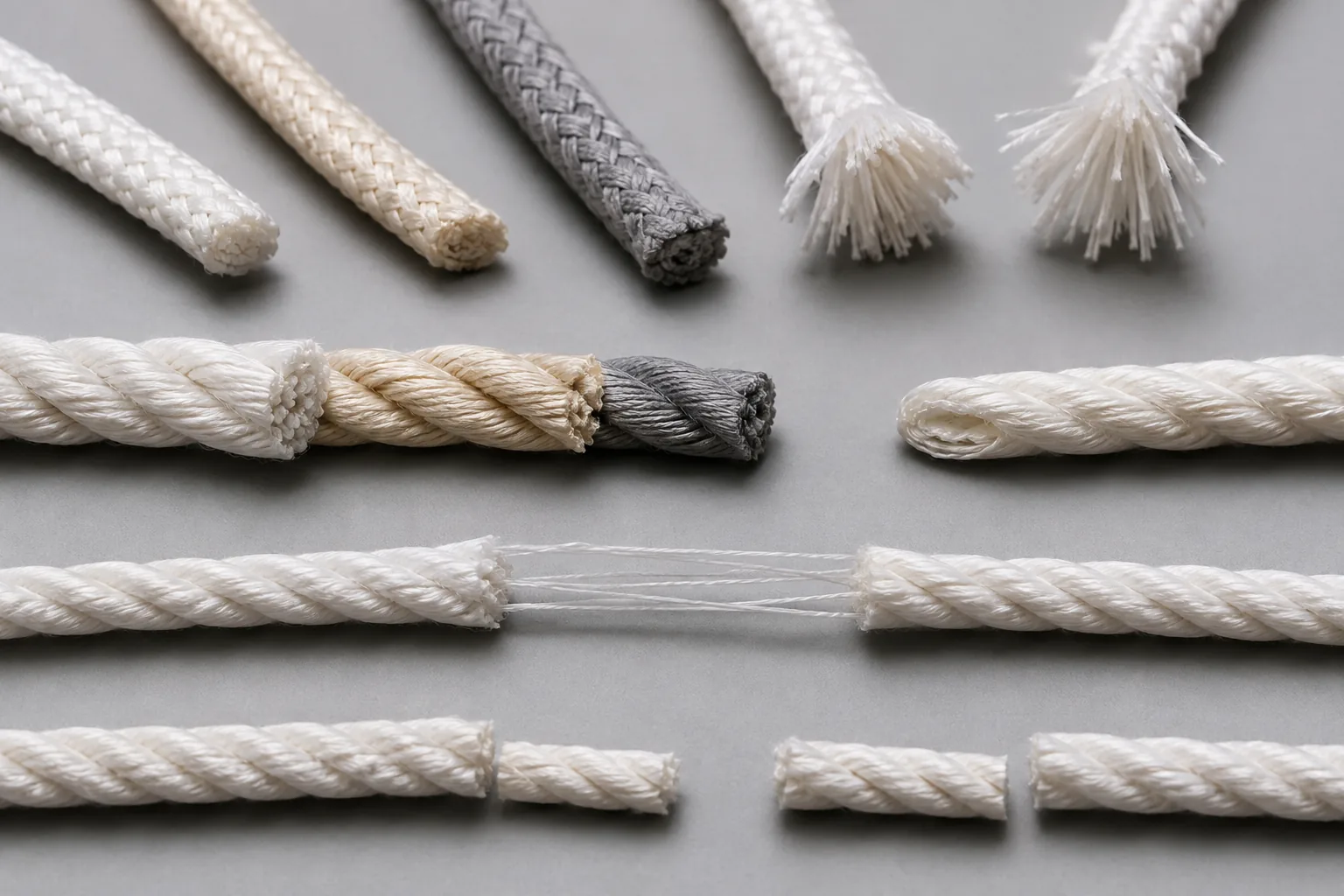
Braided and twisted cords store torsional energy and can open immediately after separation. Cut quality depends on restraining the construction without flattening it and fully severing fine filaments before tension is released.
Updated
Where This Cutting Application Appears
Cordage cut-to-length
Produces measured sections for assembly, packaging or further end treatment.
Reinforcement-cord preparation
Cuts braided or twisted reinforcement before insertion into hose, belt or composite products.
Synthetic-cord end sealing
Combines separation with an approved thermal end condition when the polymer and process permit it.
Cut-To-Length Separation process boundary
cut-to-length separation for braided and twisted textile cord is planned around separation across the material flow or part axis to establish a controlled repeat length or finished end; it is not longitudinal width conversion, shaped contour production or particle-size reduction.
Cut-To-Length Separation setup checkpoint
For braided and twisted textile cord, confirm target length, datum or registration reference, feed indexing, support on both sides, cut timing and post-cut transfer.
Cut-To-Length Separation acceptance checkpoint
For braided and twisted textile cord, evaluate length distribution, squareness or cutoff angle, both cut faces, deformation, registration drift and stacking or discharge consistency.
Define the Required Cut Result
- Complete filament separation
- Limited strand opening after release
- Round ends without clamp flattening
- Repeatable length under defined tension
Problems to Diagnose Before Changing the Knife
Strand splay
- Record braid or twist direction
- Define tension at release
- Check distance from restraint to cut
Flattened end
- Inspect clamp profile and load
- Compare cord compressibility
- Check knife penetration force
Partial filament cuts
- Inspect the edge for local nicks
- Spread the rejected end for examination
- Check support beneath the cord
Length variation
- Define measuring tension
- Verify feed grip and stop
- Allow for twist recovery
Knife Forms That May Be Considered
| Possible knife form | When it may be considered | What must be confirmed |
|---|---|---|
| shear-cut knife pair | Provides positive separation where matched edges can capture the cord without squeezing it flat. | Confirm dimensions and edge details from the cord cutoff equipment, an unworn sample or an approved drawing before manufacture. |
| serrated knife | May suit large soft braids through progressive slicing if it does not comb filaments outward. | Confirm dimensions and edge details from the braided-cord cutter equipment, an unworn sample or an approved drawing before manufacture. |
| heated knife when material permits | Can cut and seal compatible thermoplastic filaments, subject to temperature, emissions and end-quality approval. | Confirm dimensions and edge details from the heated cord cutter equipment, an unworn sample or an approved drawing before manufacture. |
Information to Send for Technical Review
You do not need to know the exact blade name. Send the available workpiece, machine, current-knife and cut-result information so the application can be reviewed against a drawing or sample.
- Cutter and feed-unit model
- Fiber polymer and filament size
- Braided, twisted or core-sheath construction
- Cord diameter and compression behavior
- Cut length and measuring tension
- Cycle rate and restraint method
- Allowed splay or sealed-end condition
- Knife sample, quantity and destination
Questions About This Cutting Application
Why does cord length change after cutting?
Released tension and twist can shorten or rotate the cord. Specify conditioning and measuring tension.
Can heat seal every synthetic cord?
No. Polymer, finish, smoke controls and downstream use must permit thermal cutting.
How can strand splay be evaluated?
Define the time after release and the maximum opened diameter or loose-filament length.
Does a serrated knife always reduce force?
It can, but unsuitable teeth may comb a braid apart. Trial the exact construction.
What sample is most useful?
Send uncut cord, accepted ends and rejected ends with braid direction and cutting tension identified.
Related product and service information
- Cutting Carpet Tiles to Size - carpet tile stock · square cutting and sizing
- Cutting Uncured Tire Tread Rubber Strips - uncured tire tread rubber strips · cross-cutting tread strips
- Cutting Extruded Rubber Profiles to Length - extruded rubber profiles · in-line cut-to-length
Request a Custom Cutting-Knife Review
Send the workpiece details, machine or holder information, current knife photos or sample, required quantity and examples of the present cut problem. Final dimensions, material, edge geometry and tolerances are confirmed from the approved requirements.