
Blade Application Guides / Application Guide / Printing and labels
Shrink Sleeve Label Web Edge-Trimming Blades
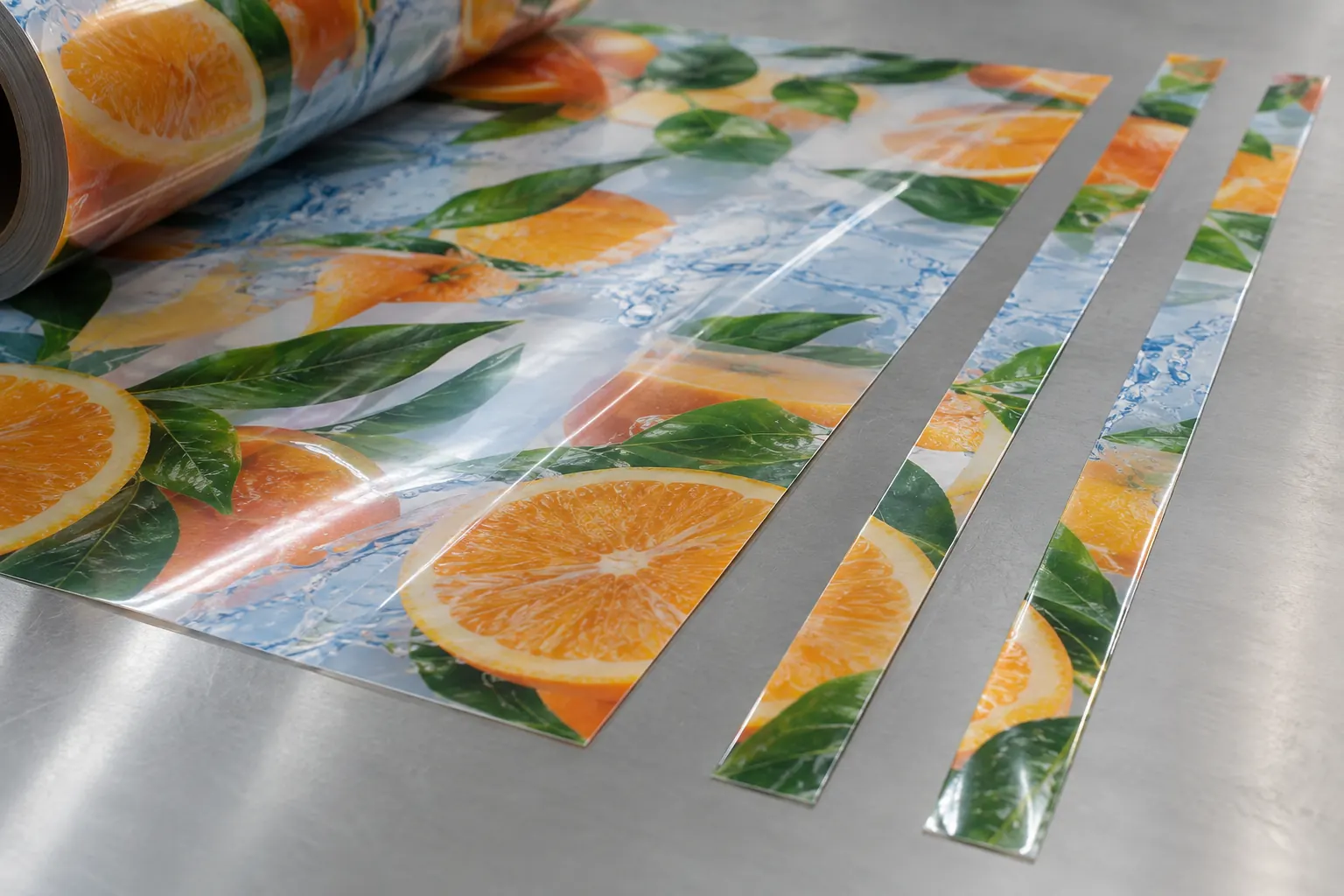
Edge trimming establishes final margins on printed shrink sleeve webs before slitting or seaming. Oriented film trim is light, springy and prone to static, while a small defect at the finished edge can propagate during shrinking; margin control and waste handling therefore require equal attention.
Updated
Where This Cutting Application Appears
Printed-margin finishing
Removes unprinted, distorted or uneven film outside the approved sleeve artwork.
Seaming-width preparation
Creates stable edges and a controlled web width before sleeve forming and seaming.
Lamination-edge cleanup
Trims compatible printed or coated sleeve constructions to a flush final boundary.
Width Edge Trimming process boundary
Width edge trimming removes controlled side margins to establish parallel finished edges and final web width; it is not a transverse length cut.
Width Edge Trimming setup checkpoint
Define both finished edge positions, centerline control, side guidance, trim width and reliable removal of the two continuous edge strips.
Width Edge Trimming acceptance checkpoint
Measure finished width across the run and inspect parallelism, camber, burr or fray, surface damage and trim-break frequency.
Define the Required Cut Result
- Straight margin registered to graphics
- Smooth edge without nicks, whitening or notches
- Continuous narrow-waste removal despite static
- Finished width stable for seaming and application
Problems to Diagnose Before Changing the Knife
Trim strip flutters and breaks
- Record strip width, speed and extraction tension
- Review static and airflow
- Compare film orientation and edge defects
Finished edge develops stress whitening
- Identify polymer and orientation
- Inspect support and lateral loading
- Compare edge condition before and after conditioning
Trim line moves relative to artwork
- Check lateral print register and web guide
- Measure incoming edge variation
- Review sensor datum and roll alignment
Waste sticks to the usable web
- Review static control and surface treatment
- Inspect route separation angle
- Record humidity and winding conditions
Knife Forms That May Be Considered
| Possible knife form | When it may be considered | What must be confirmed |
|---|---|---|
| razor edge-trimming arrangement | May suit selected thin sleeve films where the line provides compatible support and controlled exposure. | Confirm holder, exposure, polymer, thickness, speed, support, waste route and safety provisions. |
| circular shear-trimming arrangement | May suit printed or laminated sleeve webs requiring paired rotary control. | Confirm diameters, bores, overlap, side load, rotation and margin path from installed equipment data. |
Information to Send for Technical Review
You do not need to know the exact blade name. Send the available workpiece, machine, current-knife and cut-result information so the application can be reviewed against a drawing or sample.
- Film polymer, thickness and orientation
- Print, varnish and surface-treatment details
- Incoming and final web widths
- Artwork margin, seam allowance and tolerance
- Speed, tension, web guide and static control
- Current trimming action and mounting interface
- Waste-strip width, extraction and collection route
- Samples showing breaks, whitening, drift and adhesion
Questions About This Cutting Application
Why can trim waste break even when the finished edge looks clean?
The narrow strip may contain print variation, static loading or hidden nicks and may be overstressed by extraction.
Does stress whitening always mean the film will fail?
Not always, but it indicates local deformation and should be evaluated through seaming and shrink tests.
How is artwork margin controlled?
Coordinate print registration, lateral web guiding and the physical trim position using a shared datum.
Why does waste return to the web?
Static attraction, airflow and an unsuitable separation route can overcome the strip's low stiffness.
What defines acceptable edge quality?
Use magnified edge inspection plus downstream seaming, application and shrink performance.
Related product and service information
- ABF Build-Up Film Roll Slitting Blades - ABF build-up film · roll slitting
- Security Paper Label Stock Edge Trimming Blades: Feature and Liner Protection - security paper label stock · width edge trimming
- Bookbinding Laminate Film Edge Trimming Blades: Clear Edges and Adhesive Control - bookbinding laminate film · width edge trimming
Request a Custom Cutting-Knife Review
Send the workpiece details, machine or holder information, current knife photos or sample, required quantity and examples of the present cut problem. Final dimensions, material, edge geometry and tolerances are confirmed from the approved requirements.