
Blade Application Guides / Application Guide / Printed electronics
Printed Heater PET Web Shear Slitting Blades
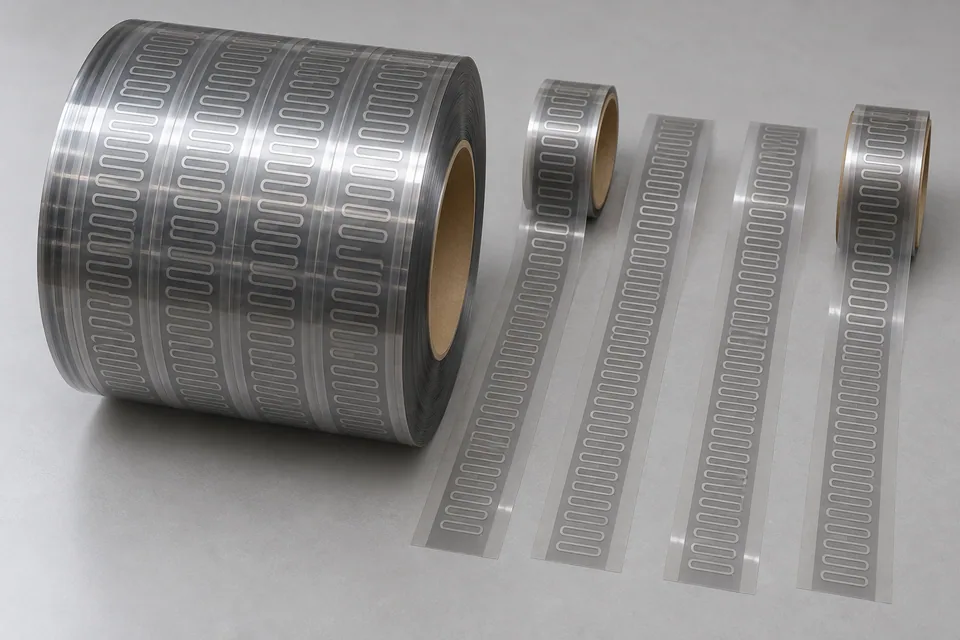
Shear slitting divides a moving printed PET heater web into parallel lanes between paired rotary cutting edges. The web may carry silver, dielectric and resistive ink layers; the exact artwork and cure state come from the buyer. Unlike a stationary razor, paired shears bring two knife edges together, so actual side clearance, overlap and arbor alignment matter. Keep the cut path in a buyer-approved blank margin, inspect both cut edges and compare electrical checks before and after rewinding. Width alone cannot prove heater safety or output.
Updated
Where This Cutting Application Appears
Put the shear line on approved artwork
Overlay the lane-width schedule on the printed heater pattern. Identify busbars, terminal pads and dielectric coverage; inspect registration marks at the front and rear of the run so a drifting web cannot move an active track under a rotary knife.
Set both rotary edges as a pair
Review upper and lower knife diameters, spacer stack, overlap and side clearance using the machine drawings. Trial the cured printed stock rather than bare PET, and inspect whether ink buildup changes the cut after repeated turns.
Inspect lane and printed margins
Measure each delivered lane and examine both slit sides for PET burr, curl, ink flake or rubbed conductive lines. Compare print-to-edge clearance across the web and collect debris samples where the machine first sheds particles.
Test after the rewind path
Inspect strips at knife exit and after separation and winding. A guide may abrade the printed face after a clean shear. The buyer should compare continuity or resistance at the required test points before accepting conversion.
Define the Required Cut Result
- Hold strip width and artwork-to-edge clearance.
- Avoid circuit contact, ink flaking and PET-edge distortion.
- Maintain clean face surfaces through winding.
- Provide lanes for buyer electrical inspection.
Problems to Diagnose Before Changing the Knife
One lane approaches a printed busbar
- Check artwork registration and web guide drift.
- Inspect knife and spacer positions.
- Compare print pitch across the lot.
Ink particles rise later in the run
- Inspect knife buildup and edge wear.
- Verify print cure state.
- Check separator and guide abrasion.
A heater circuit fails after slitting
- Compare pre-cut and post-cut electrical data.
- Map failure to knife or winding contact.
- Inspect conductor edge under the buyer method.
Knife Forms That May Be Considered
| Possible knife form | When it may be considered | What must be confirmed |
|---|---|---|
| Matched rotary shear knife pair | For a printed PET line designed for paired longitudinal shear cuts. | Confirm arbor, overlap, side clearance and pattern-safe slit on actual stock. |
| Outside-edge rotary trim pair | Where the plan removes a sacrificial margin before rewinding. | Confirm useful circuit clearance and trim takeoff separately. |
Information to Send for Technical Review
You do not need to know the exact blade name. Send the available workpiece, machine, current-knife and cut-result information so the application can be reviewed against a drawing or sample.
- Actual PET and print stack
- Cured artwork with busbars, terminals and keep-out zone
- Master width and lane plan
- Knife, arbor and spacer drawings
- Side clearance and overlap record
- Accepted PET and ink edge samples
- Guide and rewind arrangement
- Buyer continuity or resistance method
Questions About This Cutting Application
How is shear slitting different from razor slitting?
A paired rotary shear uses mating edges; a razor uses a single stationary blade. Setup and likely defects differ.
Can the knife cut through a printed track?
Only if the buyer drawing explicitly permits it. The default trial should use a defined unprinted margin.
Why inspect both sides of a slit?
A paired shear can leave different burr or ink damage on the two adjacent lanes.
Does a good lane width prove heater performance?
No. The buyer must test electrical and thermal behavior of the converted design.
Which stock should be used for trial?
Use the actual cured print and PET grade, with production guides and winding path.
Public references and scope
These public sources provide material, cutting-method or safety context for this guide. Supplier pages describe their own materials or equipment; they do not establish a MEIRENTE blade specification or performance claim. Confirm the actual grade, machine setup and required cut with a drawing or sample.
Related product and service information
- RFID Aluminum Antenna Laminate Cross-Cutting Blades - RFID aluminum antenna laminate · cross cutting
- Printed Heater PET Web Razor Slitting Blades - printed heater PET web · razor slitting
- Printed Battery Current-Collector Film Rotary Die-Cutting Blades - printed battery current-collector film · rotary die cutting
Request a Custom Cutting-Knife Review
Send the workpiece details, machine or holder information, current knife photos or sample, required quantity and examples of the present cut problem. Final dimensions, material, edge geometry and tolerances are confirmed from the approved requirements.