
Blade Application Guides / Application Guide / Printed electronics
Printed Heater PET Web Razor Slitting Blades
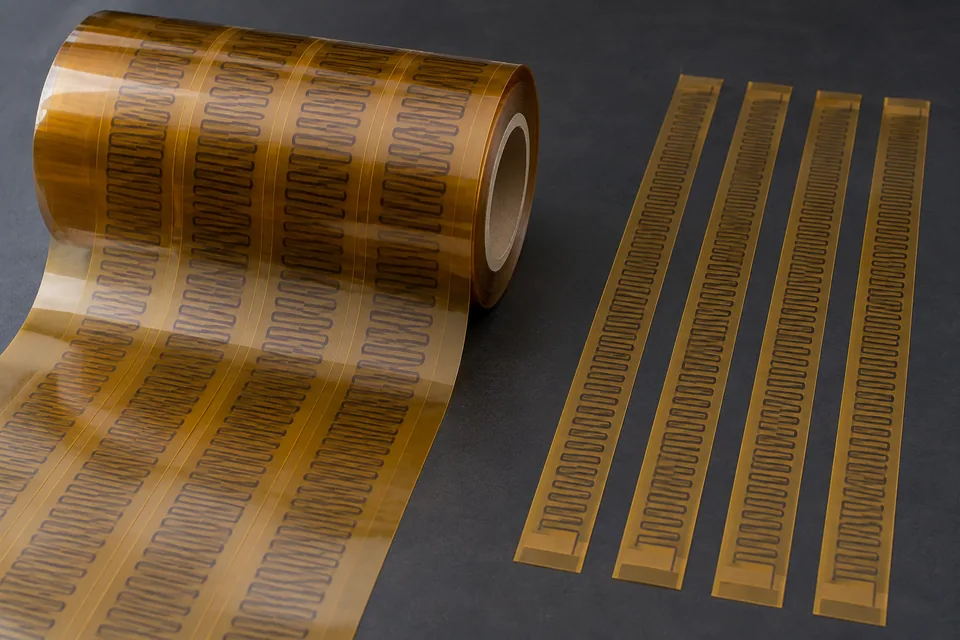
Printed PET heater stock may carry conductive, dielectric and resistive ink patterns; a Henkel/Quad manufacturer example prints those layers on PET film, and Coveme identifies roll-to-roll printed-heater uses for treated polyester substrates. Razor slitting uses a sharp stationary blade to divide a continuous web lengthwise, so the blade path must remain outside the customer’s printed heater circuitry and busbars. This is a different problem from cutting blank PET: ink abrasion, trace proximity and winding contact can damage a functional pattern. Confirm the exact print layout, cured ink state and acceptable edge before trialing the web. Heater output and safety require separate electrical testing.
Updated
Where This Cutting Application Appears
Map blade paths to the circuit layout
Use the printed artwork and registration marks to place each razor line in an approved unprinted margin. Identify busbars, terminals and any dielectric overprint; record the minimum buyer-defined clearance from the active design rather than using a generic distance.
Trial the actual razor configuration
The razor enters a moving film web at a shallow angle in the OEM method. Compare fresh blade condition, penetration, support and web tension on cured production stock. A line that cuts clean bare PET may catch or smear a raised ink edge.
Inspect print and film together
Measure each lane width and inspect the slit for nicks, strings, plastic debris and ink flake. Check the adjacent printed conductors under the buyer’s magnification or continuity method and compare with an untouched control.
Follow strips through rewinding
A wound lane may rub its printed face against guides or neighboring wraps. Sample at knife exit and after collection for scratches, ink transfer and new electrical discontinuities; document winding direction and protective interleaf if used.
Define the Required Cut Result
- Hold slit lanes within the artwork registration plan.
- Keep the razor out of active heater tracks and terminals.
- Avoid PET edge nicks, ink debris and face abrasion.
- Deliver strips suitable for buyer electrical verification.
Problems to Diagnose Before Changing the Knife
A trace shows a new open circuit
- Check artwork-to-blade alignment.
- Inspect ink damage beside the slit and after winding.
- Compare pre-cut continuity on the same web lot.
Ink flakes at the slit edge
- Check whether print encroaches on the cut margin.
- Review cure state and blade drag.
- Inspect fresh versus worn razor samples.
PET lane curls or wanders
- Check web tension and blade penetration.
- Review upstream tracking and guide contact.
- Compare lane width through the run.
Knife Forms That May Be Considered
| Possible knife form | When it may be considered | What must be confirmed |
|---|---|---|
| Stationary razor blade and holder | For a compatible film web with an approved unprinted cut path. | Confirm blade angle, support, clean PET edge and no circuit contact in a production-stock trial. |
| Alternate film-slitting method | If the printed stack or margin is not compatible with razor cutting. | Compare methods only against the buyer’s print layout, edge and electrical inspection. |
Information to Send for Technical Review
You do not need to know the exact blade name. Send the available workpiece, machine, current-knife and cut-result information so the application can be reviewed against a drawing or sample.
- PET grade, print and cure-state description
- Layer artwork with busbars, terminals and keep-out margins
- Web width and target lane schedule
- Registration method and permitted drift
- Razor holder, support and tension details
- Accepted PET edge and ink-debris samples
- Winding face and interleaf arrangement
- Pre- and post-cut continuity or resistance plan
Questions About This Cutting Application
Why is bare PET an insufficient test sample?
It lacks the raised and functional printed layers that can shed, smear or be cut by the razor.
Where should a razor path run?
Only in a buyer-approved margin outside active tracks, terminals and required dielectric areas.
Can visual edge inspection prove the heater works?
No. The buyer must compare electrical measurements and any thermal tests on the converted heater design.
What changes after rewinding?
Guides and winding contact can abrade ink or create a discontinuity even when the knife-exit edge looked acceptable.
Is razor slitting always suitable?
No. Suitability depends on the cured print stack, film support, margin width and required cut edge; trial the actual web.
Public references and scope
These public sources provide material, cutting-method or safety context for this guide. Supplier pages describe their own materials or equipment; they do not establish a MEIRENTE blade specification or performance claim. Confirm the actual grade, machine setup and required cut with a drawing or sample.
Related product and service information
- Printed Heater PET Web Rotary Die-Cutting Blades - printed heater PET web · rotary die cutting
- RFID Aluminum Antenna Laminate Rotary Die-Cutting Blades - RFID aluminum antenna laminate · rotary die cutting
- Printed Battery Current-Collector Film Rotary Die-Cutting Blades - printed battery current-collector film · rotary die cutting
Request a Custom Cutting-Knife Review
Send the workpiece details, machine or holder information, current knife photos or sample, required quantity and examples of the present cut problem. Final dimensions, material, edge geometry and tolerances are confirmed from the approved requirements.