
Blade Application Guides / Application Guide / Electrical equipment manufacturing
Pre-Lamination Copper Busbar Sheet Precision Blanking Blades
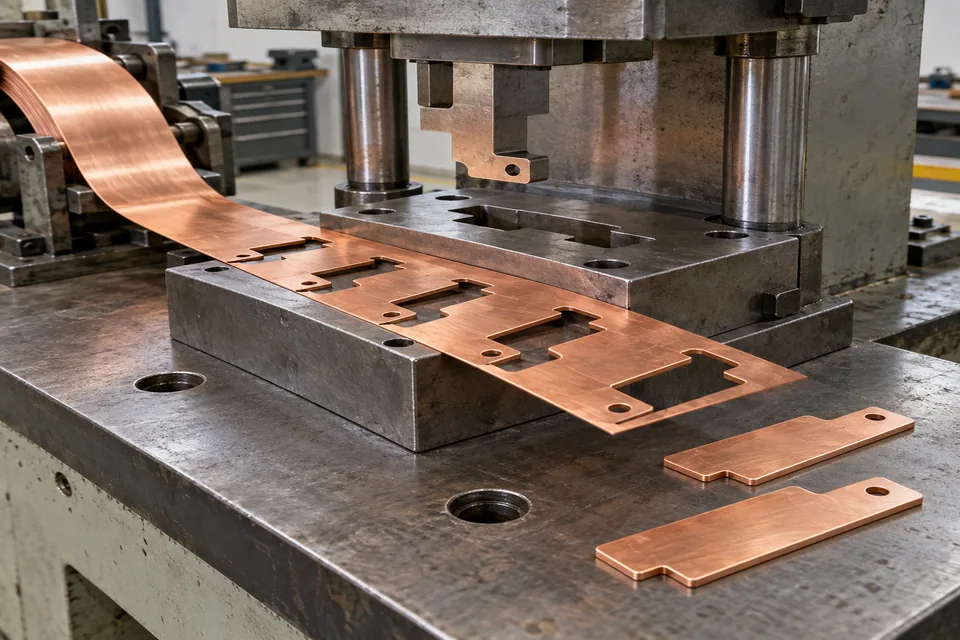
A laminated busbar is assembled from fabricated copper conductors and dielectric layers. Mersen describes metal fabrication with punch presses as well as separate precision die cutting of insulation before assembly and lamination. The workpiece in this guide is therefore bare, pre-lamination copper busbar sheet or strip—not a completed insulated busbar. Precision blanking releases a discrete copper conductor profile, often with specified openings or terminals, using a matched punch and die. TRUMPF explains that the punch/die edges shear sheet material and produce a slug. Actual copper grade, thickness and temper must come from the buyer, because burr and bend response affect later joining and dielectric coverage. A passed blank is only a component; the busbar owner qualifies the assembled electrical insulation and performance.
Updated
Where This Cutting Application Appears
Register the conductor and dielectric drawings
Compare copper outline, holes, joining tabs and bend zones with the separate insulation-film drawing. Mark areas where dielectric must overhang metal and where a contact face remains bare. Do not cut through already laminated insulation to correct a conductor-profile error.
Trial the matched tool on specified copper
Record sheet orientation, punch/die geometry, clearance, stripper and press support. Inspect sheet flatness before and after the stroke. A tight corner, narrow bridge or large hole can distort a thin copper region even if the tool nominally matches the drawing.
Inspect the blank and skeleton
Measure profile and hole locations from the assembly datums. Examine both cut faces for burr direction, rollover, tears, local work hardening marks and trapped slugs. Check the skeleton for partially connected tabs that could detach into the next stroke.
Test pre-lamination fit
Place an accepted copper blank against the intended dielectric shape and mating connector or fixture. Confirm conductor edge clearance, hole alignment and expected joining access. Final lamination, plating or dielectric tests are separate buyer-owned steps.
Define the Required Cut Result
- Release copper conductor profiles to the approved pre-lamination drawing.
- Control burr and flatness where insulation will wrap or seal.
- Eject slugs and preserve contact/joining surfaces.
- Provide traceable blanks for assembly fit and electrical qualification.
Problems to Diagnose Before Changing the Knife
A burr threatens dielectric overlap
- Inspect punch/die clearance and wear.
- Map burr direction to the lamination face.
- Compare accepted edge samples with the dielectric drawing.
Holes shift relative to the outside profile
- Check common datums and strip registration.
- Review press and die alignment.
- Measure blanks after release and flattening.
Copper lifts with the punch
- Inspect stripper action and local support.
- Review material temper and sheet thickness.
- Check for slug retention in the die.
Knife Forms That May Be Considered
| Possible knife form | When it may be considered | What must be confirmed |
|---|---|---|
| Matched profile punch and die | For a repeated conductor outline on a press designed for the actual copper sheet. | Confirm clearance, stripper, press mounting and burr/flatness on sample stock. |
| Compound blanking and piercing tool | When conductor perimeter and approved terminal holes require one registered stroke. | Confirm slug ejection, bridge integrity and assembly datum accuracy. |
Information to Send for Technical Review
You do not need to know the exact blade name. Send the available workpiece, machine, current-knife and cut-result information so the application can be reviewed against a drawing or sample.
- Copper alloy, temper, thickness and surface finish
- Conductor blank and dielectric-layer drawings
- Hole, terminal and joining-feature datums
- Press, punch, die and stripper drawings
- Accepted burr direction, edge and flatness samples
- Slug and skeleton removal plan
- Subsequent bend, plate, join and lamination sequence
- Busbar owner fit and electrical qualification criteria
Questions About This Cutting Application
Why specify pre-lamination stock?
Busbar makers fabricate copper and insulation components before controlled assembly; cutting a finished laminate is a different and risky task.
Does precision blanking cut the insulation too?
No. This guide addresses bare copper conductors; the dielectric part has its own cutting and acceptance plan.
Which burr side is acceptable?
Use the buyer’s drawing and insulation-overlap plan; no universal burr direction is safe.
Can the same die make openings and outline?
A compound tool may do so if the machine and geometry support it and all slugs leave cleanly.
Does a correct blank prove busbar electrical performance?
No. The assembled laminated busbar needs its own insulation, joining and electrical qualification.
Public references and scope
These public sources provide material, cutting-method or safety context for this guide. Supplier pages describe their own materials or equipment; they do not establish a MEIRENTE blade specification or performance claim. Confirm the actual grade, machine setup and required cut with a drawing or sample.
Related product and service information
- Electrochemical Biosensor Spacer Tape Kiss Cutting Blades - electrochemical biosensor spacer tape · kiss cutting
- Stainless Woven Wire Mesh Precision Blanking Blades - stainless woven wire mesh · precision blanking
- Rolled-Annealed Copper Foil Precision Blanking Blades - rolled-annealed copper foil · precision blanking
Request a Custom Cutting-Knife Review
Send the workpiece details, machine or holder information, current knife photos or sample, required quantity and examples of the present cut problem. Final dimensions, material, edge geometry and tolerances are confirmed from the approved requirements.