
Blade Application Guides / Application Guide / Advanced solar manufacturing
Photovoltaic Edge-Seal Tape Cross-Cutting Blades
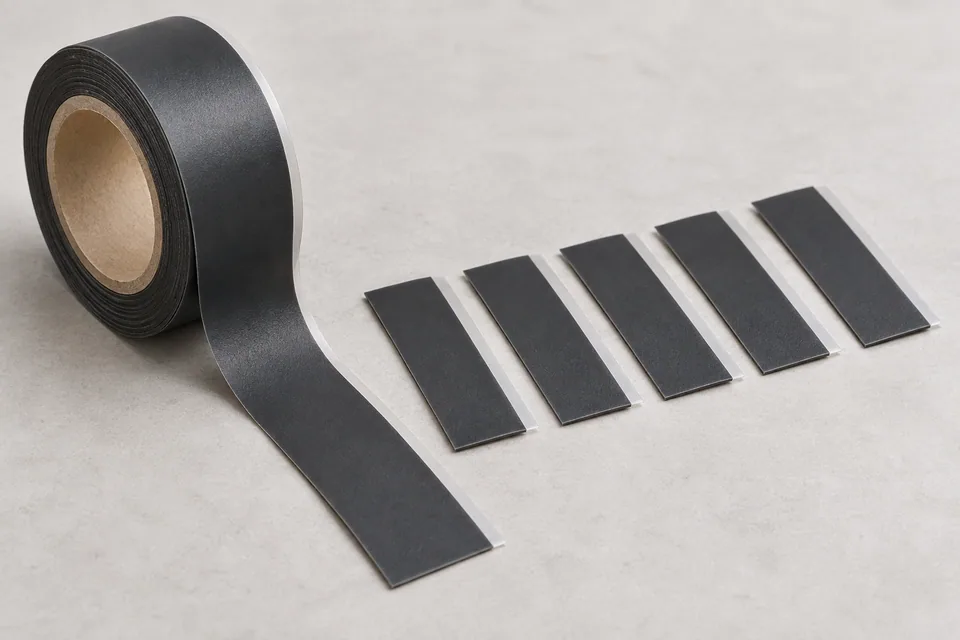
Photovoltaic edge-seal tape is an adhesive-backed strip used in some module constructions. One manufacturer describes an acrylic-foam adhesive with a black weathering backing, but the customer’s actual tape, adhesive and release liner must be identified. Cross cutting divides a narrow continuous tape into specified lengths. It is not cutting a free-standing encapsulant sheet: adhesive transfer, liner split and squashed foam ends become key defects. Trial the exact tape construction and inspect pieces after liner handling. A cut length alone cannot qualify a module seal.
Updated
Where This Cutting Application Appears
Define the installed length and overlap
Set tape length from the module-edge drawing and identify whether the piece includes a start or end overlap. Record backing orientation and which release liner, if any, remains on the cut piece for assembly.
Support the adhesive stack
Trial a transverse blade and counter-surface that separate backing, acrylic foam and liner together without pushing adhesive beyond the end. Observe the blade after repeated cuts for buildup, and compare the first piece with later pieces.
Inspect both cut ends
Measure usable length and check the backing for tears, the foam for compression, and the liner for partial cuts or premature lift. Pull one sample through the buyer’s normal liner-removal step to expose hidden adhesive strings or edge distortion.
Keep pieces from bonding in collection
Separate cut pieces according to the tape supplier’s handling instructions. Reinspect after stacking or kit packing; blocking and liner movement can be introduced after an acceptable knife exit and affect assembly placement.
Define the Required Cut Result
- Hold the specified tape-piece length.
- Sever backing, adhesive and liner as required.
- Limit adhesive ooze, foam crush and end deformation.
- Deliver pieces with usable liner and correct orientation.
Problems to Diagnose Before Changing the Knife
Adhesive strings remain between pieces
- Inspect blade buildup and edge condition.
- Check temperature and dwell at the cut.
- Confirm the liner and adhesive are both fully severed.
Liner pulls away before assembly
- Check whether the blade nicked or lifted it.
- Inspect takeoff and stacking contact.
- Compare incoming liner adhesion with cut samples.
Foam end bulges beyond backing
- Review cut pressure and support.
- Measure after the tape relaxes.
- Check whether a dull edge compresses rather than parts the foam.
Knife Forms That May Be Considered
| Possible knife form | When it may be considered | What must be confirmed |
|---|---|---|
| Short-stroke transverse tape knife | For a narrow tape line with supported backing and liner. | Confirm complete layer separation and clean adhesive end on actual tape. |
| Indexed die cutter | Where repeated fixed lengths or corner features are required. | Confirm backing and liner release, adhesive buildup and length after handling. |
Information to Send for Technical Review
You do not need to know the exact blade name. Send the available workpiece, machine, current-knife and cut-result information so the application can be reviewed against a drawing or sample.
- Tape maker and exact backing/adhesive/liner stack
- Module-edge length and overlap drawing
- Whether liner stays on delivered pieces
- Accepted adhesive-ooze and foam-crush samples
- Knife and anvil or die drawing
- Tape feed and indexing method
- Temperature and blade-cleaning observations
- Collection and kit-packing method
Questions About This Cutting Application
Why is liner integrity part of cutting acceptance?
A partly severed or prematurely lifted liner can spoil application even if the tape backing is the right length.
Is this the same as cutting encapsulant film?
No. The tape includes an adhesive stack and often a liner, so the cut ends must be checked for ooze and layer separation.
Can a cut tape prove a weatherproof seal?
No. Sealing performance depends on the specified tape, substrates, assembly process and buyer testing.
What reveals adhesive buildup on a knife?
Compare early and later cuts for strings, end deformation and release force, then inspect the edge and cleaning interval.
What does the supplier need to see?
Provide tape samples with liner, required length and overlap, cutter drawing and accepted cut-end examples.
Public references and scope
These public sources provide material, cutting-method or safety context for this guide. Supplier pages describe their own materials or equipment; they do not establish a MEIRENTE blade specification or performance claim. Confirm the actual grade, machine setup and required cut with a drawing or sample.
Related product and service information
- Photovoltaic Edge-Seal Tape Rotary Die-Cutting Blades - photovoltaic edge-seal tape · rotary die cutting
- Perovskite Solar Barrier Film Cross Cutting Blades - perovskite solar barrier film · cross cutting
- Solar Ribbon Cover Film Cross Cutting Blades - solar ribbon cover film · cross cutting
Request a Custom Cutting-Knife Review
Send the workpiece details, machine or holder information, current knife photos or sample, required quantity and examples of the present cut problem. Final dimensions, material, edge geometry and tolerances are confirmed from the approved requirements.