
Blade Application Guides / Application Guide / Specialty metal converting
Niobium Metal Foil Precision Blanking Blades
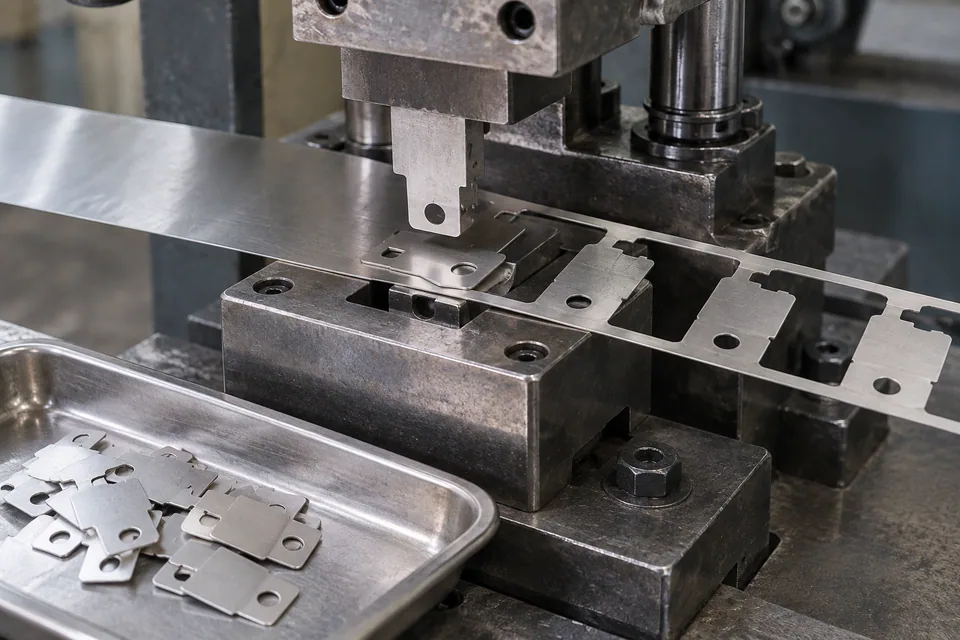
Admat describes coiled niobium foil made with rolling schedules intended for stamped and deep-drawn parts; Eagle Alloys offers niobium foil and finite blanks. Precision blanking is therefore a grounded route for a specified foil part: matched punch and die tooling separates a finite profile from a strip or sheet. It differs from coil slitting and rectangular cut-to-length. The exact alloy, grain condition and intended later forming step determine where the outline can be placed and how the cut edge is accepted. A good blank by dimensions alone does not prove the drawn cup or final component will pass.
Updated
Where This Cutting Application Appears
Place the outline on the material
Read the drawing for profile, holes, tabs and any carrier features. Identify whether the foil is pure niobium, niobium-zirconium or another alloy and whether the blank will later be deep drawn. Set the blank direction from the actual forming plan. Do not rotate a part purely to save material when anisotropy or downstream layout forbids it.
Qualify punch and die engagement
Support the delivered foil under the tool and set clearance by a real-gauge trial. Check entry and breakthrough on both faces. A very thin blank can lift with the punch or wrinkle before cutting, so confirm stripping and hold-down behavior as well as the perimeter edge. Monitor small slugs for retained or double-hit pieces.
Inspect small features and faces
Measure outline and any hole after release from the die. Check burr direction, rollover, torn corners, distorted tabs and broad-face marks. Compare the part with its surrounding skeleton; elongated holes in the skeleton may reveal feed or tool problems. Keep representative samples from first and later strokes to detect tool buildup or wear.
Protect identity during collection
Segregate parts, carrier scrap and slugs. Record alloy, lot, gauge, temper or anneal condition and tooling revision. If the next step is electronic or vacuum use, its cleanliness procedure controls whether temporary lubricant, carrier film or cleaning is allowed. Avoid transferring a generic finishing step into an unqualified part.
Check the actual downstream forming
Feed accepted blanks into the specified draw, press or joining operation. Look for cracks starting at a cut edge, wrinkling and inconsistent cup height, then relate defects to material condition and die result. Admat explicitly connects niobium foil rolling schedule to deep-draw performance. Blanking approval requires this handoff evidence, while final functional performance remains the buyer’s responsibility. Include first and last parts from a production-like die trial. If a thin slug remains attached to the carrier, stop before it is carried into the next press stroke. Review the scrap skeleton for progressive stretching.
Define the Required Cut Result
- Make repeatable finite niobium foil profiles.
- Limit burr, torn corners and face damage.
- Control slug removal and thin-part pickup.
- Verify later forming compatibility.
Problems to Diagnose Before Changing the Knife
Blank lifts with the punch
- Review stripper and hold-down.
- Inspect adhesion or vacuum pickup.
- Check double-hit marks.
Drawn cup cracks from a cut corner
- Inspect burr and corner radius.
- Review grade and rolling direction.
- Trial actual forming.
Knife Forms That May Be Considered
| Possible knife form | When it may be considered | What must be confirmed |
|---|---|---|
| Matched punch and die | For drawing-defined niobium foil blanks. | Confirm full perimeter and slug release on actual grade. |
| Progressive blanking tool | Where carrier stock holds small pieces through several hits. | Verify feed pitch and final release. |
Information to Send for Technical Review
You do not need to know the exact blade name. Send the available workpiece, machine, current-knife and cut-result information so the application can be reviewed against a drawing or sample.
- Niobium grade or alloy and foil condition
- Part drawing, holes and grain direction
- Carrier and hold-down plan
- Burr, flatness and slug criteria
- Later draw or joining operation
Questions About This Cutting Application
Does blanking mean slitting?
No. Blanking punches finite profiles; slitting leaves a continuous roll.
Why specify the later forming step?
The blank edge and orientation can affect draw behavior.
Can any niobium foil grade use the same die?
No. Grade, gauge and condition require trial.
Does a perfect outline prove a good cup?
No. Deep drawing and final tests follow.
Public references and scope
These public sources provide material, cutting-method or safety context for this guide. Supplier pages describe their own materials or equipment; they do not establish a MEIRENTE blade specification or performance claim. Confirm the actual grade, machine setup and required cut with a drawing or sample.
Related product and service information
- Niobium Metal Foil Precision Coil Slitting Blades - niobium metal foil · precision coil slitting
- Amorphous Metal Ribbon Precision Blanking Blades - amorphous metal ribbon · precision blanking
- Beryllium-Copper Foil Precision Blanking Blades - beryllium-copper foil · precision blanking
Request a Custom Cutting-Knife Review
Send the workpiece details, machine or holder information, current knife photos or sample, required quantity and examples of the present cut problem. Final dimensions, material, edge geometry and tolerances are confirmed from the approved requirements.