
Blade Application Guides / Application Guide / Electronic metal converting
Nickel-Clad Copper Strip Precision Coil Slitting Blades
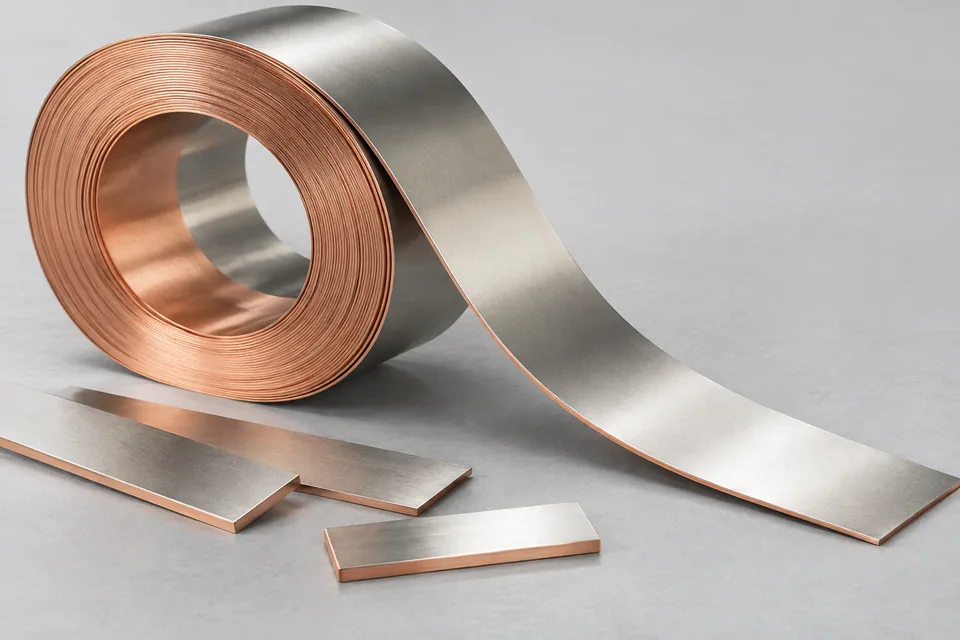
Raytron describes nickel-clad copper strip made through clad bonding, rolling and slitting, and Chalco lists nickel/copper and nickel/copper/nickel composite stock in coils and sheets for battery connections. This material is a layered metal strip, not nickel electroplated copper; a cut through its width exposes the cross-section of the copper and nickel layers. This guide covers longitudinal slitting of a named clad source coil to buyer-specified battery-lead or connection widths. DIENES describes paired shear knives for nonferrous metal webs, giving one route to test. The cut edge must be judged for burrs, layer lift and exposed-core acceptance under the buyer’s joining and corrosion design. A slit strip does not certify weldability or current-carrying performance in a completed pack.
Updated
Where This Cutting Application Appears
Specify the clad orientation and lane widths
Obtain the true stack drawing: Ni/Cu on one face, Ni/Cu/Ni on both faces, or another released ratio. Record source width, total gauge and whether the nickel face must meet a weld electrode. Lay out each lane with the downstream tab pitch and any border allowance.
Trial upper and lower blade engagement
Run a short coil section at the specified temper with matched circular shear knives. Inspect both slit faces for a folded nickel lip, copper smear and any opening at the interface. Changing the cut side can change which metal appears raised toward the later welding surface.
Track edge quality through rewind
Measure width and camber on each narrow reel and compare first, middle and last sections. Unwind a sample to check whether adjacent turns rubbed nickel away or trapped metallic fragments. Capture narrow waste so it does not spring back against the product coil.
Hand off for the joining trial
Label stack architecture, nickel orientation, parent lot and slit-edge direction. The battery engineer must test its actual welding method, contact resistance, temperature rise and environmental exposure. A clean-looking clad cross-section cannot establish the finished connection’s safety or life.
Define the Required Cut Result
- Provide specified clad-metal lane widths.
- Keep nickel and copper layers bonded at cut edges.
- Limit burr, smear and loose conductive slivers.
- Preserve face and lot identification through rewinding.
Problems to Diagnose Before Changing the Knife
Nickel lifts at a cut edge
- Review shear side load and knife wear.
- Check incoming bond quality and temper.
Copper smears over the nickel face
- Inspect cut direction and engagement.
- Compare both retained edges under magnification.
Narrow reels show camber or imprint
- Review rewind tension and source coil set.
- Unwind a representative middle section.
Knife Forms That May Be Considered
| Possible knife form | When it may be considered | What must be confirmed |
|---|---|---|
| Matched upper/lower rotary shear pair | For a proven Ni/Cu clad coil and lane plan. | Confirm both-edge bond integrity, width and wound-coil condition. |
Information to Send for Technical Review
You do not need to know the exact blade name. Send the available workpiece, machine, current-knife and cut-result information so the application can be reviewed against a drawing or sample.
- True metallurgical clad stack, not plating description
- Ni/Cu layer ratio and overall gauge
- Parent coil temper and rolling direction
- Target lane widths and battery-tab drawing
- Permitted exposed-copper edge condition
- Knife setup and fragment collection
- Rewind, package and face orientation
- Receiving weld and electrical test plan
Questions About This Cutting Application
Is nickel-clad strip the same as nickel-plated copper?
No. Specify the bonded metal layers and verify the actual stock.
Will slitting reveal copper at the edge?
Usually a cross-section of the layered strip is exposed; acceptance belongs to the buyer’s design.
Why inspect both new edges?
Shear action can bend nickel or copper differently on each side.
Does a good cut prove a weld?
No. Run joining and electrical tests on the finished connection.
What starts an RFQ?
Send the clad-stack certificate, lane plan and weld-face drawing.
Public references and scope
These public sources provide material, cutting-method or safety context for this guide. Supplier pages describe their own materials or equipment; they do not establish a MEIRENTE blade specification or performance claim. Confirm the actual grade, machine setup and required cut with a drawing or sample.
Related product and service information
- Nickel-Clad Copper Strip Edge-Trimming Blades - nickel-clad copper strip · strip edge trimming
- Rolled-Annealed Copper Foil Precision Coil Slitting Blades - rolled-annealed copper foil · precision coil slitting
- Ultra-Thin Stainless-Steel Foil Precision Coil Slitting Blades - ultra-thin stainless-steel foil · precision coil slitting
Request a Custom Cutting-Knife Review
Send the workpiece details, machine or holder information, current knife photos or sample, required quantity and examples of the present cut problem. Final dimensions, material, edge geometry and tolerances are confirmed from the approved requirements.