
Blade Application Guides / Application Guide / Membrane module manufacturing
Nanofiltration Membrane Sheet Shear Slitting Blades
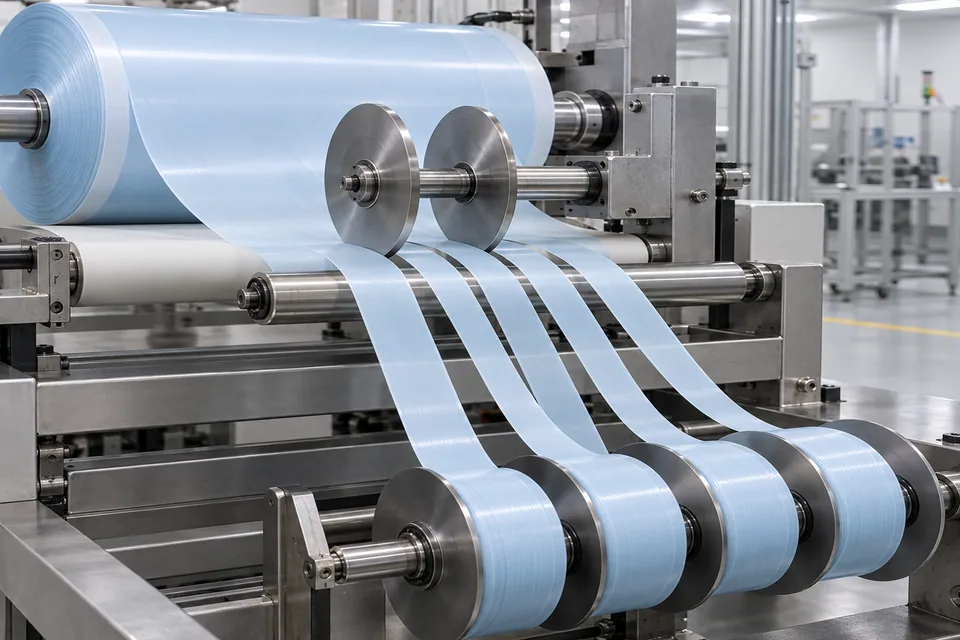
Nanofiltration flat sheet may be a thin-film composite membrane supplied as a roll for element fabrication. A DuPont NF flatsheet data sheet describes dry rolled stock and cutting into sections; other membrane grades can have different handling requirements. Shear slitting divides the approved sheet lengthwise into narrower webs using paired rotary edges. The trial must protect the selective surface from scratches and particles while fully severing the support layer. Record the supplier grade, face orientation and storage condition before cutting. Flux or rejection cannot be inferred from a straight slit.
Updated
Where This Cutting Application Appears
Set lane width for the intended element
Use the spiral-wound or flat-cell layout to assign each useful lane and edge allowance. Mark active membrane face versus support and identify any area reserved for adhesive or sealing so the slit line does not consume useful area.
Protect the selective layer at the knives
Inspect support and guide surfaces before bringing a dry roll to the shear pair. Trial actual stock with measured knife overlap and clearance; check whether the support fabric pulls or an active coating is marked near the rotary nip.
Inspect both layers at the edge
Measure lane width and straightness, then view each slit for coating lift, support-fiber tails, curling or loose particles. Compare both faces against an untouched control from the same roll.
Preserve stock until element assembly
Follow the membrane supplier’s packaging and storage instructions. Recheck the wound lanes after handling, because a clean knife-exit edge can be scratched or contaminated at a guide or during rewinding.
Define the Required Cut Result
- Produce lane widths required by the element design.
- Avoid scratches and particles on the active face.
- Fully separate backing and coating without delamination.
- Keep membrane identity and orientation through collection.
Problems to Diagnose Before Changing the Knife
Support fibers remain across the slit
- Inspect lower and upper rotary edges.
- Check the actual composite thickness and backing.
- Compare cut support at that lane.
Active face has a new scratch
- Locate its first appearance.
- Inspect guides and separator contact.
- Compare to uncut stock.
Lane curls at the edge
- Check tension and knife engagement.
- Measure after conditioning or relaxation specified by supplier.
- Inspect coating and backing asymmetry.
Knife Forms That May Be Considered
| Possible knife form | When it may be considered | What must be confirmed |
|---|---|---|
| Matched rotary shear knife pair | Only where the supplied NF roll and line allow a continuous supported cut. | Confirm width, coating and support edge on actual stock. |
| Outside-edge trim pair | Where a sacrificial parent-roll margin is removed. | Confirm useful active area and trim takeoff remain intact. |
Information to Send for Technical Review
You do not need to know the exact blade name. Send the available workpiece, machine, current-knife and cut-result information so the application can be reviewed against a drawing or sample.
- NF supplier and grade
- Active-face and support orientation
- Dry or wet shipping/handling condition
- Parent roll and element lane drawing
- Allowed scratch, particle and edge defects
- Knife, spacer and guide drawings
- Storage and rewinding plan
- Buyer post-conversion integrity and filtration test
Questions About This Cutting Application
Is an NF flatsheet a single plastic layer?
Often no. Supplier examples are thin-film composites; inspect the active layer and support separately.
Can a slitter set membrane rejection?
No. Rejection and flux are measured on the material or fabricated element using specified tests.
What should be checked at a slit edge?
Look for support fibers, coating lift, curl and contamination on the active face.
Does the roll always arrive wet?
No. DuPont describes a dry NF rolled flatsheet; follow the actual supplier’s storage instructions.
What information is needed first?
Provide the exact membrane grade, face orientation, element layout and approved edge samples.
Public references and scope
These public sources provide material, cutting-method or safety context for this guide. Supplier pages describe their own materials or equipment; they do not establish a MEIRENTE blade specification or performance claim. Confirm the actual grade, machine setup and required cut with a drawing or sample.
Related product and service information
- Aerospace Structural Adhesive Film Cut To Size Blades - aerospace structural adhesive film · cut to size
- Electrodialysis Spacer Mesh Shear Slitting Blades - electrodialysis spacer mesh · shear slitting
- Ceramic Membrane Support Green Sheet Cross-Cutting Blades - ceramic membrane support green sheet · transverse cutting
Request a Custom Cutting-Knife Review
Send the workpiece details, machine or holder information, current knife photos or sample, required quantity and examples of the present cut problem. Final dimensions, material, edge geometry and tolerances are confirmed from the approved requirements.