
Blade Application Guides / Application Guide / Technical textile and fastener converting
Hook-and-Loop Fastener Tape Slitting Blades
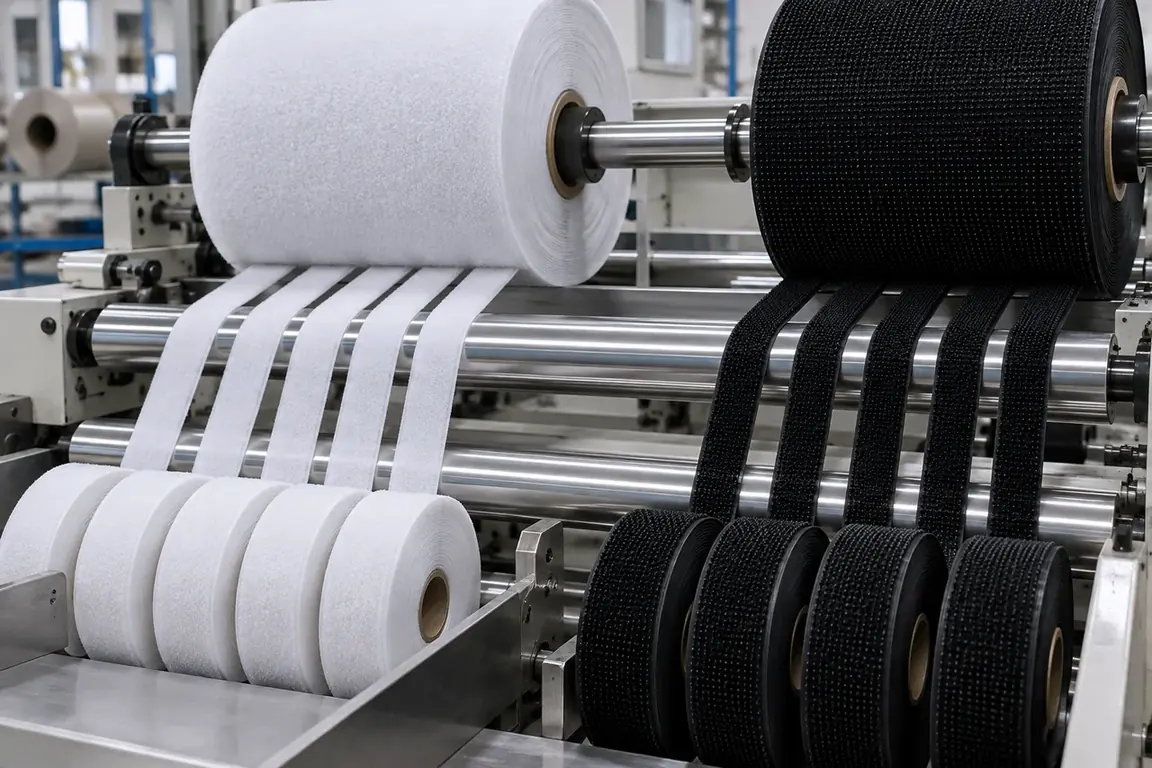
Hook-and-loop fastener tape slitting blades convert wider woven, knitted, nonwoven or molded-hook rolls into specified widths and shapes. Backing, pile direction, hook geometry, binder coat and optional adhesive affect separation. Review should define the cut side, orientation, finished edge, adhesive and liner arrangement, winding and machine interface.
Updated
Where This Cutting Application Appears
Woven and knitted loop tape slitting
Wide loop-material rolls are converted while controlling backing fray and pile disturbance.
Molded hook roll conversion
Engineered hook material is slit without unacceptable edge crushing.
Adhesive-backed fastener shapes
Laminated material is slit or profiled while liner and adhesive remain usable.
Slitting, Slit-Winding And Rotary Die-Cutting process boundary
Slitting, slit-winding and rotary die-cutting for Woven, knitted or molded hook-and-loop fastener rolls is a linked sequence: the output condition and datum from each operation become the controlled input for the next. It should not be evaluated as one generic cut or accepted only by the final dimension.
Slitting, Slit-Winding And Rotary Die-Cutting setup checkpoint
For Woven, knitted or molded hook-and-loop fastener rolls, define the operation order, intermediate dimensions, registration transfer, material support, web or part handling and waste route for every stage of Slitting, slit-winding and rotary die-cutting.
Slitting, Slit-Winding And Rotary Die-Cutting acceptance checkpoint
Verify both intermediate and final results from Slitting, slit-winding and rotary die-cutting, including dimensions, registration, edge or feature quality, material damage, waste separation and stable transfer between stages.
Define the Required Cut Result
- Consistent width and straight roll edges.
- Controlled backing separation without loose yarns or delamination.
- Preserved hook or loop function beside the edge.
- Clean adhesive edges and stable winding without blocking.
Problems to Diagnose Before Changing the Knife
Woven or knitted backing frays
- Identify fiber, structure, binder and feed direction.
- Compare both edges from the same slit.
- Determine whether fraying starts at cutting, winding or later handling.
Molded hooks are crushed near the edge
- Document hook orientation and functional keep-out area.
- Inspect support and contact near the hook surface.
- Compare engagement of accepted and rejected samples.
Adhesive contaminates edges or components
- Map adhesive coverage, liner and edge setback.
- Record buildup interval and material temperature.
- Review cleaning and waste path with production material.
Narrow rolls telescope or vary in width
- Measure width and face alignment along rolls.
- Review guiding, tension, core alignment and support.
- Check whether pile compression changes apparent width.
Knife Forms That May Be Considered
| Possible knife form | When it may be considered | What must be confirmed |
|---|---|---|
| Rotary shear slitting arrangement | For continuous width conversion of supported fastener webs. | Backing, surface orientation, shafts, overlap, slit plan and accepted edge. |
| Supported score-cutting arrangement | For compatible material and machines separating against a support roll. | Support hardness, web construction, adhesive stack, holder loading and edge. |
| Rotary profile die-cutting arrangement | For repeated fastener patches rather than continuous rolls. | Profile, orientation, liner result, hook keep-out, waste removal and interface. |
Information to Send for Technical Review
You do not need to know the exact blade name. Send the available workpiece, machine, current-knife and cut-result information so the application can be reviewed against a drawing or sample.
- Hook, loop or combined construction and production rolls.
- Fiber or polymer, backing, binder and surface direction.
- Adhesive, lamination and release-liner arrangement.
- Parent width, finished widths, slit layout and feed direction.
- Machine model, holders, shafts and supports.
- Core, winding and downstream requirements.
- Accepted and rejected samples showing defects.
- Functional inspection, production expectation and trial quantity.
Questions About This Cutting Application
Why identify hook tape and loop tape separately?
Surface geometry and backing can behave differently during support and cutting.
How should molded-hook edge damage be assessed?
Define the functional zone and use the approved engagement test.
Can coated and uncoated tape use the same setup?
Not automatically; adhesive, liner, buildup and winding must be reviewed.
What helps diagnose fraying?
Provide construction, feed direction, paired slit edges and later-handling samples.
Is finished width enough to specify the blade?
No; construction, interface, support, slit layout and edge standard are needed.
Related product and service information
- Aerogel Insulation Blanket Cut To Size Blades - aerogel insulation blanket · cut to size
- Coated Paper Sheet Trimming Without Surface Damage - coated paper sheets · sheet trimming
- Tissue Log Cross Cutting and Compression Control - tissue logs · cross cutting
Request a Custom Cutting-Knife Review
Send the workpiece details, machine or holder information, current knife photos or sample, required quantity and examples of the present cut problem. Final dimensions, material, edge geometry and tolerances are confirmed from the approved requirements.