
Blade Application Guides / Application Guide / Composite manufacturing
Glass Fiber Epoxy Prepreg Cut-To-Size Blades
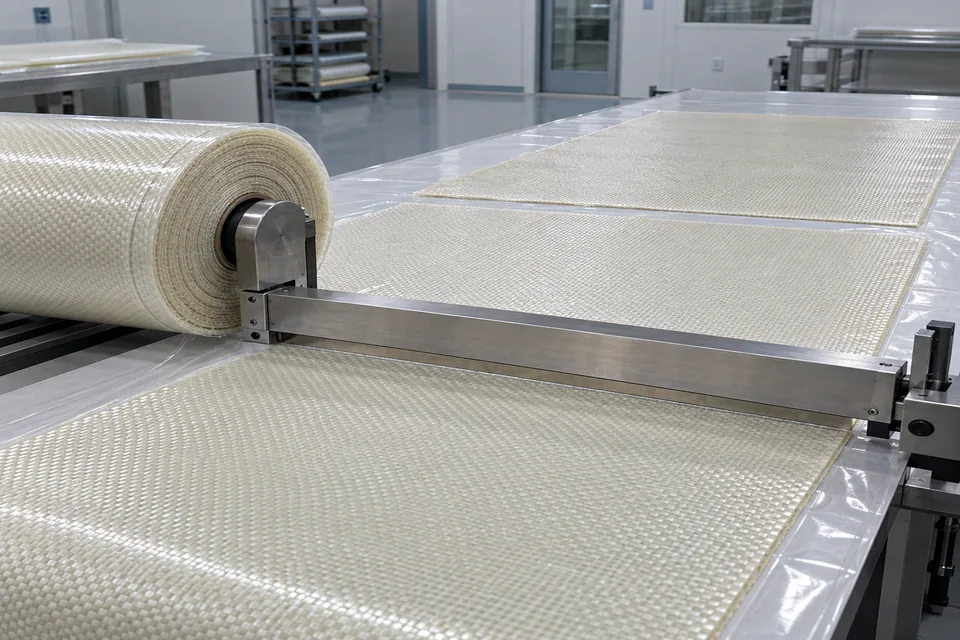
Hexcel supplies epoxy prepregs reinforced with woven, multiaxial and unidirectional glass fibers, including materials for wind blade manufacture. Eastman identifies cutting of glass prepreg as an established composite-converting task. Cut to size here means a first straight-edged blank from wider uncured broadgoods, leaving any curved or angled final ply outline for a later process. Grade, fiber architecture, resin tack and liner construction belong to the supplier’s actual delivered roll; no generic cutter setting can be promised.
Updated
Where This Cutting Application Appears
Choose a blank from the ply plan
Read the laminate schedule for fabric axis, ply dimensions and handling margin. A woven glass grade may need a warp/fill reference while a unidirectional grade needs an explicit fiber direction. Nest rectangular blanks so the later contour station can find the required final plies. Identify whether a resin film, peel ply or release liner must stay with each blank until layup.
Cut the actual prepreg stack
Support the material across its width and trial straight cuts on the delivered resin/fiber/liner construction. Excess pressure can squeeze resin at the edge; insufficient engagement leaves glass-fiber bridges that tear during lift. Compare cutting with the principal fiber axis and across it if both directions occur in the blank layout. Handle under the buyer’s material-control procedure, without inventing out-time or temperature limits.
Inspect all four blank edges
Measure length, width and squareness after the blank lies flat. Look for glass fuzz, displaced yarns, resin smear, liner damage and corner delamination. A clean-looking resin edge may conceal an unsevered glass tow underneath, so inspect both faces and the waste. Record the material orientation mark before stacking with other plies.
Kit for later ply cutting
Keep grade, lot and orientation with each blank. Protect release surfaces from dust and avoid creating folds during storage or transport. The composite maker still performs final contour cutting, layup and cure acceptance. A sized blank meets an intermediate dimensional requirement only; it does not establish laminate strength.
Use a representative first-article test
Send one accepted blank through the buyer’s later nesting or layup preparation. Confirm that the blank provides enough edge stock at the most constrained ply without forcing a fiber-axis rotation. Record whether the liner can be removed cleanly after the sizing cut. Recheck corner defects after handling, since fiber bridges can appear only when the piece is lifted. Freeze tool selection only after this downstream trial is reviewed.
Define the Required Cut Result
- Make rectangular glass/epoxy prepreg stock for later ply shapes.
- Sever glass yarns and resin cleanly without weave shift.
- Preserve liner and fiber orientation.
- Maintain uncured-material traceability.
Problems to Diagnose Before Changing the Knife
Glass fibers bridge at the underside
- Inspect both faces and sacrificial waste.
- Review blade edge and bed support.
- Compare cuts along and across reinforcement.
Resin beads along a cut edge
- Check pressure and tool buildup.
- Review handling state under supplier instructions.
- Inspect stacked blanks for sticking.
Knife Forms That May Be Considered
| Possible knife form | When it may be considered | What must be confirmed |
|---|---|---|
| Supported straight cutter | For flat roll-to-blank sizing on the qualified prepreg. | Confirm full-stack severance and square dimensions. |
| Guided cross-web round knife | For straight end cutting after a trial on the actual glass prepreg stack. | Verify full-width severance without resin pull or fiber distortion. |
Information to Send for Technical Review
You do not need to know the exact blade name. Send the available workpiece, machine, current-knife and cut-result information so the application can be reviewed against a drawing or sample.
- Exact glass/epoxy grade and fiber architecture
- Liner or peel-ply construction
- Blank schedule, fiber axis and final nest allowance
- Material-control procedure
- Fiber-tail, resin-smear and dimensional criteria
Questions About This Cutting Application
Does cut to size finish the ply?
No. It creates a simple blank; the final ply contour is a later operation.
Can woven and UD glass use the same orientation rule?
No. The laminate drawing defines the relevant fiber axis for each architecture.
What happens if fibers bridge?
Lifting the blank can pull yarns and distort the edge.
Does a clean blank prove cured strength?
No. Layup and cure performance require separate qualification.
Public references and scope
These public sources provide material, cutting-method or safety context for this guide. Supplier pages describe their own materials or equipment; they do not establish a MEIRENTE blade specification or performance claim. Confirm the actual grade, machine setup and required cut with a drawing or sample.
Related product and service information
- Membrane-Switch Spacer Film Cross-Cutting Blades - membrane-switch spacer film · cross cutting
- Carbon Fiber Epoxy Prepreg Cut-To-Size Blades - carbon fiber epoxy prepreg · cut to size
- Silicone Rubber Sheet Cut To Size Blades - silicone rubber sheet · cut to size
Request a Custom Cutting-Knife Review
Send the workpiece details, machine or holder information, current knife photos or sample, required quantity and examples of the present cut problem. Final dimensions, material, edge geometry and tolerances are confirmed from the approved requirements.