
Blade Application Guides / Application Guide / Printed electronics
Membrane-Switch Spacer Film Cross-Cutting Blades
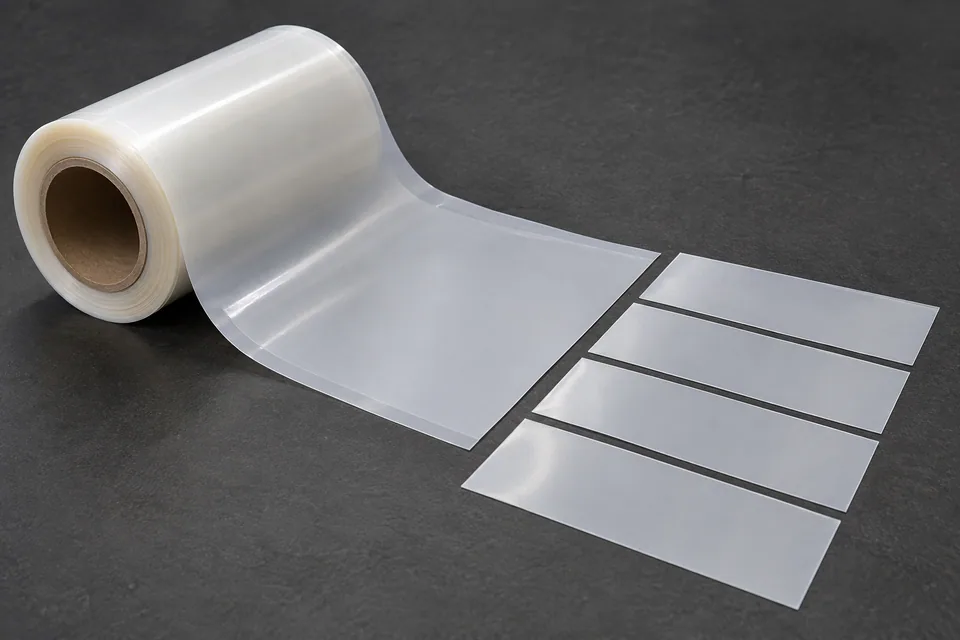
Membrane-switch spacer material can be a polyester carrier coated with adhesive and protected by one or two liners. A 3M roll-format example specifies PET carrier, acrylic adhesive and double paper liners; another buyer grade may differ. Cross cutting makes rectangular lengths from roll stock for later switch-part processing. It does not form the switch aperture or the finished circuit spacer. Trial the actual layer stack, identify which liner remains on each cut sheet and inspect adhesive at the transverse ends. Switch actuation and bond life require downstream qualification.
Updated
Where This Cutting Application Appears
Define sheet length and liner state
Set the cut length from the downstream die or print layout, including handling margin. Mark the primary liner and any face orientation so a cross-cut sheet enters the next process consistently.
Support every layer during the stroke
Observe whether the cross knife parts both liners, adhesive and polyester carrier cleanly. A soft adhesive may string or transfer to the blade; compare first and later cuts and note how buildup changes the cut end.
Inspect the usable rectangle
Measure length and squareness after lay-flat recovery. Examine each transverse edge for liner fracture, adhesive ooze, exposed tack and paper fiber transfer; check that the PET carrier is fully severed.
Simulate downstream handling
Stack and transfer sheets as the buyer will before a later die-cut. If a liner lifts or tunnels after collection, trace whether cross-cut contact or storage condition caused it. Do not infer switch function from flat-sheet appearance.
Define the Required Cut Result
- Deliver the planned sheet length and squareness.
- Keep required liners attached and intact.
- Limit adhesive strings and contaminated ends.
- Preserve orientation for later aperture cutting.
Problems to Diagnose Before Changing the Knife
Adhesive accumulates on the cross knife
- Compare cut ends over successive strokes.
- Inspect blade cleaning and temperature.
- Check whether the liner is supporting the adhesive.
One liner splits or tunnels
- Check blade penetration and anvil contact.
- Review takeoff and stacking bends.
- Compare liner condition before cutting.
Sheet is out of square
- Inspect registration and hold-down across web.
- Check cross-knife alignment.
- Measure after the sheet lies flat.
Knife Forms That May Be Considered
| Possible knife form | When it may be considered | What must be confirmed |
|---|---|---|
| Supported transverse knife | For roll-to-sheet sizing of a spacer laminate. | Confirm all required layers separate without ooze or liner tearing. |
| Indexed cross-cut module | Where repeated sheet lengths feed a later die cutter. | Confirm pitch, squareness and liner orientation across a run. |
Information to Send for Technical Review
You do not need to know the exact blade name. Send the available workpiece, machine, current-knife and cut-result information so the application can be reviewed against a drawing or sample.
- Exact spacer product and adhesive/carrier/liner stack
- Primary and secondary liner identification
- Roll width and target sheet length
- Later die-layout margin
- Accepted adhesive-ooze and paper-fiber samples
- Knife, anvil and indexing drawings
- Stacking and storage condition
- Buyer final switch qualification plan
Questions About This Cutting Application
Does cross cutting create switch apertures?
No. It sizes the spacer roll into rectangular sheets; aperture or profile die cutting is a later operation.
Why identify both liners?
One liner may remain with the part during later processing, so a premature split can spoil assembly.
What is checked at a transverse end?
Look for adhesive ooze, PET bridges, split liner and paper fiber transfer.
Can a neat sheet prove switch life?
No. Bond integrity and actuation performance belong to the finished switch qualification.
Which sample should be trialed?
Use the actual spacer laminate with its production liners, not bare polyester film.
Public references and scope
These public sources provide material, cutting-method or safety context for this guide. Supplier pages describe their own materials or equipment; they do not establish a MEIRENTE blade specification or performance claim. Confirm the actual grade, machine setup and required cut with a drawing or sample.
Related product and service information
- Membrane-Switch Spacer Film Rotary Die-Cutting Blades - membrane-switch spacer film · rotary die cutting
- RFID Aluminum Antenna Laminate Cross-Cutting Blades - RFID aluminum antenna laminate · cross cutting
- Printed Battery Current-Collector Film Cross-Cutting Blades - printed battery current-collector film · cross cutting
Request a Custom Cutting-Knife Review
Send the workpiece details, machine or holder information, current knife photos or sample, required quantity and examples of the present cut problem. Final dimensions, material, edge geometry and tolerances are confirmed from the approved requirements.