
Blade Application Guides / Application Guide / Paperboard converting
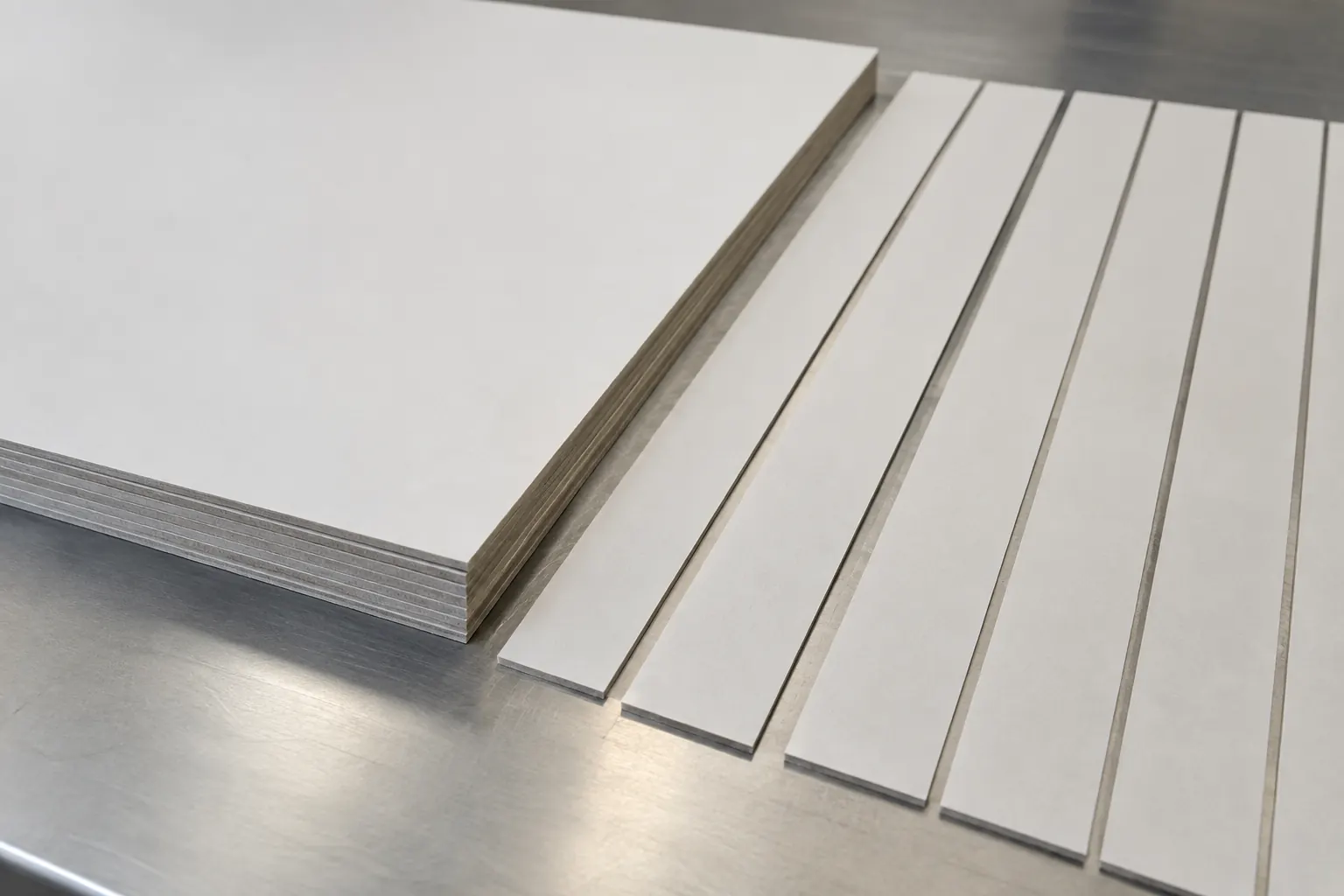
Folding Boxboard Sheet Slitting: Square Edges and Coating Protection
Folding boxboard combines multiple fiber layers with a printable coated face, creating different failure modes through its thickness. Sheet slitting must control coating flake, fiber burr, ply separation and dimensional accuracy so the resulting strips feed reliably into printing, creasing or blanking.
Updated
Where This Cutting Application Appears
Folding-carton blank preparation
Large board sheets are slit into strip or press widths before printing, creasing and profile blanking.
Sleeve and insert conversion
Coated paperboard strips are prepared for sleeves, dividers and structural packaging components.
Short-run board sizing
Stock sheets are width-adjusted for prototype, digital-print or specialty converting jobs with limited quantities.
Sheet Slitting process boundary
Sheet slitting divides sheet stock along parallel longitudinal lines to create strips; it is not final rectangular sizing or a shaped profile cut.
Sheet Slitting setup checkpoint
Confirm sheet support, parallel guide references, blade-line spacing and how narrow strips leave the cutting zone without rotating or overlapping.
Sheet Slitting acceptance checkpoint
Inspect strip width at several positions, edge straightness, surface marking and whether the strips remain flat enough for the next operation.
Define the Required Cut Result
- Control coating flakes and fiber burr through all plies
- Prevent delamination at the slit edge
- Hold strip width, parallelism and squareness
- Protect printable faces from pressure marks and scratches
Problems to Diagnose Before Changing the Knife
Fiber burr projects from the reverse side
Review board furnish, ply orientation, moisture, support, cutting direction, clearance or overlap and edge condition on both faces.
Coated face chips beside the slit
Compare coating strength, score or print layers, board bending at separation, contact pressure and sharp changes in cutting load.
Plies separate near the edge
Check interply bond, moisture, board storage, compression, support, cut direction and whether delamination predates slitting.
Strip width tapers along the sheet
Review sheet alignment, guide datum, holder parallelism, side movement, sheet squareness and the measurement procedure.
Knife Forms That May Be Considered
| Possible knife form | When it may be considered | What must be confirmed |
|---|---|---|
| Paired circular sheet slitting | Consider where flat boxboard sheets pass through matched rotary slitters. | Confirm diameters, bores, thicknesses, overlap, side force, feed direction and holder dimensions from the installed equipment. |
| Straight shear slitting | Consider where the sheet is divided by a linear shearing action with full-width support. | Confirm blade length, mounting, clearance, rake, hold-down and board range from machine documentation and trials. |
Information to Send for Technical Review
You do not need to know the exact blade name. Send the available workpiece, machine, current-knife and cut-result information so the application can be reviewed against a drawing or sample.
- Folding boxboard grade, basis weight, caliper and ply construction
- Coated side, print, varnish, moisture and grain direction
- Incoming sheet size, target strip widths and tolerances
- Feed direction, speed, lane count and sheet-alignment method
- Support, hold-down and finished-strip delivery arrangement
- Existing slitting action, holders and verified dimensions
- Coating chips, burrs, delamination and accepted edge samples
- Downstream printing, creasing, blanking and inspection needs
Questions About This Cutting Application
Why do the coated and reverse edges look different?
The coated face and fibrous reverse have different fracture behavior, while board plies and cut direction influence where burrs or chips emerge.
Can slitting cause folding boxboard delamination?
It can expose or extend weak interply bonding, but incoming board condition, moisture and storage should be checked before assigning the cause.
How should sheet-strip width be inspected?
Measure at defined positions along multiple strips, including parallelism and the incoming sheet datum, using conditioned samples.
Does grain direction matter for later creasing?
Yes. Slit orientation can change the grain relationship to folds and creases, so downstream carton geometry should be provided.
Can final knife dimensions be inferred from board thickness?
No. Board thickness informs the review, but actual equipment interfaces, support, motion, tolerances and approved drawings control dimensions.
Related product and service information
- Liquid Packaging Board Edge-Trimming Blades - liquid packaging board · edge trimming
- Solid Bleached Sulfate Board Sheet-Slitting Blades - solid bleached sulfate board · sheet slitting
- Folding Boxboard Profile Cutting: Clean Carton Shapes and Creases - folding boxboard · profile cutting
Request a Custom Cutting-Knife Review
Send the workpiece details, machine or holder information, current knife photos or sample, required quantity and examples of the present cut problem. Final dimensions, material, edge geometry and tolerances are confirmed from the approved requirements.