
Blade Application Guides / Application Guide / Paperboard converting
Folding Boxboard Profile Cutting: Clean Carton Shapes and Creases
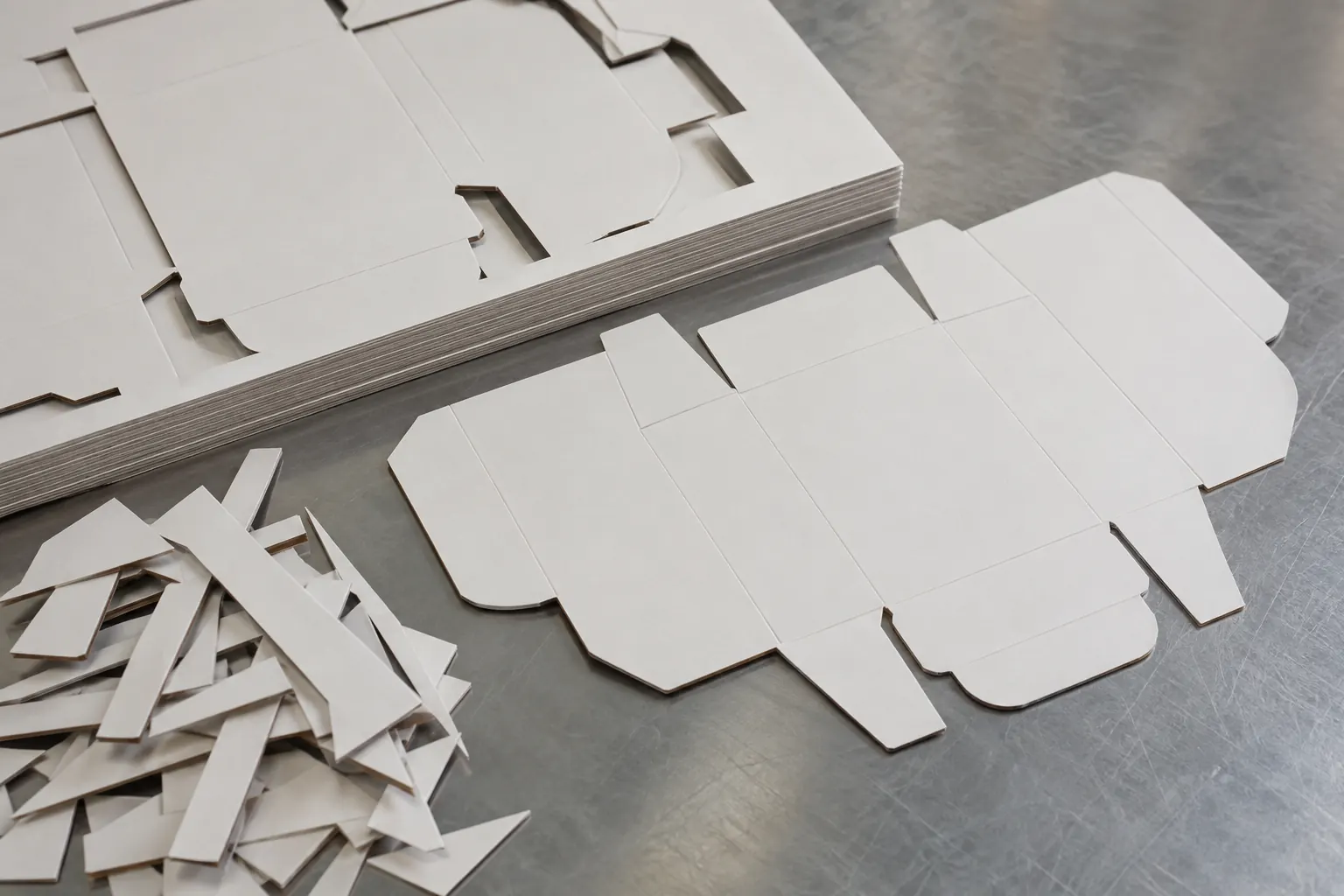
Profile cutting folding boxboard creates carton outlines, windows, slots and related features in a coated multilayer sheet. Cut completion, edge appearance, crease relationship and print registration must be evaluated together because excessive pressure can crush plies while insufficient separation leaves fiber bridges.
Updated
Where This Cutting Application Appears
Folding-carton blanks
Printed board is cut into carton outlines with tabs, slots and windows aligned to creases and graphics.
Sleeves and promotional packs
Repeated coated-board profiles are produced for wraps, sleeves and display packaging with visible edge requirements.
Paperboard inserts and carriers
Structural inserts, dividers and product carriers are cut with holes and retaining features for later folding or assembly.
Profile Cutting process boundary
Profile cutting follows the specified finished outline, including shaped or non-rectangular boundaries; it is distinct from straight sizing and narrow edge cleanup.
Profile Cutting setup checkpoint
Review the finished outline, inside and outside radii, start and stop points, material support near corners and the method used to remove shaped waste.
Profile Cutting acceptance checkpoint
Compare the complete profile to the drawing or template, including corners, holes, narrow features, edge condition and fit in the downstream assembly.
Define the Required Cut Result
- Complete carton outlines, slots and windows without bridges
- Limit coating chips, reverse burr and ply crushing
- Maintain cut-to-print and cut-to-crease registration
- Strip waste without tearing tabs or deforming blanks
Problems to Diagnose Before Changing the Knife
Fiber bridges remain in windows or slots
Check board caliper and density, support, pressure uniformity, feature width, grain direction and repeating tooling positions.
Coated face cracks around tight curves
Review coating strength, curve radius, board moisture, cut progression, print layers and support at the profile.
Tabs delaminate during waste stripping
Evaluate interply bond, tab geometry, grain, stripping direction, bridge layout, speed and handling after separation.
Cut and crease move relative to print
Measure artwork repeat, print marks, feed traction, material positioning, cutting timing and the relationship between profile and creasing operations.
Knife Forms That May Be Considered
| Possible knife form | When it may be considered | What must be confirmed |
|---|---|---|
| Rotary profile-cutting form | Consider where repeated folding-carton outlines are produced on compatible rotary converting equipment. | Confirm blank CAD, repeat, cylinder interface, board range, support and registration from approved production data. |
| Flatbed profile-cutting form | Consider where sheets are positioned and profile cut by a compatible platen or reciprocating process. | Confirm tooling interface, support, stripping arrangement, cutting sequence and board range from the actual equipment and approved trials. |
Information to Send for Technical Review
You do not need to know the exact blade name. Send the available workpiece, machine, current-knife and cut-result information so the application can be reviewed against a drawing or sample.
- Folding boxboard grade, caliper, plies, grain and moisture
- Coating, ink, varnish, laminate and surface requirements
- Carton CAD, slot widths, windows, radii, repeat and tolerances
- Print and crease datums with allowable registration deviation
- Feed direction, speed, tension and sheet or web format
- Installed profile-cutting interface, support, pressure and creasing arrangement
- Accepted blanks, fiber bridges, chips and delaminated tabs
- Waste stripping, folding, gluing and package-test requirements
Questions About This Cutting Application
Why do small boxboard windows retain fiber bridges?
Feature size, board plies, local support, pressure uniformity and debris clearance affect completion. Repeating positions can indicate a tooling pattern.
Can excessive pressure damage carton performance?
Yes. It may crush plies, mark coatings or weaken tabs and crease areas. Acceptance should include folding and package function, not only separation.
How is cut-to-crease registration checked?
Measure both features from a shared datum across multiple repeats and operating states, then fold representative blanks to confirm function.
Why can waste stripping delaminate tabs?
High stripping load across weak interply bonds, narrow tabs or unfavorable grain can peel layers. Matrix design and stripping direction need review.
Is carton CAD enough to manufacture the profile-cutting form?
No. Repeat, machine interface, support, board construction, print and crease references, speed and approved tolerances are also required.
Related product and service information
- Folding Boxboard Sheet Slitting: Square Edges and Coating Protection - folding boxboard · sheet slitting
- Liquid Packaging Board Edge-Trimming Blades - liquid packaging board · edge trimming
- Recycled Grey Chipboard Edge-Trimming Blades - recycled grey chipboard · edge trimming
Request a Custom Cutting-Knife Review
Send the workpiece details, machine or holder information, current knife photos or sample, required quantity and examples of the present cut problem. Final dimensions, material, edge geometry and tolerances are confirmed from the approved requirements.