
Blade Application Guides / Application Guide / Adhesive tape converting
Duct Tape Jumbo Roll Slitting Blades
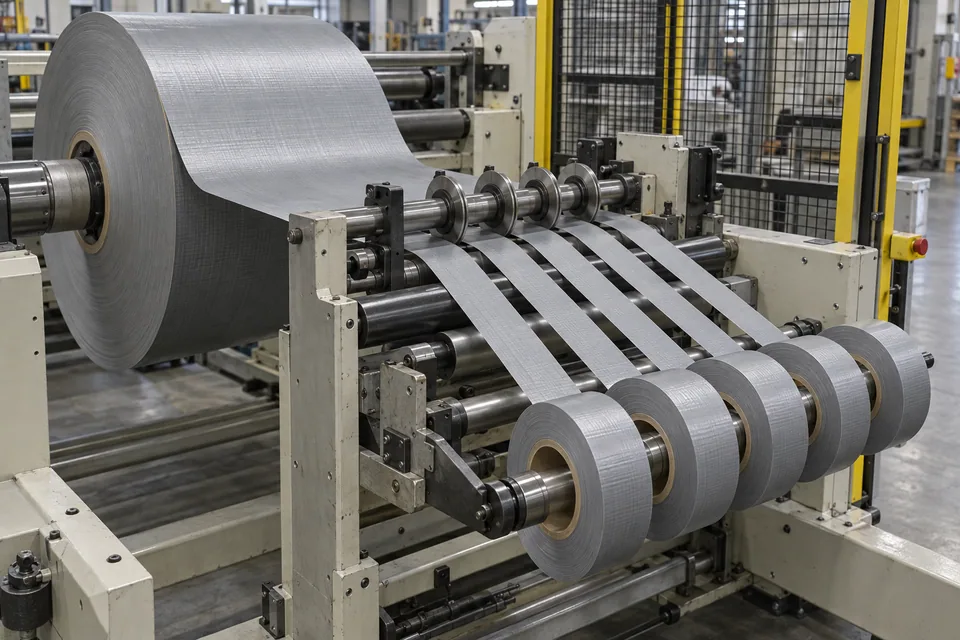
A duct-tape jumbo roll is wide coated stock awaiting width conversion. Romtech describes machines that unwind jumbo tape, slit it lengthwise and rewind narrower rolls, explicitly including duct tape. KEW also lists a duct-tape slitter rewinder. This operation cuts an unwound web; it does not chop a wound log across its face. Tesa describes different cloth and PVC backings, so one blade selection cannot cover every construction. The converter's roll, target widths and acceptance criteria must govern the trial.
Updated
Where This Cutting Application Appears
Identify the stock before setting the knife bank
Record the roll's backing, reinforcement, adhesive and any liner. A PE-laminated cloth grade and a PVC-backed grade may fail differently at the cut. Identify the adhesive side, roller contact path, splices and distorted parent-roll edges. Map finished widths and edge-trim waste before setting knife positions. If coating build varies across the width, sample from the actual production lot.
Trial a longitudinal cut under realistic web tension
Romtech offers razor, shear and crush configurations; 3M advises selecting the method from material properties and observed edges. Trial candidates on the specified tape. Compare backing separation, cloth fray, adhesive pickup and lane deflection. Hold web guidance, blade alignment and winding tension steady while comparing knives so that a winding defect is not mistaken for blade damage.
Inspect every retained lane and the scrap edge
After the web relaxes, examine both sides of each retained edge for projecting fibers, crushed backing, adhesive strings, debris and width variation. Check a narrow lane and a middle lane because support and winding conditions differ. An edge that looks clean at the cutter may block to the next wrap or show a rough band after rewind. Agree on sample length and inspection points before approving the setup.
Separate cut defects from roll-formation defects
3M distinguishes loose winding, telescoping and variable slit-edge quality. For telescoping, review tension and steering before changing knives. For fray on an otherwise square roll, inspect edge support, knife condition and cloth construction. Compare samples from early and late in the run: adhesive accumulating on a clean knife may gradually spoil the edge. Set a compatible cleaning practice if the line also handles other adhesives.
Release widths only after a rewind check
Measure widths, unwind a sample, and check for adhesive transfer or exposed fibers. Confirm core alignment and roll build. Record knife form, alignment, cleaning interval and the tape grade tested. Slitting acceptance establishes the agreed converted-roll condition; adhesion, weathering and end-use suitability require separate evaluation. Any blade-life or throughput expectation needs a buyer-line trial.
Define the Required Cut Result
- Convert the specified jumbo roll into narrower rewound rolls.
- Limit fray, backing distortion and adhesive transfer.
- Maintain lane tracking and acceptable roll build.
- Document the buyer-grade blade trial.
Problems to Diagnose Before Changing the Knife
Fibers project from the slit edge
- Compare actual backing with the trial sample.
- Inspect blade condition and engagement.
- Check both faces after rewind.
Adhesive builds on the knife or transfers to a neighboring roll
- Record adhesive side and contact path.
- Compare early and late run samples.
- Use a compatible knife-cleaning method.
Finished roll telescopes despite a visually clean cut
- Inspect steering and core alignment.
- Review winding tension history.
- Separate roll-build causes from knife condition.
Knife Forms That May Be Considered
| Possible knife form | When it may be considered | What must be confirmed |
|---|---|---|
| Razor slitting blade | Trial on a supported web; reject if the sample frays or strings adhesive. | Inspect both backing faces after rewind. |
| Shear slitting knife pair | Trial controlled scissor action on reinforced backing. | Set overlap and side load per line procedure; check fray and pickup. |
| Crush or score slitting wheel | Only if the tape tolerates compression without a raised edge. | Check debris, adhesive squeeze-out and test-unwind behavior. |
Information to Send for Technical Review
You do not need to know the exact blade name. Send the available workpiece, machine, current-knife and cut-result information so the application can be reviewed against a drawing or sample.
- Actual duct-tape backing, reinforcement, adhesive and liner construction
- Mother-roll width, winding direction, core and splice map
- Finished width plan and permitted edge-trim scrap
- Slitter geometry, anvil and web-guidance arrangement
- Edge appearance, debris, roll-build and test-unwind acceptance limits
Questions About This Cutting Application
Is this operation the same as cutting a wound tape log?
No. This guide concerns longitudinal cuts in an unwound jumbo web, followed by rewinding each lane.
Which knife form should be ordered for duct tape?
Choose after trials on the buyer's tape and line. Backing construction, adhesive tack and required edge condition affect the result.
Why inspect after rewinding if the open-web edge looks clean?
Roll build, telescoping, blocking or later adhesive transfer can appear only when the lane is wound and unwound.
Does a clean slit qualify the tape for its final application?
No. It confirms only the agreed converted-roll condition; adhesion and application suitability require separate evaluation.
Why check both outside and middle lanes?
A narrow outside lane may see different support and winding pressure from a central lane.
Public references and scope
These public sources provide material, cutting-method or safety context for this guide. Supplier pages describe their own materials or equipment; they do not establish a MEIRENTE blade specification or performance claim. Confirm the actual grade, machine setup and required cut with a drawing or sample.
Related product and service information
- Aluminum Foil Tape Rotary Die Cutting Blades - aluminum foil tape · rotary die cutting
- Single-Use Bioreactor Bag Film Roll Slitting Blades - single-use bioreactor bag film · roll slitting
- Virus-Filtration Membrane Roll Slitting Blades - virus-filtration membrane · roll slitting
Request a Custom Cutting-Knife Review
Send the workpiece details, machine or holder information, current knife photos or sample, required quantity and examples of the present cut problem. Final dimensions, material, edge geometry and tolerances are confirmed from the approved requirements.