
Blade Application Guides / Application Guide / Pharmaceutical packaging
Unit-Dose Powder Stick-Pack Film Rotary Die-Cutting Blades
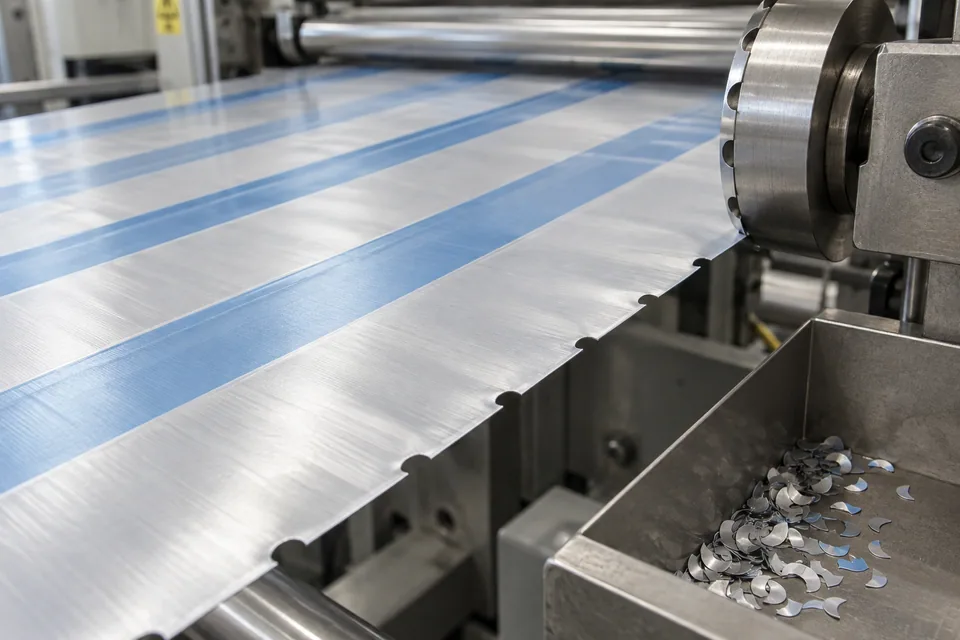
An unfilled powder stick-pack laminate may need a repeated tear-start feature or shaped web blank before form-fill-seal. Amcor identifies pharmaceutical stick-pack laminate formats, IMA identifies powder stick machinery, and RotoMetrics documents rotary dies for flexible packaging webs. Here rotary die cutting means a shaped repeat made against an anvil; it is not the longitudinal conversion of a wide web into lanes and does not imply cutting into filled doses. The buyer must show exactly where the future side and end seals lie, what layers the die may sever, and whether a notch, partial score or fully released blank is intended. A feature that opens easily but crosses a seal can spoil package integrity. Test the actual film and the eventual filled package separately.
Updated
Where This Cutting Application Appears
Define the intended opening feature
Supply a die line distinguishing complete cut, partial score and notch. Locate it against print, powder fill zone and vertical/horizontal seal lands. A one-sided tear starter may be appropriate only where the packaging owner permits it; do not add an opening to an approved pack design without a drawing revision.
Match cylinder repeat to pack pitch
Record repeat length, registration sensor, anvil surface and film tension. Compare die impression over multiple revolutions and from one web edge to the other. Check a printed production laminate rather than a blank surrogate because artwork and layer orientation affect acceptance.
Remove tiny cutouts before filling
Observe whether a notch slug or scrap web remains on adhesive/sealant, wraps around a roll or travels toward the powder contact path. Inspect all laminate layers for feathering, perforation beyond the intended depth and coating transfer onto the die.
Validate through finished-stick handling
Run trial film through forming, filling and sealing. Inspect opening force, tear path, seam continuity and leakage under the packaging owner’s method. The die trial supplies dimensional and visual cut evidence; it does not certify powder containment or dose stability.
Define the Required Cut Result
- Place the repeated feature at the approved print and seal position.
- Cut only specified layers without puncturing the future dose cavity.
- Eject all small slugs and keep sealant faces clean.
- Preserve traceable material for pack-maker opening and leak tests.
Problems to Diagnose Before Changing the Knife
Notch strays into a vertical seam
- Review web registration and die repeat.
- Check forming-tube lane placement.
- Compare cut location after production tension settles.
Score penetrates the barrier layer
- Inspect die-to-anvil pressure and high spots.
- Confirm correct laminate face and layer stack.
- Use the buyer’s backside/foil inspection method.
Slug remains on the film
- Check die ejection and static.
- Inspect sealant tack and cut completion.
- Trace downstream guides for scrap carryover.
Knife Forms That May Be Considered
| Possible knife form | When it may be considered | What must be confirmed |
|---|---|---|
| Engraved rotary profile die | For a fixed tear notch or shaped repeat on a compatible flexible-web die station. | Confirm cylinder repeat, anvil, feature position and slug route in machine drawings. |
| Flexible rotary die on matched cylinder | For a trialed repeated score or shallow opening feature if supported by the installed station. | Confirm layer-depth control and barrier preservation on production laminate. |
Information to Send for Technical Review
You do not need to know the exact blade name. Send the available workpiece, machine, current-knife and cut-result information so the application can be reviewed against a drawing or sample.
- Actual stick-pack laminate and face orientation
- Feature drawing: notch, score or full-cut shape
- Printed repeat and eye-mark tolerances from buyer
- Future fill zone and every seal land
- Rotary cylinder/anvil and registration drawings
- Layer-by-layer cut-depth instruction
- Slug or matrix collection design
- Buyer tear-opening and sealed-stick qualification method
Questions About This Cutting Application
Why specify unfilled film?
Cutting before filling avoids assuming a die may touch powder or a finished dose; station placement is buyer-specific.
Does a rotary die replace a slitter?
Not for continuous lane creation; the die produces repeated local features or blanks.
Can a tear feature touch a seal?
Only if the approved package design and validation allow it. The cut must follow the buyer seal drawing.
What is a hidden failure in a partial score?
It may nick the barrier layer or backside while looking acceptable from the print face.
What proves the feature works?
The packaging owner must test opening behavior and finished-pack integrity after forming and sealing.
Public references and scope
These public sources provide material, cutting-method or safety context for this guide. Supplier pages describe their own materials or equipment; they do not establish a MEIRENTE blade specification or performance claim. Confirm the actual grade, machine setup and required cut with a drawing or sample.
Related product and service information
- Unit-Dose Powder Stick-Pack Film Shear Slitting Blades - unit-dose powder stick-pack film · shear slitting
- Pharmaceutical Desiccant Lidding Film Rotary Die-Cutting Blades - pharmaceutical desiccant lidding film · rotary die cutting
- Suppository Strip-Pack Foil Rotary Die-Cutting Blades - suppository strip-pack foil · rotary die cutting
Request a Custom Cutting-Knife Review
Send the workpiece details, machine or holder information, current knife photos or sample, required quantity and examples of the present cut problem. Final dimensions, material, edge geometry and tolerances are confirmed from the approved requirements.