
Blade Application Guides / Application Guide / Printed electronics
Printed Heater PET Web Rotary Die-Cutting Blades
Rotary die cutting repeats a shaped heater outline along a moving printed PET web. The die may create tabs or openings as well as an outside perimeter; it is not the continuous lane-making operation of shear slitting. Printed heater examples use conductive, dielectric and resistive ink on PET, so the tool path must be registered to the actual circuit artwork. Trial the cured production stack with the buyer’s release liner and matrix plan. Inspect a released part for ink cracks, cut-through errors and face marks, then leave functional heater testing to the buyer.
Updated
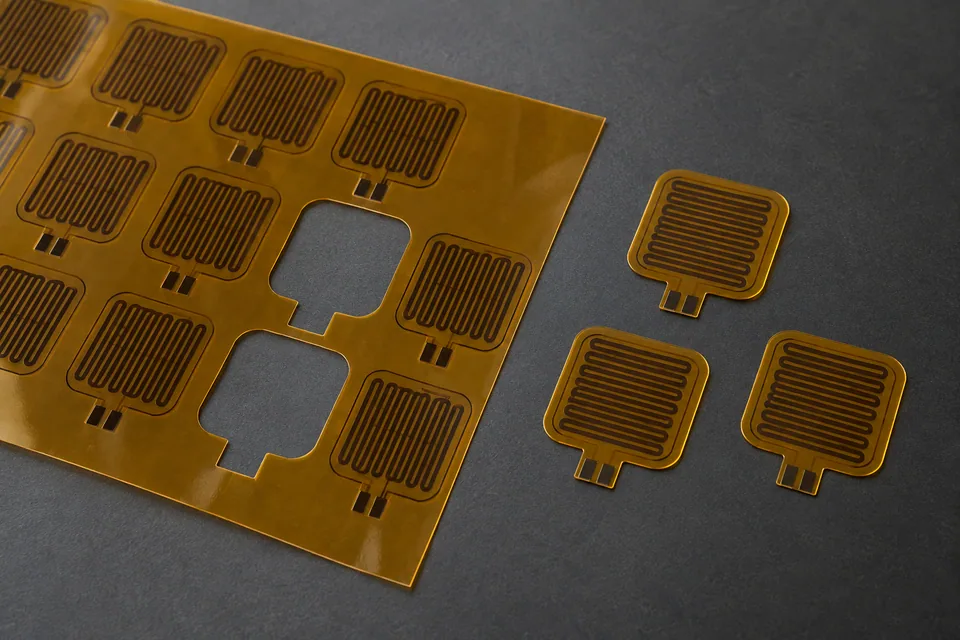
Where This Cutting Application Appears
Register every profile to the circuit
Use artwork datums to place the outer boundary, connector tab and internal cutouts. Specify the buyer’s keep-out around active conductor and dielectric regions; monitor print-to-die registration at startup and after the web reaches steady speed.
Choose through-cut or kiss-cut deliberately
Document which layers the rotary die must sever and whether a liner remains intact. Test die pressure on the actual printed stack because excess penetration can score a liner or cut a busbar, while incomplete penetration can leave attached PET bridges.
Check matrix and small waste removal
Observe stripping of the surrounding web and internal slugs. A printed pad can flex or peel when matrix tension is too high; keep released parts and waste pieces for comparison and inspect tabs for corner cracks.
Inspect electrical features after release
Measure profile, holes and print-to-edge distance on collected parts. Examine ink and PET faces for scuffing, cracks or lifted lines after winding or stacking, and compare buyer-specified continuity data with incoming web samples.
Define the Required Cut Result
- Match the repeated profile to the approved artwork.
- Sever intended layers while preserving any specified liner.
- Release matrix without tearing printed tabs.
- Keep circuit and dielectric areas clear of die damage.
Problems to Diagnose Before Changing the Knife
Die cuts through a conductor
- Check registration and artwork pitch.
- Inspect die dimensions and lateral wander.
- Review print-to-cut keep-out rule.
Parts remain in the matrix
- Check die penetration and anvil condition.
- Observe stripping angle and pressure.
- Inspect small corners for PET bridges.
Continuity changes after release
- Compare the same artwork position before and after cutting.
- Inspect ink cracks near tabs.
- Review matrix tension and collection contact.
Knife Forms That May Be Considered
| Possible knife form | When it may be considered | What must be confirmed |
|---|---|---|
| Rotary profile die | For registered repeated outlines on a compatible printed web. | Confirm die height, anvil, registration and smallest feature on actual stock. |
| Rotary kiss-cut die | Where the buyer requires part layers cut while a liner remains unbroken. | Confirm layer penetration and liner integrity in a sample trial. |
Information to Send for Technical Review
You do not need to know the exact blade name. Send the available workpiece, machine, current-knife and cut-result information so the application can be reviewed against a drawing or sample.
- Print artwork and die-line file
- PET grade, ink cure and any liner construction
- Connector-tab and active-track keep-out
- Repeat pitch and registration marks
- Rotary die and anvil drawings
- Matrix and slug discharge route
- Accepted edge and face defects
- Buyer electrical inspection method
Questions About This Cutting Application
What makes a rotary die trial different from slitting?
It creates repeated shaped parts with registered tabs and openings, so pitch and matrix release are central.
Should the liner be cut?
Only as the buyer drawing specifies. Through-cut and kiss-cut need different die settings and inspections.
Why keep the stripped matrix?
It reveals incomplete PET separation or excessive peel force that may damage a released heater.
Can the die-cut part be approved visually?
Visual and dimensional checks are necessary, but circuit function needs buyer electrical testing.
Which feature is the stress case?
Trial the smallest opening, sharpest tab and least print-to-edge clearance in the approved design.
Public references and scope
These public sources provide material, cutting-method or safety context for this guide. Supplier pages describe their own materials or equipment; they do not establish a MEIRENTE blade specification or performance claim. Confirm the actual grade, machine setup and required cut with a drawing or sample.
Related product and service information
- Printed Heater PET Web Shear Slitting Blades - printed heater PET web · shear slitting
- RFID Aluminum Antenna Laminate Rotary Die-Cutting Blades - RFID aluminum antenna laminate · rotary die cutting
- Printed Battery Current-Collector Film Rotary Die-Cutting Blades - printed battery current-collector film · rotary die cutting
Request a Custom Cutting-Knife Review
Send the workpiece details, machine or holder information, current knife photos or sample, required quantity and examples of the present cut problem. Final dimensions, material, edge geometry and tolerances are confirmed from the approved requirements.