
Blade Application Guides / Application Guide / Wind blade manufacturing
PET Structural Foam Core Cut-To-Size Blades
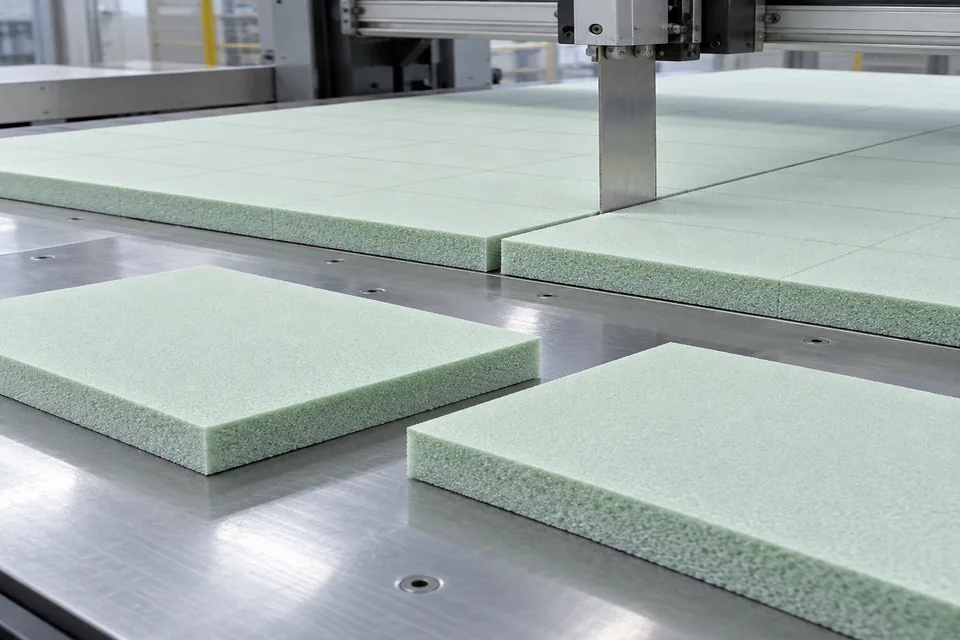
Armacell describes structural PET foam cores used in wind turbine blades; Gurit and Diab also identify PET core as a wind-blade sandwich material. That supports cutting larger PET foam sheets into identified stock blanks before profile shaping or local kit features. This guide does not concern thin PET film, although the polymer name is the same. Foam grade, density, cell structure, thickness and any grooves or perforations determine how a blade or saw should be trialed.
Updated
Where This Cutting Application Appears
Derive the stock rectangle from the blade kit
Use the shell or web core layout to choose length, width and orientation. Record the supplied foam grade and whether a skin, scrim, groove or perforation is already present. Leave only the buyer-approved allowance for later contouring or scarf preparation. A uniform rectangle can be the right intermediate part even though the final blade core is curved.
Fixture the compressible foam
Support the sheet near the cut line without flattening cells. Trial tool entry and exit at the thickest relevant stock and at any groove intersection. A saw or straight core cutter may create different dust and edge-cell damage; choose by actual coupon evidence, not by a universal PET setting. Keep the foam face free of oils or debris that could interfere with bonding.
Inspect edge-cell quality
Measure length, width, squareness and local thickness after release from the fixture. Look for crushed cells, torn skin, melted-looking smear from tool friction, loose foam crumbs and blocked infusion channels. Review the full cut depth. A top surface that looks sharp does not prove the sidewall and underside remain suitable for later core placement.
Hand off to kit and infusion teams
Label the blank with grade, lot and blade-kit position. Pack it so edges are not dented in transit. The laminate owner decides final profiling and resin-infusion acceptance; correct blank size alone says nothing about finished sandwich shear or fatigue behavior.
Trial the next core-making step
Ask the kitting group to use a sized coupon for the intended contour, groove or bonding preparation. Check whether the starting edge stays stable when the foam is lifted and positioned over a curved tool. If damage spreads from a cut cell into the retained core, revise support or tool approach. Retain an uncut control from the same sheet to distinguish incoming foam defects from sizing damage. Keep the trial coupon beside the production lot record so later kit damage can be separated from defects that were visible immediately after sizing.
Define the Required Cut Result
- Make rectangular PET foam stock for later blade-core kits.
- Avoid crushing or tearing cells through thickness.
- Keep grooves and bonding faces clean.
- Retain grade and blade-position identity.
Problems to Diagnose Before Changing the Knife
Cells collapse along the cut wall
- Check clamp pressure and underlay.
- Compare cut entry and exit.
- Inspect full thickness after release.
Foam crumbs lodge in grooves
- Review chip collection and tool wear.
- Inspect grooves before packing.
- Use only approved cleaning methods.
Knife Forms That May Be Considered
| Possible knife form | When it may be considered | What must be confirmed |
|---|---|---|
| Core-compatible straight blade | For supported sheet sizing after real-grade coupon trials. | Confirm full-depth sidewall and dimension. |
| Fine-tooth or approved saw tool | Where thick stock needs controlled stock removal. | Check crumbs, heat marks and cell crushing. |
Information to Send for Technical Review
You do not need to know the exact blade name. Send the available workpiece, machine, current-knife and cut-result information so the application can be reviewed against a drawing or sample.
- Exact PET foam grade and density
- Sheet thickness and any groove or scrim design
- Core-kit location and stock dimensions
- Bonding-face cleanliness requirement
- Cell damage and dust acceptance criteria
Questions About This Cutting Application
Is PET foam the same workpiece as PET film?
No. This is a thick cellular structural core.
Does this form the final wind-blade core?
It sizes stock; later profiling may still be required.
Why inspect full depth?
A damaged sidewall may be hidden beneath an acceptable top edge.
Can dimensional acceptance prove blade fatigue performance?
No. Completed sandwich structures require separate validation.
Public references and scope
These public sources provide material, cutting-method or safety context for this guide. Supplier pages describe their own materials or equipment; they do not establish a MEIRENTE blade specification or performance claim. Confirm the actual grade, machine setup and required cut with a drawing or sample.
Related product and service information
- Decorative Plywood Panel Cut To Size Blades - decorative plywood panel · cut to size
- End-Grain Balsa Core Sheet Cut-To-Size Blades - end-grain balsa core sheet · cut to size
- Silicone Rubber Sheet Cut To Size Blades - silicone rubber sheet · cut to size
Request a Custom Cutting-Knife Review
Send the workpiece details, machine or holder information, current knife photos or sample, required quantity and examples of the present cut problem. Final dimensions, material, edge geometry and tolerances are confirmed from the approved requirements.