
Blade Application Guides / Application Guide / Flexible packaging
Mono-Material PE Pouch Film Cross Cutting
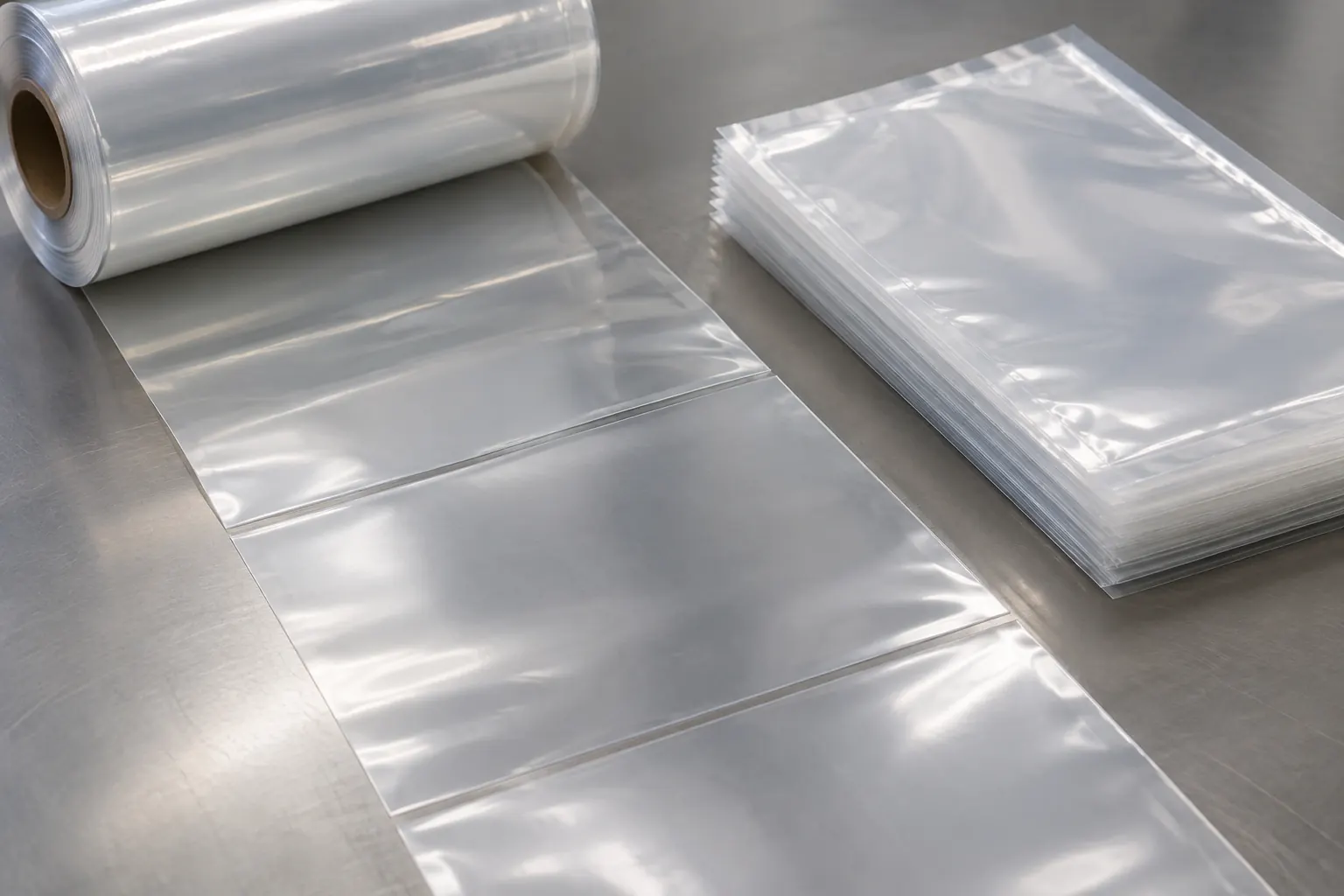
Transverse cutting of mono-material PE pouch film must stop a moving, extensible web at a defined repeat without pulling the cut line or distorting seal areas. The review should distinguish continuous web cross cutting from stacked-sheet guillotining and document print registration, web temperature, restraint and finished blank handling.
Updated
Where This Cutting Application Appears
Printed pouch blanks
Cut repeated all-PE web sections to registered lengths before forming or secondary conversion.
Sample and trial sheets
Prepare controlled sheets for sealing, print and barrier evaluation.
Lid or overwrap blanks
Cross cut flexible PE structures where flatness and dimension affect later placement.
Transverse Cross Cutting process boundary
Transverse cross cutting separates material across the web into sheets or repeated lengths; it is distinct from longitudinal roll slitting.
Transverse Cross Cutting setup checkpoint
Confirm repeat length, registration reference, web speed, cut timing, support across the width and sheet transfer immediately after separation.
Transverse Cross Cutting acceptance checkpoint
Measure repeat length and squareness, then inspect leading and trailing edges, registration error, sheet curl and stacking consistency.
Define the Required Cut Result
- Hold cutoff length and print-to-cut registration.
- Avoid drawn, hooked or wrinkled transverse edges.
- Protect seal zones from contamination and deformation.
- Control static and keep lightweight blanks separated.
Problems to Diagnose Before Changing the Knife
Cut length changes after relaxation
- Record web tension and temperature at cutoff.
- Measure immediately and after conditioning.
- Check draw between registration and cutting stations.
Transverse edge pulls into a curved line
- Review cross-web tension and support.
- Inspect cutting sequence across the width.
- Compare gauge profile and web tracking.
Printed repeat and cut position drift
- Check mark contrast and sensor datum.
- Record repeat variation and control response.
- Separate material stretch from timing error.
Sheets cling together or scatter
- Measure static and ambient humidity.
- Review discharge and collection method.
- Check surface treatment and slip package.
Knife Forms That May Be Considered
| Possible knife form | When it may be considered | What must be confirmed |
|---|---|---|
| Straight cross-cut knife arrangement | For lines that separate a moving web against a compatible counter-edge or support. | Confirm cut motion, rake, length, mounting, clearance, speed and web restraint from machine data. |
| Rotary cutoff arrangement | For repeated high-speed transverse separation on equipment designed around a rotary cutoff. | Confirm repeat range, cylinder interface, synchronization, web speed and approved drawing. |
Information to Send for Technical Review
You do not need to know the exact blade name. Send the available workpiece, machine, current-knife and cut-result information so the application can be reviewed against a drawing or sample.
- PE layer stack, gauge, orientation, coating and sealant construction
- Web width, target cutoff length and tolerance after relaxation
- Print repeat, eye-mark details and cut-to-print tolerance
- Line speed, tension, temperature and acceleration profile
- Cutting motion, support, holder drawings and existing sample
- Winding direction and which face contacts guides or collection surfaces
- Allowed edge draw, wrinkle, particles and seal-zone defects
- Blank collection method, downstream operation and production quantity
Questions About This Cutting Application
Why does a correct hot-web length become short later?
An extensible PE web can be measured while elongated. Define conditioning time and tension-free measurement for acceptance.
Is cross cutting the same as slitting?
No. Cross cutting separates across web travel and introduces different timing, restraint and registration requirements.
Can print marks eliminate all length error?
They correct registration only within the control system's capability; web stretch and repeat variation still matter.
Why do cut blanks stick together?
Static, surface treatment, tack, humidity and collection pressure can all contribute.
Which knife form is suitable?
That depends on whether the line uses straight, flying or rotary cutoff motion; the machine interface must confirm it.
Related product and service information
- Nylon Retort Pouch Film Rotary Die Cutting Blades: Tough-Layer Edge Control - nylon retort pouch film · rotary die cutting
- EVOH Barrier Film Laminate Cross Cutting Blades: Layer and Barrier Integrity - EVOH barrier film laminate · transverse cross cutting
- Metallized PET Packaging Film Cross Cutting Blades: Coating and Edge Protection - metallized PET packaging film · transverse cross cutting
Request a Custom Cutting-Knife Review
Send the workpiece details, machine or holder information, current knife photos or sample, required quantity and examples of the present cut problem. Final dimensions, material, edge geometry and tolerances are confirmed from the approved requirements.