
Blade Application Guides / Application Guide / Flexible packaging
EVOH Barrier Film Laminate Cross Cutting Blades: Layer and Barrier Integrity
An EVOH barrier film laminate uses a moisture-sensitive barrier layer within a multilayer structure selected for the package. Because layer thicknesses, tie layers and outer films vary by construction, cutting trials should focus on the supplied laminate, edge integrity and package performance instead of assuming a universal material response.
Where This Cutting Application Appears
High-barrier food pouches
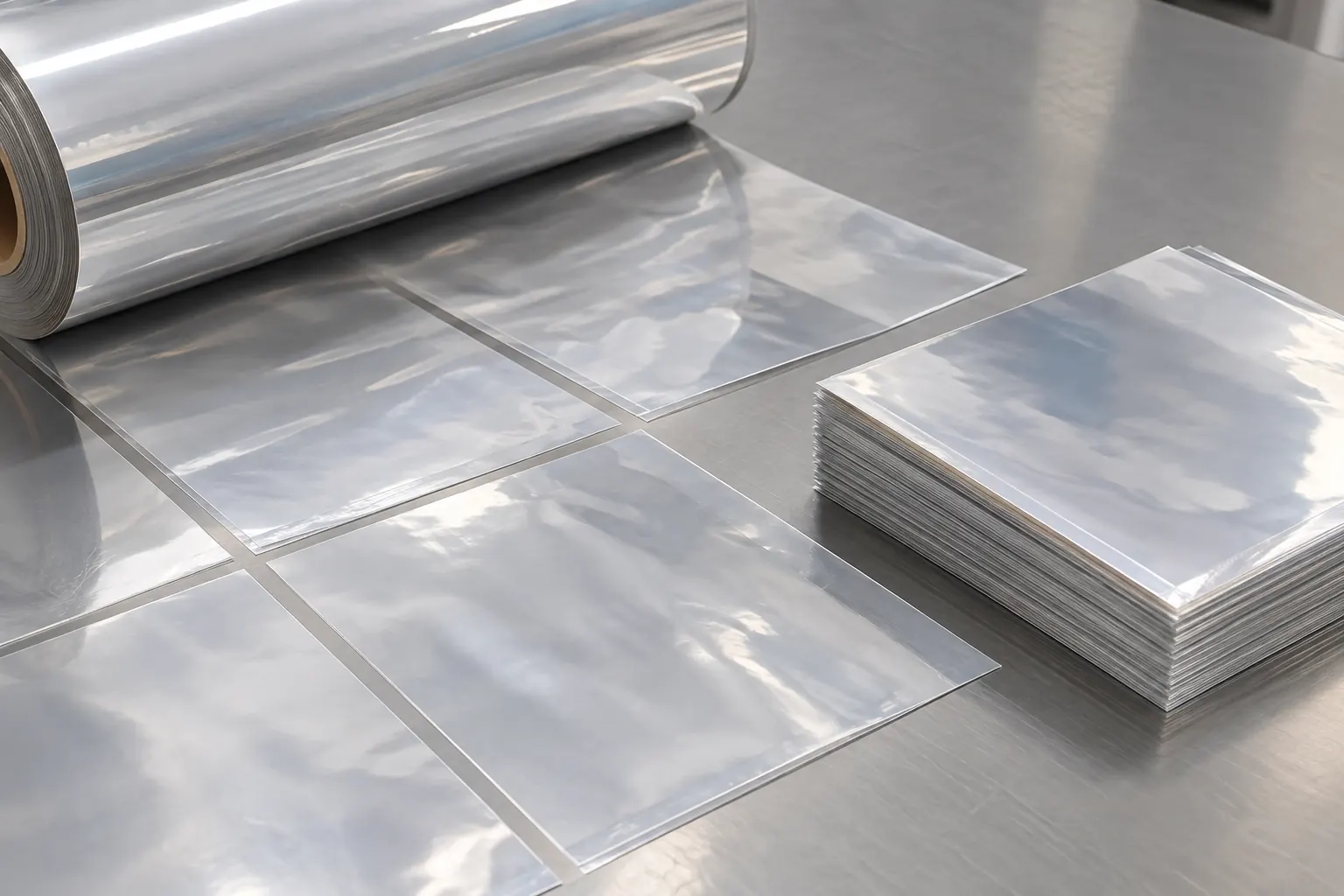
Multilayer webs are converted for oxygen-sensitive foods, where clean edges support sealing, registration and stable package geometry. During transverse cross cutting, a continuous web is separated to a repeat length or sheet format. Review cut squareness, registration and exit-edge behavior for this application.
Pharmaceutical and medical overwrap
Barrier laminates are prepared for protected products, requiring traceable dimensions and no unexplained layer separation at the edge. During transverse cross cutting, a continuous web is separated to a repeat length or sheet format. Review cut squareness, registration and exit-edge behavior for this application.
Barrier lidding and liner webs
EVOH-containing structures are sized for lids or liners, where width, flatness and sealing-zone cleanliness affect downstream use. During transverse cross cutting, a continuous web is separated to a repeat length or sheet format. Review cut squareness, registration and exit-edge behavior for this application.
Common Ways to Describe This Cutting Problem
- EVOH barrier film laminate cross-cutting blades
- EVOH barrier film laminate cross cutting cut quality guide
- EVOH barrier film laminate cross cutting defect troubleshooting
- how to reduce cut-length variation or out-of-square sheets in EVOH barrier film laminate cross cutting
- High-barrier food pouches EVOH barrier film laminate cross cutting specification
- Pharmaceutical and medical overwrap EVOH barrier film laminate cross cutting edge acceptance
- EVOH barrier film laminate cross cutting production trial RFQ data
- EVOH barrier film laminate cross cutting supplier technical review
Define the Required Cut Result
- Produce square, clean transverse cuts without dragging the laminate
- Hold cut length, skew and registration within the approved tolerance
- Protect layer bonding, barrier zone and sealing surfaces
- Deliver converted material accepted for printing, pouch making, sealing and barrier verification
Problems to Diagnose Before Changing the Knife
Interlayer separation at the converted edge
Inspect layer stack, tie-layer condition, laminate cure, storage humidity, cut direction and peel behavior. Determine whether separation existed in the incoming web or initiates at the cut.
Barrier-layer exposure or edge cracking
Review the approved structure, local thickness variation, flexing after cutting and environmental conditioning. Barrier performance cannot be inferred from visual appearance alone and should follow the customer's test method.
Cut-length variation or out-of-square sheets
Check feed indexing, web tension, mark sensing, cross-web alignment, material slip and dimensional readings at both sides of consecutive sheets.
Exit-edge tearing, tailing or blocked sheet separation
Review support at the exit side, web speed, material tack, static, cut sequence and whether the defect follows a particular web surface or roll position.
Knife Forms That May Be Considered
| Possible knife form | When it may be considered | What must be confirmed |
|---|---|---|
| Rotary cutoff form | Consider when the installed line separates a moving web with synchronized rotary motion. | Confirm this form only from the EVOH barrier film laminate sample, installed equipment interface, operating motion, support condition and approved drawing. |
| Straight cutoff form | Consider where the existing equipment uses a stationary, reciprocating or guillotine-style transverse action with suitable support. | Confirm this form only from the EVOH barrier film laminate sample, installed equipment interface, operating motion, support condition and approved drawing. |
Information to Send for Technical Review
You do not need to know the exact blade name. Send the available workpiece, machine, current-knife and cut-result information so the application can be reviewed against a drawing or sample.
- Complete laminate structure and nominal thickness by layer
- EVOH grade location, tie layers and supplier handling limits
- Lamination cure status, storage humidity and roll age
- Barrier, peel and sealing acceptance methods after conversion
- Incoming roll dimensions, web direction and material orientation
- Required sheet or blank length, squareness and tolerance method
- Feed speed, indexing cycle, registration control and support layout
- Existing cutoff-part sample, mounting dimensions and approved drawing
Questions About This Cutting Application
Does EVOH content alone determine cutting behavior during transverse cross cutting?
No. Outer films, tie layers, total gauge, orientation, lamination method and conditioning can dominate the edge response. Review the complete supplied structure and representative samples.
How should barrier integrity be checked after cutting during transverse cross cutting?
Use the package owner's specified barrier or package test on conditioned samples. Visual edge inspection is useful for screening but does not by itself confirm oxygen-barrier performance.
Why can the two sides of a cross-cut sheet measure differently during transverse cross cutting?
Web skew, uneven tension, feed slip, sensor alignment or support geometry can shift one side relative to the other. Record both side lengths over consecutive cycles.
When should cross-cut dimensions be measured during transverse cross cutting?
Use a defined conditioning time appropriate to the film because tensioned laminates may recover after cutting. Keep the same method for trial and production approval.
How is rotary versus straight cutoff selected during transverse cross cutting?
Selection follows the existing machine motion, feed mode, support and mounting interface. Confirm those details and an approved drawing rather than choosing from the material name.
Request a Custom Cutting-Knife Review
Send the workpiece details, machine or holder information, current knife photos or sample, required quantity and examples of the present cut problem. Final dimensions, material, edge geometry and tolerances are confirmed from the approved requirements.