
Blade Application Guides / Application Guide / Electronics recycling
Flexible Printed Circuit Scrap Secondary Shredder Knives
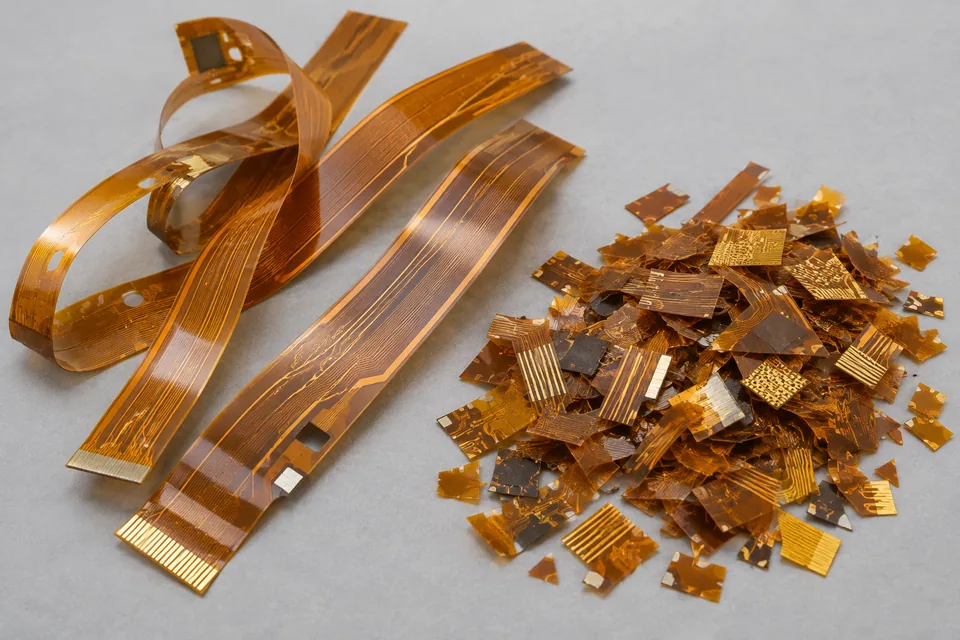
Secondary shredding receives already opened flexible-circuit scrap and narrows it to an intermediate fraction. Record the upstream size distribution, long-ribbon content, copper coverage and attached components before the trial. Knife selection should match the secondary rotor/counterknife interface and the granulator or sorter feed requirement, not the original sheet dimensions.
Updated
Where This Cutting Application Appears
Verify the upstream fraction
Sample the primary-shredder discharge and record its size range, proportion of long strips, attached components and moisture or contamination. If the upstream output varies, a secondary knife trial should include those extremes rather than a single easy batch.
Set an intermediate endpoint
Agree on the medium-fragment distribution needed by the following granulator or sorter. Inspect for uncut copper-polymer tails and bundled pieces as well as nominal size. A screen opening alone is not an acceptance test for the whole lot.
Review engagement and residence
Inspect rotor and counterknife overlap or the installed cutter arrangement, screen condition and feed rate. Track whether pieces escape too early, recirculate excessively or wrap at the shaft. Use the OEM geometry to set the allowed knife position.
Check thermal and discharge effects
Record temperature trends, dust pickup and the point where discharge may back up. Heat or accumulation can change polymer response and feed behavior. Trial the actual route to the next stage, not only a sample collected beneath the machine.
Define the Required Cut Result
- Deliver an intermediate fraction accepted by the next stage.
- Reduce long tails and bundled pieces to agreed limits.
- Keep wrapping and discharge blockage within the trial criteria.
- Document machine load and temperature for representative feed batches.
Problems to Diagnose Before Changing the Knife
Intermediate fragments contain long copper-polymer tails
- Quantify tail length in the sampled output.
- Inspect cutter overlap, stationary edge condition and screen bypass.
- Check whether primary fragments exceed the secondary feed envelope.
Material wraps at the shaft after a tool change
- Identify the shape and source of the wrapping fraction.
- Compare cutter projection and anti-wrap features with the OEM drawing.
- Review feed rate and discharge accumulation.
Output size shifts during a run
- Sample early, middle and late output using the same size bands.
- Check knife wear, screen damage and changing upstream composition.
- Record throughput and recirculation changes.
Temperature rises while size reduction slows
- Check load, dull edges and screen blockage under site lockout procedures.
- Compare feed rate and polymer-rich fraction with the accepted batch.
- Verify the downstream conveyor is not constraining discharge.
FPC secondary shredding: separate upstream variation from cutter and screen effects
Use matching upstream and secondary samples to locate where long tails, wrapping or size drift begin.
Long copper-polymer tails dominate only some batches
Compare the incoming primary-shredder distribution and ribbon content before changing overlap or screen. Keep difficult and easy feed samples.
Wrap begins after a cutter change
Verify cutter projection, overlap, stationary edge, anti-wrap features and discharge against the OEM drawing and the previous accepted setup.
Intermediate output widens as the run continues
Sample early, middle and late output; inspect edge condition, screen damage, recirculation, feed rate and upstream composition changes.
Acceptance Criteria for a Controlled Trial
Agree how the trial will be judged before changing the knife or machine setting.
- Define the incoming primary-shredder size distribution and long-strip share for the trial.
- Classify a fixed-mass output into oversize, target and fines bands and measure long tails.
- Count wrap, reversal and blocked-discharge events over a stabilized interval.
- Record temperature, load and labeled rotor/counterknife edge and seat observations.
Knife Forms That May Be Considered
| Possible knife form | When it may be considered | What must be confirmed |
|---|---|---|
| Secondary shredder rotor cutter | For further reduction when the installed machine uses replaceable cutters. Select the secondary rotor cutter and counterknife from the actual overlap, screen, holder faces and handoff range; a primary shredder profile is not an interchangeable substitute. | Verify cutter profile, holder fit, fasteners and approved projection against the machine drawing. |
| Secondary counterknife | For the matching stationary edge of that rotor arrangement. | Verify mounting, overlap and service clearance with the machine owner. |
Information to Send for Technical Review
You do not need to know the exact blade name. Send the available workpiece, machine, current-knife and cut-result information so the application can be reviewed against a drawing or sample.
- Representative primary-shredder output with size and long-strip distribution
- FPC layer stack, copper coverage, attached components and batch variation
- Maximum secondary feed piece and target intermediate output bands
- Named granulator or separator handoff limit and inspection method
- Secondary shredder make or model, rotor layout, overlap and adjustment method
- Rotor cutter, counterknife, holder, spacer and screen drawings with used samples
- Feed rate, speed, recirculation, wrapping, load and temperature records
- Early, middle and late accepted/rejected samples from one traceable run
Related Recycling Knife and Service Pages
Questions About This Cutting Application
How is secondary shredding different from primary shredding?
It receives already opened scrap and aims for a narrower intermediate fraction; the primary stage is designed around accepting the original bulky feed.
Is the screen opening the finished particle size?
No. Check a measured sample distribution, including long tails and fines, because shape and recirculation also matter.
Why request upstream samples?
The secondary knife sees the primary output, not the original sheet. Its size and strip length set the actual cutting load.
Can a harder cutter fix wrap?
Not by itself. Wrap can reflect feed geometry, cutter engagement, clearances or discharge. Inspect those causes first.
What records make trials comparable?
Keep the same feed batch definition, sample method, knife condition, screen and throughput record.
Public references and scope
These public sources provide material, cutting-method or safety context for this guide. Supplier pages describe their own materials or equipment; they do not establish a MEIRENTE blade specification or performance claim. Confirm the actual grade, machine setup and required cut with a drawing or sample.
Related product and service information
- Lithium Battery Separator Scrap Fine-Crusher Knives - lithium battery separator scrap · fine crushing
- Mixed Copper Cable Scrap Secondary Shredder Knives - mixed copper cable scrap · secondary shredding
- Photovoltaic Backsheet Scrap Secondary Shredder Knives - photovoltaic backsheet scrap · secondary shredding
Request a Custom Cutting-Knife Review
Send the workpiece details, machine or holder information, current knife photos or sample, required quantity and examples of the present cut problem. Final dimensions, material, edge geometry and tolerances are confirmed from the approved requirements.