
Blade Application Guides / Application Guide / Electronics recycling
Flexible Printed Circuit Scrap Granulator Knives
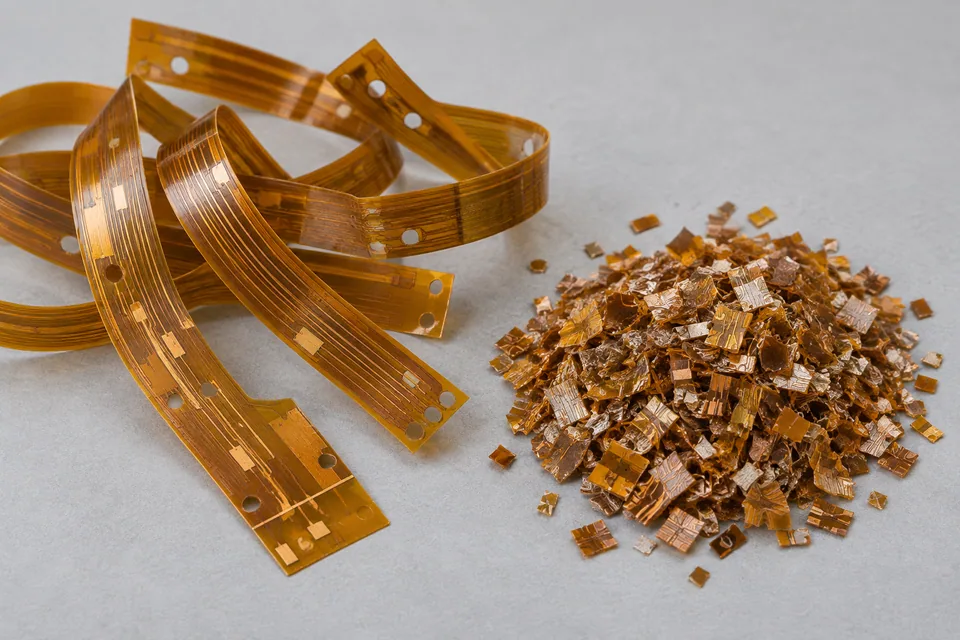
FPC granulation uses rotor and bed knives with a screen to prepare a measured fraction for metal/polymer separation. Confirm that the pre-reduced feed fits the granulator and document copper coverage, polymer layers and attached-component limits. More cutting is not automatically better when added fines, heat or dust make the next separation step less stable.
Updated
Where This Cutting Application Appears
Define a screen-based trial
Document the screen fitted to the granulator and sample a known batch at the discharge. Sieve or otherwise classify the output into agreed size bands, including fines and oversize. Do not infer the distribution from nominal screen opening alone.
Inspect the rotor and bed-knife pair
Compare the actual rotor, stationary knife seats and cutting gap with the OEM drawing. Worn or misaligned edges can increase rubbing, heat and irregular tails. Record the adjustment method before a replacement knife is specified.
Review mixed-material liberation
Inspect whether copper and polymer remain attached at the target fraction and whether the downstream sorter can handle the result. More cutting is not automatically better: excessive fines may complicate collection and separation.
Control feed and collection
Use pre-reduced feed within the specified size envelope. Observe the dust extraction, discharge and temperature for the full trial batch. Collect samples without mixing batches of different circuit construction.
Define the Required Cut Result
- Meet an agreed granule-size distribution rather than only a screen designation.
- Control oversize, long tails and excessive fines.
- Provide a fraction compatible with the named downstream separation method.
- Record heat, dust and knife wear observations for a representative run.
Problems to Diagnose Before Changing the Knife
Too many oversize pieces leave the granulator
- Check the screen for damage or bypass.
- Inspect rotor-to-bed-knife condition and cutting gap.
- Confirm feed pieces are within the machine specification.
Fines increase after an extended run
- Compare sieve results using identical sampling.
- Inspect knife sharpness, screen blockage and residence time.
- Review feed rate and changes in laminate construction.
Copper and polymer remain bonded at the target size
- Compare actual particle cross-sections with the sorter requirement.
- Review whether the selected screen and cutting sequence are appropriate.
- Trial a controlled adjustment without assuming smaller is always better.
Collection becomes dusty or hot
- Check extraction and discharge under site procedures.
- Inspect edge condition, machine load and screen blockage.
- Record batch construction and temperature at repeatable points.
FPC granulation: balance particle distribution with material liberation
Judge rotor/bed-knife performance from a traceable screened sample and the actual downstream separator requirement.
Oversize and long tails remain despite recirculation
Inspect screen damage or bypass, rotor-to-bed-knife clearance by position, seating, edge condition and maximum incoming piece size.
Copper and polymer remain attached at the target size
Compare particle cross-sections with the separator requirement. Review the staged reduction route without assuming a smaller screen is the only correction.
Fines, dust or heat rise during the run
Trend feed rate, knife condition, clearance, screen blockage, residence and extraction using the same sample interval.
Acceptance Criteria for a Controlled Trial
Agree how the trial will be judged before changing the knife or machine setting.
- Use a documented pre-reduced feed distribution and FPC construction for every comparison.
- Measure oversize, target and fines bands plus long tails from a fixed-mass sample.
- Record copper-polymer attachment and misplaced material using the downstream separator method.
- Track temperature, dust, recirculation and labeled rotor/bed-knife edge marks over a fixed interval.
Knife Forms That May Be Considered
| Possible knife form | When it may be considered | What must be confirmed |
|---|---|---|
| Granulator rotor knife | For the rotating cutting edge of a compatible screen-equipped granulator. Select rotor and bed knives as a matched interface after confirming bolt pattern, reference faces, projection, adjustment range, rotation and screen arrangement. | Confirm bolt pattern, seat, projection and sharpening allowance from the machine drawing. |
| Granulator bed knife | For the stationary mating edge against which the rotor cuts. | Confirm mounting, adjustment method and permitted gap from the OEM documentation. |
Information to Send for Technical Review
You do not need to know the exact blade name. Send the available workpiece, machine, current-knife and cut-result information so the application can be reviewed against a drawing or sample.
- Pre-reduced FPC feed distribution and maximum piece size
- Layer stack, copper coverage, adhesive, attached-component and contamination limits
- Target granule, oversize, fines and long-tail acceptance bands
- Downstream metal/polymer separation method and liberation inspection
- Granulator make or model, rotor layout, bed-knife position and clearance method
- Rotor knife, bed knife, holder, clamp and screen drawings with used samples
- Screen opening, speed, feed rate, recirculation, temperature and dust records
- Paired feed, granulate and downstream separation samples from one run
Related Recycling Knife and Service Pages
Questions About This Cutting Application
Is a granulator the same as a primary shredder?
No. A granulator typically uses rotor and bed knives with a screen to make a smaller controlled fraction from suitable feed.
Does screen size guarantee particle size?
No. The output must be sampled and classified; shape, wear and recirculation affect the distribution.
Why inspect copper-polymer attachment?
The next separator may need the materials to be sufficiently liberated. Define that requirement with an actual downstream trial.
Can the knife drawing be replaced by a photo?
A photo helps identify a machine, but mounting, projection and cutting gap require dimensioned drawings and current setup records.
What is a useful acceptance sample?
Keep a labeled feed sample, a discharge sample and a measured size distribution from the same run.
Public references and scope
These public sources provide material, cutting-method or safety context for this guide. Supplier pages describe their own materials or equipment; they do not establish a MEIRENTE blade specification or performance claim. Confirm the actual grade, machine setup and required cut with a drawing or sample.
Related product and service information
- Flexible Printed Circuit Scrap Primary Shredder Knives - flexible printed circuit scrap · primary shredding
- Lithium Battery Separator Scrap Granulator Knives - lithium battery separator scrap · granulating
- Mixed Copper Cable Scrap Granulator Knives - mixed copper cable scrap · granulating
Request a Custom Cutting-Knife Review
Send the workpiece details, machine or holder information, current knife photos or sample, required quantity and examples of the present cut problem. Final dimensions, material, edge geometry and tolerances are confirmed from the approved requirements.