
Blade Application Guides / Application Guide / Electric motor and transformer insulation converting
DMD Electrical Insulation Laminate Slitting Blades
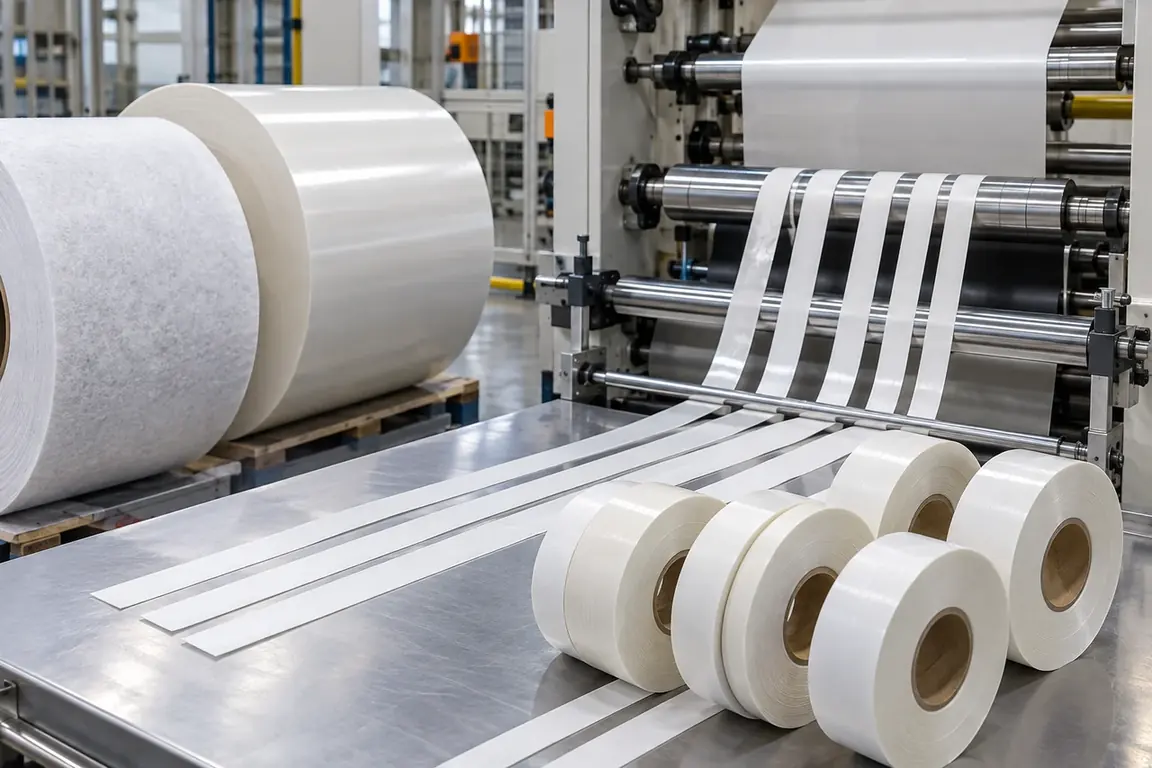
DMD electrical insulation laminate slitting blades convert multilayer polyester nonwoven and PET film insulation into strips or narrow rolls for motor and transformer component preparation. This is not the same as cutting homogeneous insulation paper: the two nonwoven faces and central film can respond differently at the slit edge. Review should define the actual laminate, layer bond, roll direction, finished strip format, winding path and accepted electrical-insulation edge.
Where This Cutting Application Appears
Motor slot insulation strip conversion
DMD master rolls are slit into controlled strips for later forming or component preparation.
Transformer insulation roll preparation
Finished widths are converted and rewound for defined winding or assembly operations.
Outer edge correction
Damaged or inconsistent margins are trimmed before usable DMD strips are collected.
Common Ways to Describe This Cutting Problem
- DMD electrical insulation laminate slitting blades
- polyester nonwoven PET insulation cutter
- motor slot DMD strip slitting knives
- DMD flexible laminate roll cutting blade
- transformer DMD insulation edge trimming knife
- electrical DMD narrow roll slitter blades
- PET nonwoven insulation strip cutting
- DMD laminate delamination cutting control
Define the Required Cut Result
- Continuous slit edges with controlled nonwoven fuzz and no loose fiber bundles.
- Central PET film edges remain free from visible burrs, tags or extended tears.
- Layer bond remains intact without local lifting or separation at the slit boundary.
- Stable strip width, tracking and winding for the customer's next insulation process.
Problems to Diagnose Before Changing the Knife
Nonwoven faces produce fuzzy slit edges
- Confirm the supplied DMD construction and identify both material faces.
- Compare edge appearance by web direction and strip position.
- Review support and separation where loose fibers first appear.
PET film leaves a tag or raised edge
- Inspect both faces to identify the layer where the tag begins.
- Compare the result at stable running, acceleration and stopping conditions.
- Review material support and movement immediately after separation.
Laminate layers open at the edge
- Identify the interface that separates and the direction of opening.
- Compare the supplied roll edge with newly slit and rewound edges.
- Distinguish cutting effects from pre-existing bond variation.
Narrow strips wander or wind unevenly
- Review the complete strip path from cutting through individual winding positions.
- Record whether instability is limited to certain widths or roll locations.
- Compare strip alignment and roll faces throughout the production sequence.
Knife Forms That May Be Considered
| Possible knife form | When it may be considered | What must be confirmed |
|---|---|---|
| Machine-matched circular slitting arrangement | For continuous width conversion of DMD laminate on an existing roll slitting station. | Holder interface, layer construction, web support, strip widths, winding and accepted edge. |
| Narrow-strip slitting arrangement | When several narrow insulation strips require controlled separation and individual rewinding. | Strip plan, separation path, winding positions, layer stability and downstream handling. |
| Supported sheet and strip cutting arrangement | When DMD must be prepared as flat strips or sheets rather than rewound rolls. | Cut layout, support surface, material direction, collection and packaging method. |
Information to Send for Technical Review
You do not need to know the exact blade name. Send the available workpiece, machine, current-knife and cut-result information so the application can be reviewed against a drawing or sample.
- DMD product identification, layer construction and representative roll samples.
- Material face, layer order, bond condition and roll direction.
- Master-roll format, finished strip widths, strip count and trim plan.
- Machine station, holder interface, web support and winding layout.
- Accepted and rejected edges showing fuzz, film tags or delamination.
- Examples of strip wandering, folding or uneven finished roll faces.
- Inspection method and downstream forming, winding or assembly requirements.
- Trial quantity, repeat production expectation and current tooling details if available.
Questions About This Cutting Application
Why does DMD require a separate review from insulation paper?
DMD combines nonwoven layers with PET film, so fiber edges, film tags and layer bonding must be assessed together.
Should both DMD faces be photographed?
Yes. Two-face inspection helps identify where fuzz, film burrs or layer opening begin.
Why is winding included in the slitting review?
A strip may have a clean edge but still become unusable if it wanders, folds or winds with an uneven face.
Can the DMD layer construction be assumed from the acronym?
No. Confirm the actual supplied product and layer arrangement for each project.
Which edge samples should be supplied?
Provide accepted and rejected slit edges from identified strip positions, plus the original master-roll edge if available.
Request a Custom Cutting-Knife Review
Send the workpiece details, machine or holder information, current knife photos or sample, required quantity and examples of the present cut problem. Final dimensions, material, edge geometry and tolerances are confirmed from the approved requirements.