
Blade Application Guides / Application Guide / Textile recycling
Discarded Workwear Textile Bale Cutting Knives
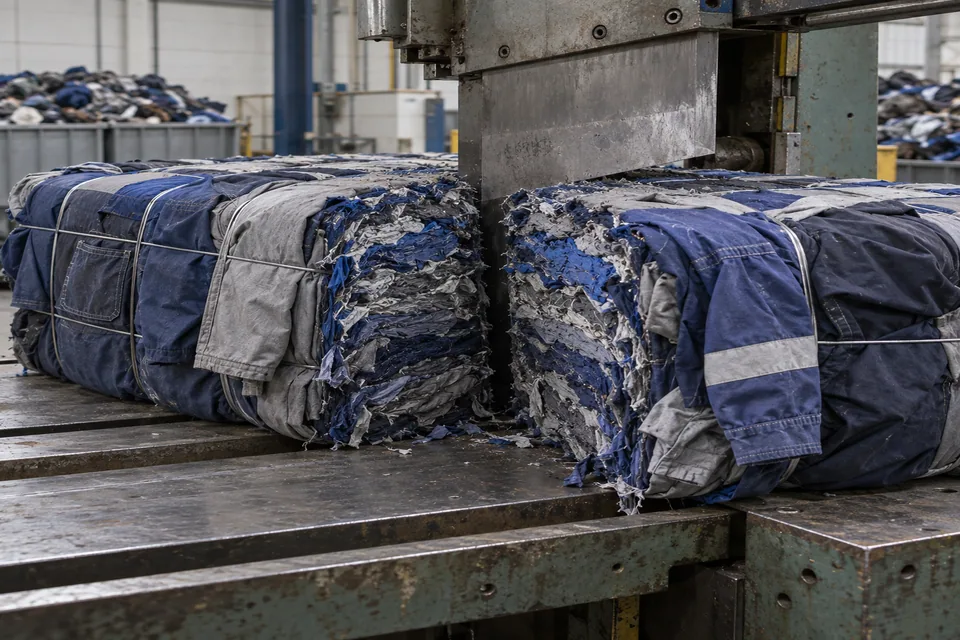
Discarded workwear may arrive as a compressed bale of garments rather than a loose textile web. ANDRITZ documents clothing as a textile recycling input and calls out metal from bale wires, zippers and buttons; Neue Herbold describes guillotine shears for fiber bales and connected textile waste. Bale cutting here means opening and cross-sectioning a controlled bale into feedable blocks before further sorting or textile reduction. It is not fine tearing or fiber opening, and it must not be treated as a clean homogeneous fabric. Uniforms can include mixed fibers, reflective trims, coatings, closures and badges. The buyer must determine the desired downstream route and how metal binding is removed before a main blade enters the bale. Cutting blades should be selected from the actual bale dimensions, density and contamination trial.
Updated
Where This Cutting Application Appears
Characterize the pressed bale
Record bale width, height, mass range, strapping material and visible garments. Determine whether the outer straps must be removed or cut by a separate wire cutter. Tag lots by fiber blend or source program where possible; mixed workwear can be unsuitable for one common recycling destination.
Locate hard inclusions before the cut
Inspect for wire ties, zippers, buttons, snaps and tools left in pockets. Plan a detection and reject method rather than expecting a guillotine blade to sever unknown metal. Mark the permitted blade path and use an infeed restraint to control expansion as the bale opens.
Trial block size for the next machine
Set a coarse slice length that the conveyor and downstream shredder or textile cutter can grip. Record guillotine blade condition, anvil fit, hold-down and stroke. Check whether tightly packed synthetic fabric smears, folds without separating or springs back after release.
Inspect cut sections and sorting access
Confirm complete cross-section separation, block size and absence of long bridging garment panels. Use the exposed cut faces to find hidden metal and non-textile components. The recycler then performs sorting, tearing, washing or chemical processing according to the chosen route.
Define the Required Cut Result
- Open bales into blocks that feed the next textile operation.
- Protect the blade from hidden metal and hard objects.
- Avoid incomplete cuts and uncontrolled springback.
- Preserve lot and fiber-stream identity for further sorting.
Problems to Diagnose Before Changing the Knife
Blade stops on a hidden closure
- Review upstream metal detection and pocket inspection.
- Identify the object before restarting.
- Inspect blade edge and anvil after the event.
Garment layers bridge across a slice
- Check blade/anvil engagement and support.
- Inspect worn edge and bale compaction.
- Compare slice thickness with the next feed requirement.
Bale expands and shifts during cutting
- Review strap-release order and restraint.
- Check clamp position and feed alignment.
- Measure blocks after release, not under compression.
Knife Forms That May Be Considered
| Possible knife form | When it may be considered | What must be confirmed |
|---|---|---|
| Heavy guillotine blade with matched anvil | For a restrained textile bale on a machine rated for the actual density and size. | Confirm mounting, stroke, hard-object controls and complete sectioning in a trial. |
| Scissor-action bale pre-cutter set | Where the existing line uses crossing edges to open dense fibrous bales. | Confirm infeed restraint, metal rejection and downstream block size. |
Information to Send for Technical Review
You do not need to know the exact blade name. Send the available workpiece, machine, current-knife and cut-result information so the application can be reviewed against a drawing or sample.
- Workwear source, fiber blend and major coatings
- Bale dimensions, density and strapping type
- Known zippers, buttons, badges and reflective hardware
- Metal detection and reject procedure
- Guillotine blade, anvil, clamp and stroke drawings
- Target block size for next machine
- Accepted incomplete-cut and contamination samples
- Recycler sorting and fiber-output plan
Questions About This Cutting Application
Is bale cutting the same as fiber opening?
No. It makes coarse feed blocks; later textile equipment separates or opens fibers.
Can binding wire stay in the bale?
The plant must identify and remove or separately cut binding metal before exposing the main cutting edge.
Why do garments need screening?
Closures, badges and mixed coatings can damage knives or contaminate the next process.
How is cut size chosen?
Set it from the next machine’s inlet and sorting needs, not from a generic bale dimension.
Does a clean slice prove recyclability?
No. Fiber blend, contamination and the downstream recycling route determine suitability.
Public references and scope
These public sources provide material, cutting-method or safety context for this guide. Supplier pages describe their own materials or equipment; they do not establish a MEIRENTE blade specification or performance claim. Confirm the actual grade, machine setup and required cut with a drawing or sample.
Related product and service information
- Hook-and-Loop Fastener Tape Slitting Blades - Woven, knitted or molded hook-and-loop fastener rolls · Slitting, slit-winding and rotary die-cutting
- Discarded Fishing Net Bale Cutting Blades - discarded fishing net · bale cutting
- Automotive Carpet Scrap Bale Cutting Blades - automotive carpet scrap · bale cutting
Request a Custom Cutting-Knife Review
Send the workpiece details, machine or holder information, current knife photos or sample, required quantity and examples of the present cut problem. Final dimensions, material, edge geometry and tolerances are confirmed from the approved requirements.