
Blade Application Guides / Application Guide / Sterile medical packaging converting
Tyvek Sterile Barrier Tray Lid Die-Cutting Blades
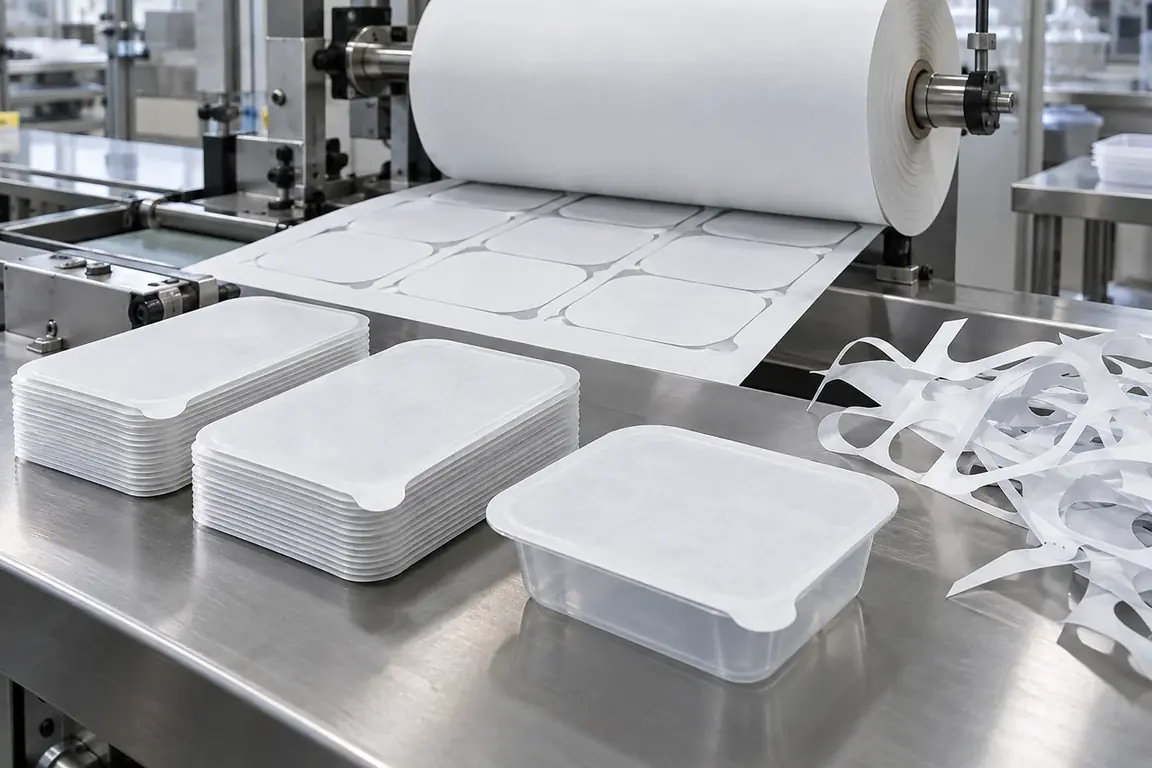
Tyvek sterile-barrier tray lid die-cutting blades convert printed or unprinted healthcare packaging rollstock into shaped lids for rigid medical trays. The cutting review should preserve the approved sealing perimeter and peel-tab relationship while considering material orientation, coating or print side, registration system, fiber release, waste stripping and clean collection without making claims about the finished package's validation.
Updated
Where This Cutting Application Appears
Rigid-tray lid preparation
Lidding rollstock is cut to the approved outer profile used with a defined medical-device tray design.
Peel-tab and corner profiling
Opening tabs and corner transitions are formed while maintaining their relationship to the intended sealing perimeter.
Registered printed-lid conversion
Printed lid graphics and cut geometry are coordinated using the production line's established registration reference.
Registered Lid Die-Cutting process boundary
Registered lid die-cutting for Tyvek sterile-barrier tray-lidding material is planned around repeatable full or controlled-depth formation of a defined shape using registered tooling and a managed waste path; it is not straight slitting, simple length separation or narrow edge cleanup.
Registered Lid Die-Cutting setup checkpoint
For Tyvek sterile-barrier tray-lidding material, confirm finished geometry, clearance or cutting depth, tool-to-anvil support, registration, feed orientation and waste or part release.
Registered Lid Die-Cutting acceptance checkpoint
For Tyvek sterile-barrier tray-lidding material, evaluate complete geometry, dimensions, registration, burr or fiber pull, corner integrity, waste separation and part flatness.
Define the Required Cut Result
- Clean continuous lid edges without loose fibers, torn corners or attached waste.
- Outer profile and peel-tab geometry matched to the controlled packaging drawing.
- Registered cuts that preserve the required relationship to printed information and seal area.
- Orderly waste removal and collection without marking or contaminating usable lid surfaces.
Problems to Diagnose Before Changing the Knife
Fibrous material remains attached at the lid edge
- Compare edge behavior along different directions of the supplied rollstock.
- Inspect straight sections, corners and peel-tab transitions on the same lid.
- Review material support and waste separation where fibers remain connected.
Cut profile shifts relative to printed artwork
- Confirm the print mark, sensor reference or mechanical datum used in production.
- Measure print-to-cut position on sequential samples using the approved method.
- Record whether the shift is progressive, intermittent or associated with roll splices.
Peel tab tears during matrix stripping
- Identify the transition where the tab remains attached to surrounding waste.
- Review tab orientation and waste-removal direction against the controlled layout.
- Compare supported and fully released parts for distortion or fiber pullout.
Lid surface is marked during collection
- Identify coated, printed and sealing faces before tracing contact points.
- Separate cutting marks from abrasion introduced during stacking or transport.
- Compare accepted and rejected lids under the customer's normal visual inspection.
Knife Forms That May Be Considered
| Possible knife form | When it may be considered | What must be confirmed |
|---|---|---|
| Registered rotary lid-cutting die | For continuous production of repeated medical tray lids from printed or unprinted sterile-barrier rollstock. | Lid layout, registration system, material direction, coated face, matrix path, machine interface and delivery method. |
| Flatbed steel-rule profile die | For sheet-fed or indexed tray lids with defined corners, peel tabs and nonrectangular outer contours. | Controlled lid drawing, material orientation, cutting support, waste stripping, surface contact and accepted edge sample. |
| Matched punch-and-die blanking tool | For discrete lid blanks when the existing press and handling method are designed for positive part separation. | Press interface, profile geometry, material construction, part ejection, trim clearance and clean collection method. |
Information to Send for Technical Review
You do not need to know the exact blade name. Send the available workpiece, machine, current-knife and cut-result information so the application can be reviewed against a drawing or sample.
- Healthcare lidding material identification and representative production roll samples.
- Coated, printed and sealing-side identification with supplied roll orientation.
- Controlled lid profile showing seal perimeter, corners, tabs and revision.
- Parent-roll format, repeat layout, feed direction and registration reference.
- Machine station, tooling interface, web support, waste stripping and lid collection.
- Accepted and rejected lids showing fibers, tears, registration shift and surface marks.
- Inspection, cleanliness, contact, traceability and packaging requirements.
- Trial quantity, downstream sealing process and current tooling information if available.
Questions About This Cutting Application
Can a Tyvek tray-lid blade be reviewed from the material grade alone?
No. The supplied construction, orientation, controlled profile, registration method, waste path and accepted edge are also required.
Why must the sealing perimeter be shown on the drawing?
It establishes the relationship between the cut edge, peel tab, printed layout and the customer's intended package design.
What edge areas should be photographed?
Photograph straight edges, corners, tab transitions and any location with loose fibers, tears or attached waste.
Does cutting review validate the finished sterile package?
No. Cutting review addresses conversion inputs and edge results; package validation remains under the customer's controlled process.
Should missing packaging requirements be inferred?
No. Unknown requirements should remain unconfirmed until the customer supplies controlled documentation or approved samples.
Related product and service information
- Anesthesia Breathing Filter Media Rotary Die Cutting Blades - anesthesia breathing filter media · rotary die cutting
- Microfluidic Diagnostic Adhesive Tape Die-Cutting Blades - Liner-backed microfluidic diagnostic adhesive tape · Registered die-cutting and kiss-cutting
- PCR Microplate Sealing Film Die-Cutting Blades - PCR microplate sealing film · Sheet die-cutting and tab profiling
Request a Custom Cutting-Knife Review
Send the workpiece details, machine or holder information, current knife photos or sample, required quantity and examples of the present cut problem. Final dimensions, material, edge geometry and tolerances are confirmed from the approved requirements.