
Blade Application Guides / Application Guide / Transdermal drug-delivery manufacturing
Transdermal Patch Laminate Rotary Die-Cutting Blades
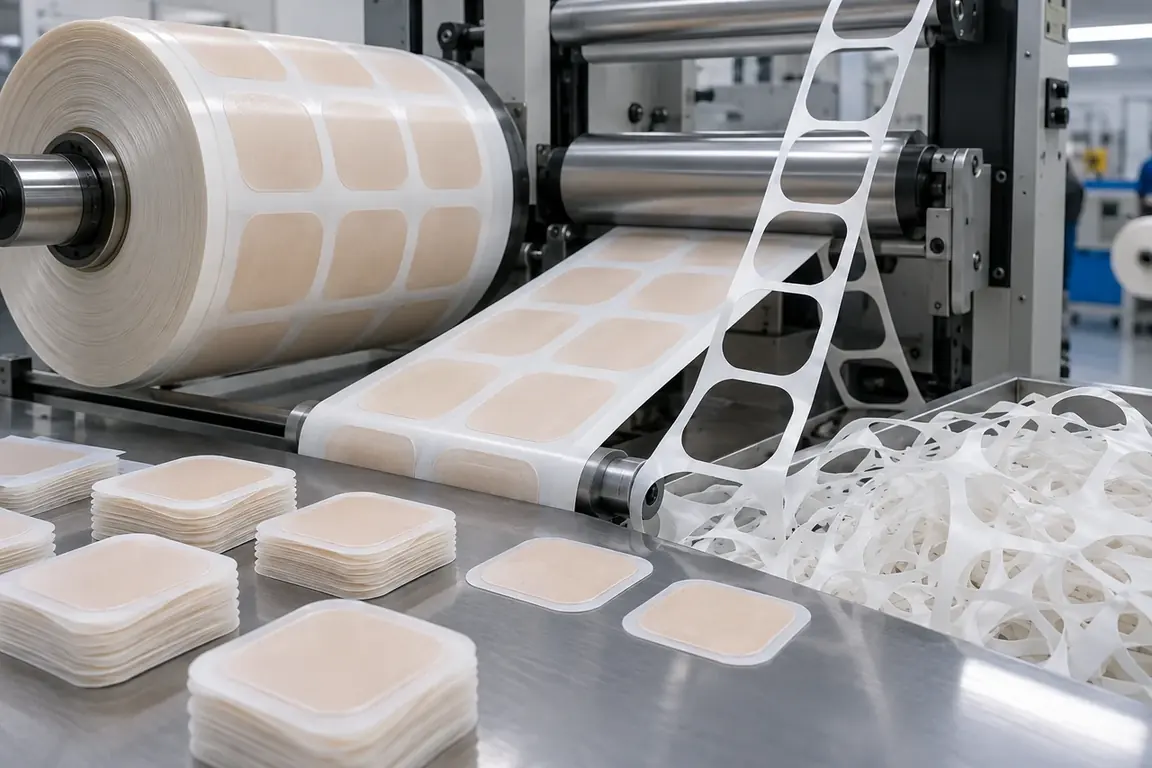
Transdermal patch laminate rotary die-cutting blades form repeated patch profiles in constructions that may include backing film, adhesive-containing layers, membranes and release liners. Review should begin with the customer's actual layer order, profile drawing, required cut result for each layer, registration reference, matrix-removal sequence and approved finished patch rather than transferring assumptions from wound dressings or ordinary adhesive labels.
Updated
Where This Cutting Application Appears
Repeated patch profile cutting
Outer patch geometry is produced repeatedly from a controlled multilayer web using the approved registration reference.
Liner-retained patch conversion
Selected patch layers are separated while the designated release liner remains suitable for later handling and packaging.
Matrix removal before packaging
Surrounding laminate waste is removed in a controlled direction without lifting or shifting usable patch components.
Rotary Die-Cutting And Kiss-Cutting process boundary
Rotary die-cutting and kiss-cutting for Liner-backed transdermal patch laminate is a linked sequence: the output condition and datum from each operation become the controlled input for the next. It should not be evaluated as one generic cut or accepted only by the final dimension.
Rotary Die-Cutting And Kiss-Cutting setup checkpoint
For Liner-backed transdermal patch laminate, define the operation order, intermediate dimensions, registration transfer, material support, web or part handling and waste route for every stage of Rotary die-cutting and kiss-cutting.
Rotary Die-Cutting And Kiss-Cutting acceptance checkpoint
Verify both intermediate and final results from Rotary die-cutting and kiss-cutting, including dimensions, registration, edge or feature quality, material damage, waste separation and stable transfer between stages.
Define the Required Cut Result
- Consistent patch profiles aligned to the controlled drawing and registration datum.
- Defined cut-through or kiss-cut result for every layer in the supplied construction.
- Clean adhesive boundaries without strings, squeeze-out transfer or lifted laminate edges.
- Stable matrix removal while finished patches remain correctly positioned on the liner.
Problems to Diagnose Before Changing the Knife
Release liner is damaged under the patch profile
- Document the required result for each backing, adhesive, membrane and liner layer.
- Inspect liner impressions around the full profile and across web positions.
- Review support and repeatability using the actual production laminate.
Adhesive strings form along the cut edge
- Identify the adhesive-containing interfaces exposed by the approved layer stack.
- Observe whether strings appear during cutting, matrix removal or patch release.
- Compare accepted and rejected samples after the same handling sequence.
Patch corners lift during waste stripping
- Map the first lifting location relative to matrix-removal direction.
- Review corner transitions, spacing and waste continuity in the repeat layout.
- Confirm whether lifting occurs consistently by lane or intermittently along the roll.
Profile registration drifts along the web
- Confirm the printed, optical or mechanical reference used in production.
- Measure sequential finished samples with the customer's approved method.
- Record changes associated with web tracking, splices or roll position without assuming cause.
Knife Forms That May Be Considered
| Possible knife form | When it may be considered | What must be confirmed |
|---|---|---|
| Registered rotary kiss-cutting die | For continuous patch production where selected laminate layers are cut while the release liner remains intact. | Repeat layout, registration datum, complete layer stack, target cut result, matrix path and accepted patch sample. |
| Flatbed patch profile die | For sheet-fed development lots or indexed transdermal laminates requiring controlled external geometry. | Controlled profile, supplied laminate state, support condition, cut result by layer, part removal and inspection method. |
| Rotary full-cut blanking die | When the approved process requires complete separation of the defined patch laminate rather than liner-retained kiss-cutting. | Layers to be separated, web support, part transfer, waste removal, edge acceptance and downstream packaging sequence. |
Information to Send for Technical Review
You do not need to know the exact blade name. Send the available workpiece, machine, current-knife and cut-result information so the application can be reviewed against a drawing or sample.
- Transdermal laminate identification and representative production samples.
- Complete layer order including backing, adhesive-containing layers, membranes and liners.
- Controlled patch profile drawing with datum, repeat layout and revision.
- Roll format, web direction, registration reference and splice information.
- Machine station, tooling interface, support, matrix path and rewinding or collection method.
- Accepted and rejected patches showing liner damage, strings, lifting and registration errors.
- Inspection, cleanliness, contact, handling and packaging requirements.
- Trial quantity, production expectation and current cutting information if available.
Questions About This Cutting Application
Why must every transdermal patch layer be identified?
Each layer can require a different cut result, and the designated release liner may need to remain intact and functional.
Is transdermal patch cutting the same as wound-dressing die-cutting?
No. The constructions and controlled product requirements differ and must be reviewed from the actual supplied patch laminate.
What should be observed during matrix removal?
Check corner lifting, adhesive strings, feature movement, retained waste and contact between matrix and usable patches.
Can a blade recommendation define pharmaceutical performance?
No. Cutting review concerns conversion behavior; product performance and validation remain under the customer's controls.
What is needed when laminate details are confidential?
Provide the process-critical layer behavior and approved samples while clearly marking restricted or unknown information.
Related product and service information
- Ostomy Hydrocolloid Skin Barrier Die-Cutting Blades - Ostomy hydrocolloid skin-barrier laminate · Aperture and outer-profile die-cutting
- Microfluidic Diagnostic Adhesive Tape Die-Cutting Blades - Liner-backed microfluidic diagnostic adhesive tape · Registered die-cutting and kiss-cutting
- PCR Microplate Sealing Film Die-Cutting Blades - PCR microplate sealing film · Sheet die-cutting and tab profiling
Request a Custom Cutting-Knife Review
Send the workpiece details, machine or holder information, current knife photos or sample, required quantity and examples of the present cut problem. Final dimensions, material, edge geometry and tolerances are confirmed from the approved requirements.