
Blade Application Guides / Application Guide / Paperboard converting
Liquid Packaging Board Sheet Slitting: Clean Edges for Carton Stock
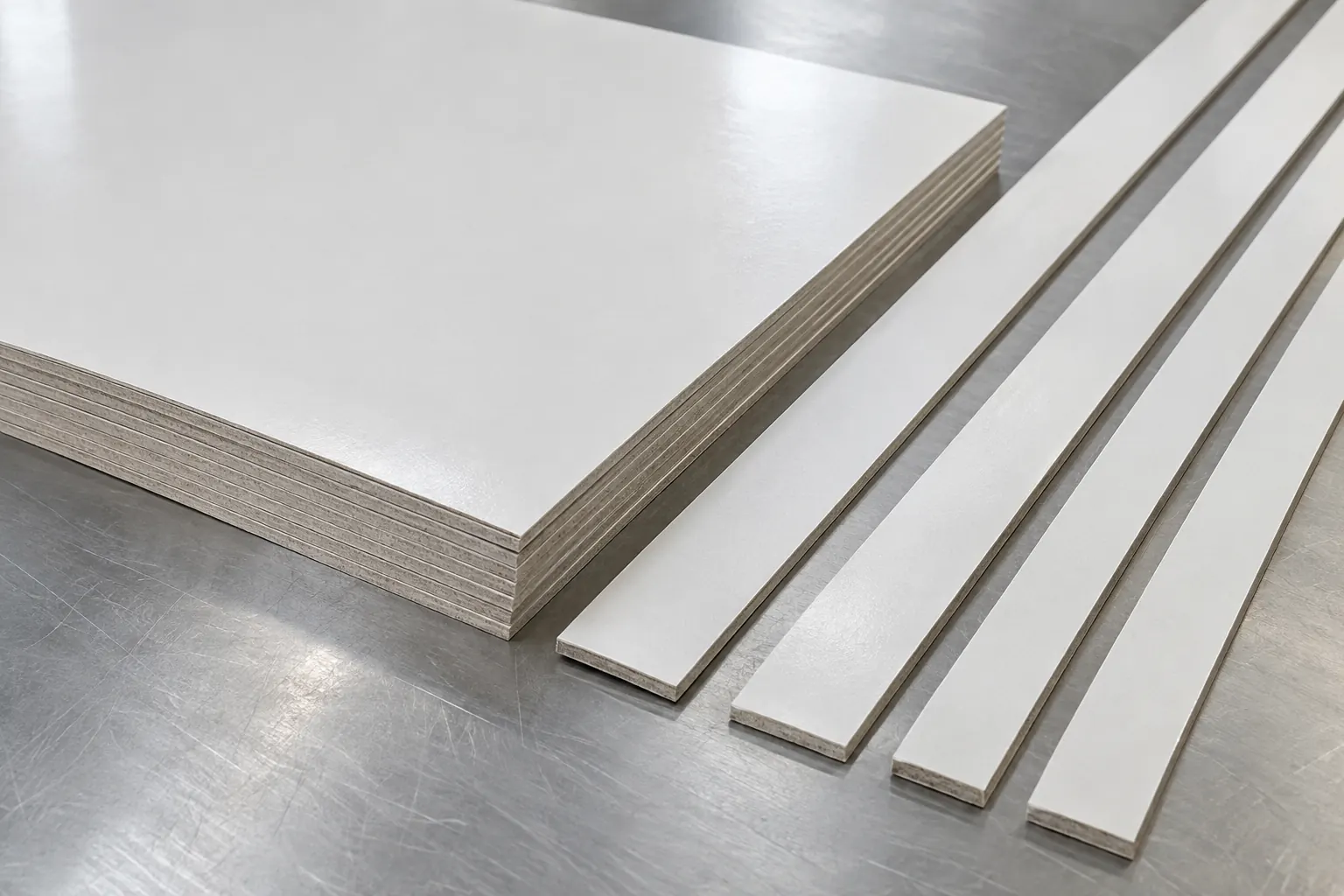
Liquid packaging board may combine strong paperboard with polymer or barrier layers, and its exact construction varies by package system. Sheet slitting must preserve bonded layers and printable surfaces while producing accurate widths for creasing, forming or further blank conversion; unknown layer specifications must be confirmed rather than assumed.
Where This Cutting Application Appears
Beverage-carton stock preparation
Large sheets are slit to converting widths before printing, creasing, sealing trials or blank production.
Liquid-food packaging components
Barrier-coated board strips are prepared for package formats where edge layers influence later forming and sealing.
Material qualification and pilot runs
Small quantities are slit for package-development tests while layer integrity and dimensions are documented.
Common Ways to Describe This Cutting Problem
- liquid packaging board sheet slitting blades
- beverage carton board sheet strip cutting
- barrier coated paperboard clean slit edge
- liquid carton stock layer separation cutting
- aseptic packaging board width slitting review
- polymer coated carton board edge quality
- sheet slitting liquid packaging paperboard
- custom slitting RFQ for beverage carton stock
Define the Required Cut Result
- Prevent separation of paperboard and barrier layers
- Control fiber burr and polymer edge deformation
- Maintain strip width and parallelism
- Protect printable and seal-related surfaces from marks
Problems to Diagnose Before Changing the Knife
Barrier layer lifts from the board edge
Confirm the actual laminate, bond condition, storage, temperature, support, cutting direction and whether lifting existed before slitting.
Polymer film stretches or forms an edge lip
Review layer type and thickness, temperature, cutting contact, support, speed and direction; do not assume the polymer chemistry.
Paper fibers remain attached beneath a clean film edge
Compare board furnish, moisture, layer bonding, cut progression, overlap or clearance and edge samples from both faces.
Strip width varies across sheet batches
Check incoming sheet size and squareness, alignment datum, holder position, feed skew and conditioned dimensional measurements.
Knife Forms That May Be Considered
| Possible knife form | When it may be considered | What must be confirmed |
|---|---|---|
| Paired circular sheet slitting | Consider where barrier-coated sheets pass through matched rotary slitters with full support. | Confirm all rotary dimensions, overlap, side force, feed direction and material compatibility from equipment data and trials. |
| Straight shear slitting | Consider where individual sheets are divided by a supported linear shearing action. | Confirm moving and fixed interfaces, clearance, rake, hold-down and actual laminate range from approved machine documentation. |
Information to Send for Technical Review
You do not need to know the exact blade name. Send the available workpiece, machine, current-knife and cut-result information so the application can be reviewed against a drawing or sample.
- Board grade, basis weight, caliper, furnish and moisture
- Verified polymer, foil or other barrier-layer construction
- Layer thicknesses, bond condition and coated-side orientation
- Incoming sheet size, slit widths, tolerances and feed direction
- Speed, support, hold-down, alignment and delivery method
- Existing slitting action, holders and verified dimensions
- Lifted layers, stretched edges, fiber burr and accepted samples
- Downstream print, crease, form, seal and food-contact requirements
Questions About This Cutting Application
Does every liquid packaging board have the same layers?
No. Constructions vary by package and supplier. Obtain the verified layer stack and do not infer polymer, foil or barrier details from the product name.
Why can a polymer layer form a lip at the edge?
A ductile surface layer may stretch when support or cutting contact is unsuitable, but layer chemistry, thickness and temperature must be confirmed.
Can a clean visual edge still have layer damage?
Yes. Small bond separation or subsurface fiber pull may appear during folding, forming or sealing. Inspect cross-sections and run functional trials.
How should slit strips be qualified?
Measure width and edge condition, inspect layer bonding, then carry representative strips through the intended crease, form or seal process.
What determines the final sheet-slitting specification?
The actual equipment interface, verified material stack, support, dimensions, speed, tolerances and approved production samples determine it.
Request a Custom Cutting-Knife Review
Send the workpiece details, machine or holder information, current knife photos or sample, required quantity and examples of the present cut problem. Final dimensions, material, edge geometry and tolerances are confirmed from the approved requirements.