
Blade Application Guides / Application Guide / Technical films
Laser-Printable Film Cross Cutting
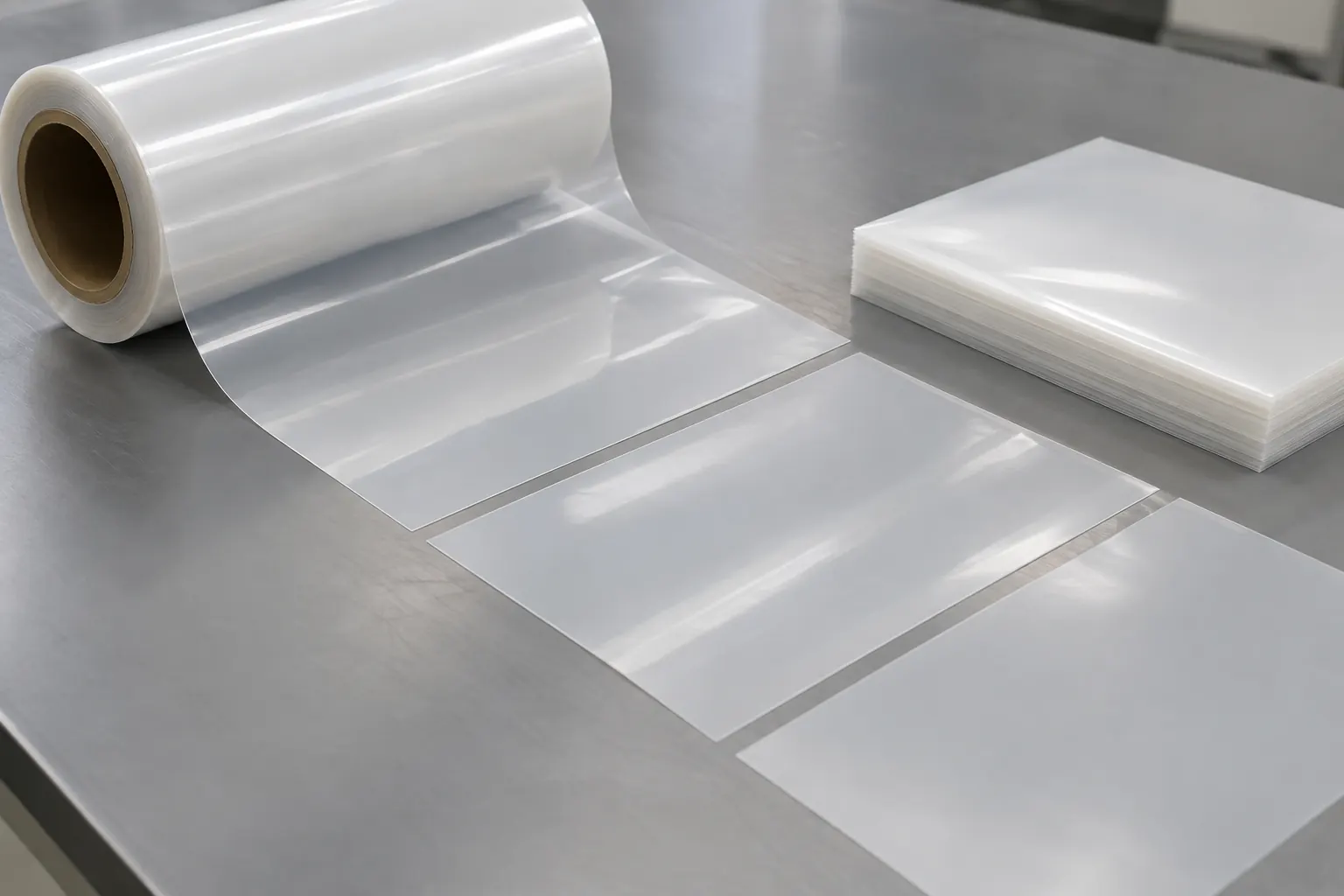
Cross-cut laser-printable film must produce square, dimensionally stable sheets that enter a printer without skew, double feeding or loose coating particles. Carrier heat history, receptive coating and any adhesive liner affect curl and stiffness. Acceptance should include conditioned dimensions and an actual print-feed trial.
Where This Cutting Application Appears
Printer-format sheets
Cut coated master rolls into standard or custom sheet sizes for laser printing.
Durable document blanks
Prepare synthetic film sheets requiring square edges and reliable feed.
Adhesive print-film sheets
Cross cut face stock and liner together while holding layer alignment.
Common Ways to Describe This Cutting Problem
- laser-printable film cross-cutting blades
- laser synthetic media sheet cutoff knife
- roll to sheet cutting toner receptive PET
- square cross cut for laser printer film
- prevent coating chips on printable film sheets
- static control in laser media sheet cutting
- adhesive printable film transverse cutting
- printer-ready polyester film blank cutting
Define the Required Cut Result
- Hold sheet length, squareness and edge straightness.
- Prevent coating chips and loose particles.
- Control curl and keep sheets individually separable.
- Deliver consistent leading edges for reliable printer pickup.
Problems to Diagnose Before Changing the Knife
Printer double-feeds cut sheets
- Check static, surface friction and stack pressure.
- Review burrs and edge blocking.
- Condition sheets before feed testing.
Leading edge is bowed or hooked
- Review support and cross-web restraint.
- Check curl and cutting progression.
- Measure squareness from a defined datum.
Coating leaves dust at cutoff
- Identify receptor coating and fillers.
- Inspect fracture on both faces.
- Check support and cleanliness.
Sheet dimensions change after storage
- Record humidity and temperature.
- Measure carrier orientation and relaxation.
- Define conditioning for acceptance.
Knife Forms That May Be Considered
| Possible knife form | When it may be considered | What must be confirmed |
|---|---|---|
| Straight cross-cut arrangement | For roll-to-sheet conversion against a compatible support or counter-edge. | Confirm motion, rake, holder, support, width, speed and printable-face orientation. |
| Rotary cutoff arrangement | For continuous high-speed production of repeated printer-sheet lengths. | Confirm repeat range, synchronization, cylinder interface, sheet delivery and tolerance. |
Information to Send for Technical Review
You do not need to know the exact blade name. Send the available workpiece, machine, current-knife and cut-result information so the application can be reviewed against a drawing or sample.
- Carrier material, gauge and printable coating details
- Adhesive and liner stack if the media is pressure sensitive
- Printable-face orientation and permitted surface contact
- Sheet width, length, squareness and conditioned tolerance
- Line speed, feed, tension, static and ambient conditions
- Cutting motion, support, holder drawing and used sample
- Allowed curl, coating chips, burrs, scratches and particles
- Target printer process, feed direction, packing and order volume
Questions About This Cutting Application
Why is sheet squareness important in laser printing?
A skewed leading edge can alter pickup, image registration and transport through the printer.
Can static be mistaken for a cutting problem?
Yes. Static can cause double feeding, poor stacking and particle attraction even with acceptable edges.
When should dimensions be measured?
Use a defined conditioning period and environment because coated films can relax or curl after cutoff.
Does a clean edge guarantee toner performance?
No. Printable coating integrity, surface cleanliness and actual fusing conditions must also be checked.
What is the best trial quantity?
Enough sheets should be cut to test dimensions, stack behavior and repeated feeding through the intended printer.
Request a Custom Cutting-Knife Review
Send the workpiece details, machine or holder information, current knife photos or sample, required quantity and examples of the present cut problem. Final dimensions, material, edge geometry and tolerances are confirmed from the approved requirements.