
Blade Application Guides / Application Guide / Paperboard converting
Folding Boxboard Cut to Size: Accurate Sheets Without Ply Damage
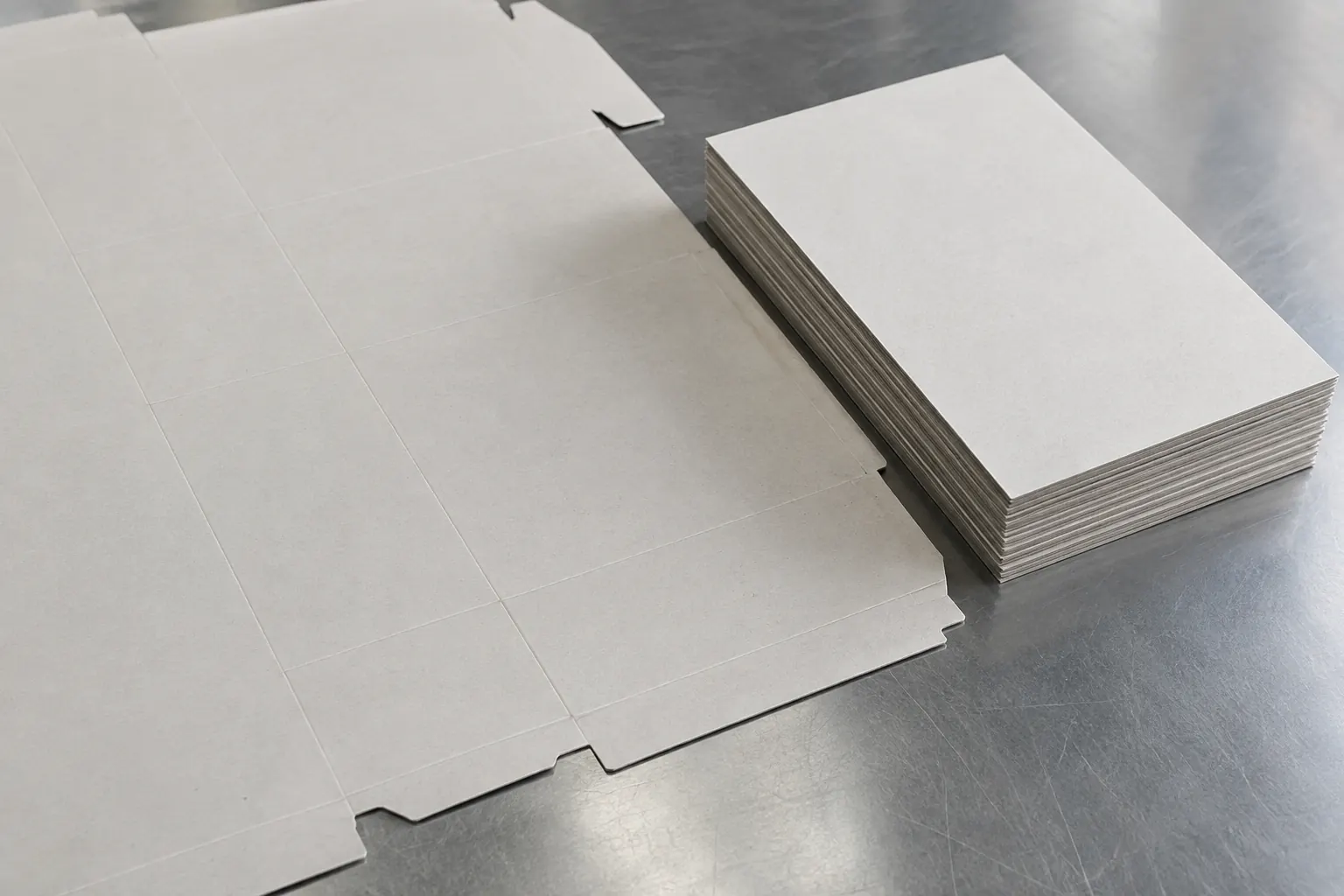
Cut-to-size operations prepare folding boxboard for print formats, samples and downstream blanking. The board must be supported through its layered thickness so coating chipping, reverse-side burr, crushed corners and dimensional movement after conditioning remain within agreed limits.
Where This Cutting Application Appears
Printing-format preparation
Mill sheets are sized to offset, digital or specialty press formats while preserving coated-face quality.
Carton prototype stock
Small lots are cut to controlled dimensions before plotting, creasing or sample-table conversion.
Packaging insert and sleeve blanks
Rectangular board pieces are prepared for secondary scoring, folding, laminating or profile cutting.
Common Ways to Describe This Cutting Problem
- folding boxboard cut-to-size blades
- FBB board sheet sizing clean edges
- folding carton board guillotine cutting guide
- cut coated boxboard without delamination
- paperboard sheet size squareness control
- folding boxboard stack cutting burr
- precision size cutting for carton board
- custom cut to size RFQ for folding boxboard
Define the Required Cut Result
- Hold length, width, squareness and stack consistency
- Minimize coating chips, fiber burr and ply separation
- Avoid compressed edges and crushed corners
- Keep printed or coated faces free from scratches
Problems to Diagnose Before Changing the Knife
Lower sheets show heavier burr than upper sheets
Review stack height, compression, support, hold-down, cutting progression, board caliper variation and condition through the pile.
Cut dimensions change after storage
Check board moisture, grain direction, conditioning time, coating balance and measurement environment.
Corners crush or split
Evaluate stack alignment, hold-down pressure, board stiffness, corner support, edge condition and handling after cutting.
Coated faces become scratched
Inspect table and clamp surfaces, loose coating particles, sheet sliding, stack turning and packaging practices.
Knife Forms That May Be Considered
| Possible knife form | When it may be considered | What must be confirmed |
|---|---|---|
| Straight guillotine cutting knife | Consider where stacked or single folding boxboard sheets are sized by a guided straight cutting action. | Confirm length, height, thickness, holes, bevel, clamp, cutting stick or counterface and machine model from approved records. |
| Straight shearing knife | Consider where single sheets are cut by a scissor-like straight shear rather than pile cutting. | Confirm moving and fixed interfaces, clearance, rake, mounting and supported board range from the actual machine. |
Information to Send for Technical Review
You do not need to know the exact blade name. Send the available workpiece, machine, current-knife and cut-result information so the application can be reviewed against a drawing or sample.
- Board grade, basis weight, caliper, plies and grain direction
- Coating, print, varnish, moisture and conditioning procedure
- Incoming sheet and required finished dimensions with tolerances
- Single-sheet or stack cutting method and maximum stack height
- Clamp pressure, support, feed alignment and delivery handling
- Current straight knife, mounting pattern and verified drawing
- Top, middle and bottom edge samples from accepted and failed stacks
- Downstream print, crease, fold and dimensional inspection plan
Questions About This Cutting Application
Why do bottom sheets have rougher edges in a stack?
Load, stack compression, support condition, debris and cutting progression can differ through the pile. Compare labeled samples from several stack levels.
How should boxboard be conditioned before sizing?
Follow the converter's material specification and stabilize samples in the agreed environment before final dimensional acceptance.
Can high clamp pressure damage folding boxboard?
Excess pressure may emboss, gloss, crush plies or mark coatings. Clamp settings should balance stack stability with surface and edge acceptance.
What measurements define a cut-to-size sheet?
Specify length, width, diagonals or squareness, edge condition, corner integrity and the conditioning state used for measurement.
Can a generic guillotine knife be specified from sheet size?
No. Final dimensions and mounting depend on the actual machine, clamp and counterface, and must follow a verified sample or approved drawing.
Request a Custom Cutting-Knife Review
Send the workpiece details, machine or holder information, current knife photos or sample, required quantity and examples of the present cut problem. Final dimensions, material, edge geometry and tolerances are confirmed from the approved requirements.