
Blade Application Guides / Application Guide / Aerospace sandwich core manufacturing
Aerospace Nomex Honeycomb Core Slicing Blades
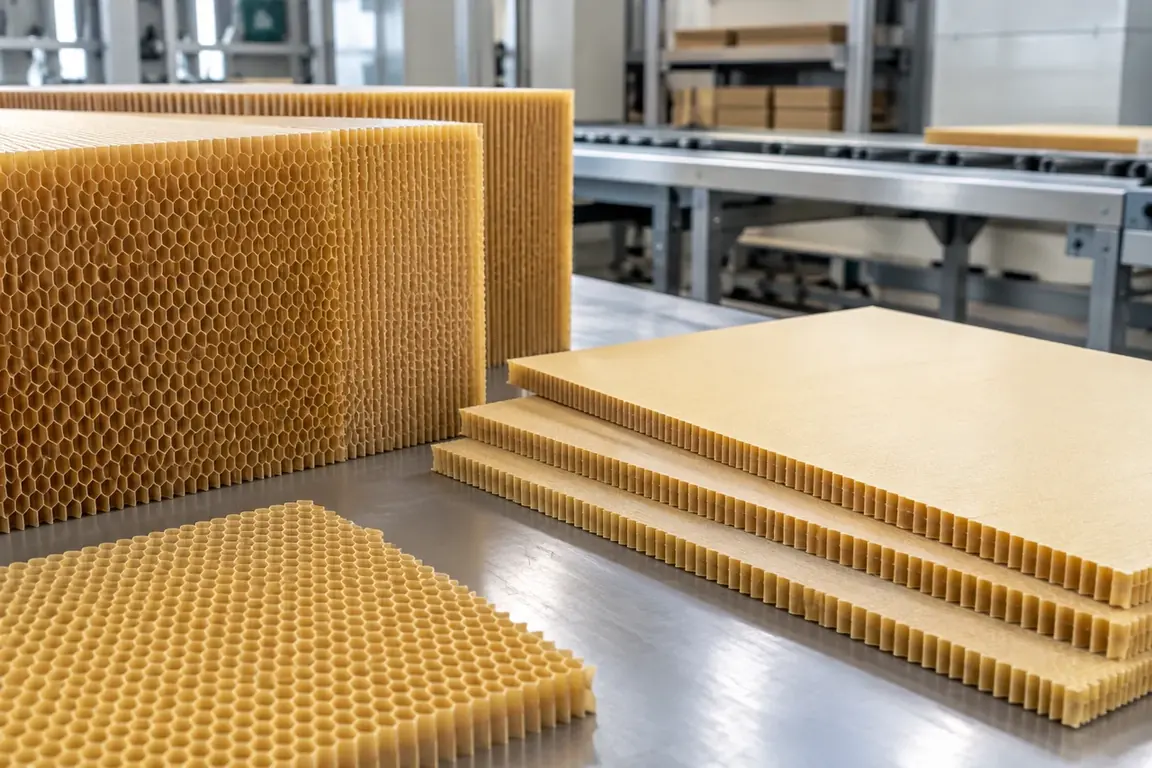
Aerospace Nomex honeycomb core slicing blades convert expanded, resin-treated aramid honeycomb blocks into core slices or prepared contours for sandwich construction. A useful review should identify the supplied core condition, cell orientation, required slice or profile geometry, support method, dust and loose-cell acceptance, and the machine interface without assuming that paper honeycomb or finished-panel cutting conditions will transfer directly.
Where This Cutting Application Appears
Core block slice preparation
Expanded aramid honeycomb blocks are separated into controlled slices for later bonding, forming or component preparation.
Tapered and contoured core preparation
Core material is trimmed to an approved outline where a sandwich component requires a defined perimeter or transition.
Development and inspection samples
Representative slices are prepared to compare cell condition, geometry and handling before a repeat production arrangement is approved.
Common Ways to Describe This Cutting Problem
- aerospace Nomex honeycomb core slicing blades
- aramid honeycomb block slicing knife
- phenolic honeycomb core cutting blades
- aircraft sandwich core slice cutter
- Nomex honeycomb contour trimming knives
- aerospace honeycomb cell edge cutting blade
- expanded aramid core sheet slicing knife
- clean cut Nomex core processing blades
Define the Required Cut Result
- Continuous sliced faces without widespread cell collapse, node separation or torn cell walls.
- Controlled finished geometry referenced to the approved drawing or accepted core sample.
- Stable support through the cut without avoidable crushing or permanent distortion.
- Clean collection and handling with loose fragments kept within the customer's inspection criteria.
Problems to Diagnose Before Changing the Knife
Cells collapse along the sliced face
- Confirm the supplied core construction, expansion condition and cell orientation.
- Review how the block is supported immediately before and through separation.
- Compare deformation on the entry face, exit face and internal sliced area.
Cell walls tear or separate at bonded nodes
- Map the direction and location of tears relative to the cell pattern.
- Check whether damage begins during cutting, unloading or later handling.
- Compare accepted and rejected slices from the same supplied block condition.
Slice geometry changes after release
- Record the support condition used during cutting and inspection.
- Confirm the customer's datum and method for measuring a compliant core slice.
- Separate temporary compression from permanent cell deformation.
Loose fragments remain inside open cells
- Identify whether fragments originate at the cut face or during downstream handling.
- Review the agreed cleaning and inspection sequence for open cells.
- Document collection, transfer and packaging contact with finished slices.
Knife Forms That May Be Considered
| Possible knife form | When it may be considered | What must be confirmed |
|---|---|---|
| Machine-matched core slicing arrangement | For separating supported expanded honeycomb blocks into flat core slices on an existing slicing station. | Machine interface, block support, cell orientation, target geometry and accepted sliced-face sample. |
| Serrated core cutting arrangement | When the supplied core and machine motion are compatible with a controlled sawing action through the cell structure. | Core construction, motion, support, fragment control and accepted cell-wall condition. |
| Custom contour trimming arrangement | When a core slice requires an approved perimeter, taper or local profile before sandwich assembly. | Controlled drawing, cell direction, profile transitions, holding method and unloading sequence. |
Information to Send for Technical Review
You do not need to know the exact blade name. Send the available workpiece, machine, current-knife and cut-result information so the application can be reviewed against a drawing or sample.
- Nomex honeycomb core designation, supplied condition and representative block samples.
- Cell orientation, expansion direction and photographs of all relevant faces.
- Controlled slice or contour drawing and clearly identified revision.
- Machine station, cutting motion, support area and available interface drawings.
- Accepted and rejected samples showing collapse, tearing or loose fragments.
- Customer inspection method for sliced faces, geometry and cell integrity.
- Cleanliness, collection, transfer and packaging requirements.
- Trial quantity, repeat production pattern and current tooling details if available.
Questions About This Cutting Application
Is Nomex honeycomb slicing the same as trimming a finished sandwich panel?
No. This application cuts exposed core before final panel construction, so cell support, orientation and loose-fragment control require a separate review.
Why must cell orientation be recorded?
Honeycomb can respond differently across its principal directions, and orientation is needed to compare trials and reproduce an accepted result.
What samples are useful for an initial review?
Provide representative uncut core plus accepted and rejected slices with their orientation and supplied condition identified.
Should slice thickness be estimated from a photograph?
No. Use the controlled drawing, customer measurement method or a verified master sample.
How should loose-cell debris be evaluated?
Apply the customer's cleaning and inspection method, then distinguish cut-face fragments from contamination introduced during handling.
Request a Custom Cutting-Knife Review
Send the workpiece details, machine or holder information, current knife photos or sample, required quantity and examples of the present cut problem. Final dimensions, material, edge geometry and tolerances are confirmed from the approved requirements.