
Công nghệ lưỡi dao / Hướng dẫn ứng dụng / Flexible electronics manufacturing
stretchable conductive film: matrix trimming dao cắt
Hướng dẫn kỹ thuật: Hướng dẫn này trình bày cách cắt stretchable conductive film · matrix trimming; gồm mục tiêu mép cắt, lỗi thường gặp và dữ liệu cần thiết để đánh giá dao đặt làm riêng.
Reviewed by the MEIRENTE technical team · Updated September 13, 2026
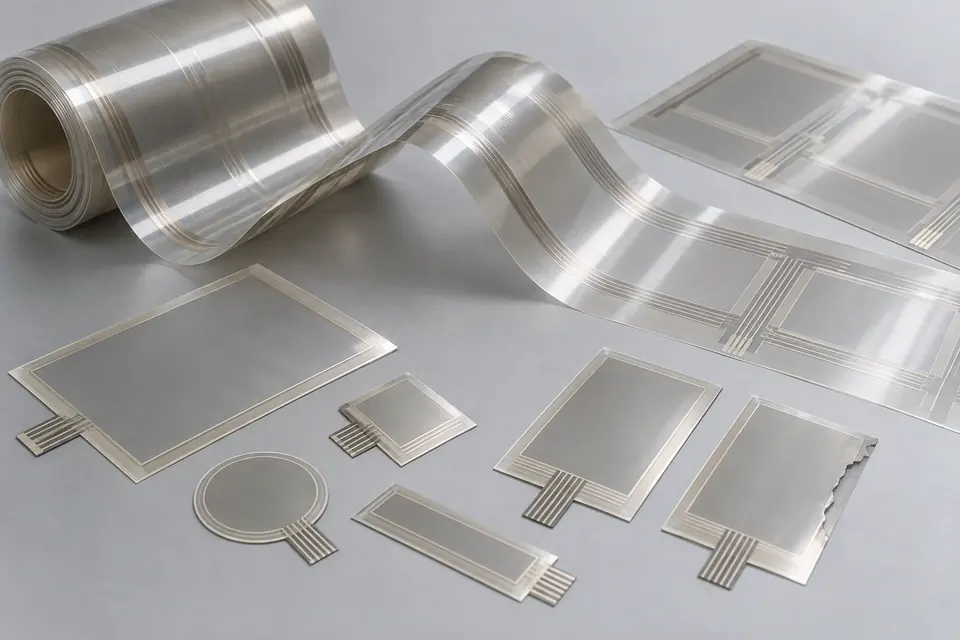
Các công đoạn sử dụng phương pháp cắt này
Flexible electronics manufacturing production
Stretchable Conductive Film is processed by matrix trimming to support touch sensing, strain measurement, flexible circuits and piezoelectric detection. The finished geometry must remain compatible with downstream handling and assembly.
Cut-quality control
Production teams compare accepted and rejected samples for profile accuracy, edge integrity, trace continuity, layer adhesion and functional-area clearance, then relate the result to waste width, peel angle, cut completeness, tension and collection path.
Stable material and waste handling
flat support, low strain, clean collection and protection of conductive surfaces help the product and waste leave the cut zone consistently without creating a second defect after separation.
Cách thường dùng để mô tả vấn đề cắt này
- stretchable conductive film matrix-trimming blades dao cắt 1
- industrial stretchable conductive film matrix-trimming blades dao cắt 2
- custom stretchable conductive film blades for matrix trimming dao cắt 3
- how to improve matrix trimming of stretchable conductive film dao cắt 4
- stretchable conductive film matrix trimming edge defect analysis dao cắt 5
- stretchable conductive film matrix trimming dimensional control dao cắt 6
- Flexible electronics manufacturing stretchable conductive film matrix trimming setup dao cắt 7
- stretchable conductive film blade RFQ data for matrix trimming dao cắt 8
Xác định kết quả cắt cần đạt
- Achieve continuous waste removal without lifting finished components for stretchable conductive film
- Prevent trace cracking, layer separation, edge burr, conductive debris or loss of flexibility
- Maintain the required geometry for touch sensing, strain measurement, flexible circuits and piezoelectric detection
- Deliver a cut condition accepted by the next flexible electronics manufacturing operation
Các vấn đề cần chẩn đoán trước khi thay dao
The cut edge shows trace cracking, layer separation, edge burr, conductive debris or loss of flexibility
Compare blade condition, waste width, peel angle, cut completeness, tension and collection path, material lot and accepted versus rejected samples.
Finished dimensions drift during a production run
Check feed registration, tension or hold-down, temperature, support condition, runout and when dimensions are measured.
The workpiece shifts, curls or loses functional surface quality
Review flat support, low strain, clean collection and protection of conductive surfaces, contact-face cleanliness, material direction, support and the first point where deformation appears.
Product and waste do not separate consistently
Check cut completeness, waste width, exit angle, static, extraction, collection tension and downstream transfer.
Các dạng dao có thể xem xét
| Dạng dao có thể phù hợp | Khi nào có thể xem xét | Nội dung phải xác nhận |
|---|---|---|
| Narrow matrix-trimming blade | Considered when matrix trimming requires continuous waste removal without lifting finished components under stable support and guidance. | Confirm only after reviewing a real stretchable conductive film sample, the equipment interface, mounting drawing, operating direction and an accepted cut reference. |
| Rotary waste-trim knife | Considered when the equipment interface and material response require an alternative geometry or cutting motion. | Confirm only after reviewing a real stretchable conductive film sample, the equipment interface, mounting drawing, operating direction and an accepted cut reference. |
Thông tin cần gửi để đánh giá kỹ thuật
Bạn không cần biết chính xác tên lưỡi dao. Hãy gửi thông tin hiện có về vật liệu cắt, máy, dao đang dùng và kết quả cắt cần đạt để ứng dụng được đánh giá theo bản vẽ hoặc mẫu.
- Stretchable Conductive Film composition, grade, thickness and allowable lot variation
- Layer, coating, porosity, temper, adhesive or surface-function details relevant to matrix trimming
- Input width and target dimensions, tolerances and acceptance drawing
- Line speed, feed mode, tension or hold-down, temperature and cutting frequency
- Current blade or knife drawing, holder interface, mounting dimensions and used sample
- Material direction, support, contact faces and product or waste collection method
- Accepted and rejected samples with limits for profile accuracy, edge integrity, trace continuity, layer adhesion and functional-area clearance
- Trial quantity, inspection method, downstream operation, packing and annual demand
Câu hỏi về ứng dụng cắt này
Why must stretchable conductive film be reviewed as a complete material construction?
Its substrate, coating, interfaces and surface condition can respond differently to pressure, friction and bending, so nominal thickness alone does not predict matrix trimming performance.
Can the blade be selected from the material name alone?
No. Confirm waste width, peel angle, cut completeness, tension and collection path, the holder interface, production speed, support and accepted samples before fixing the blade geometry.
What commonly causes defects during matrix trimming?
Material variation, unstable support, alignment error, contamination, inappropriate clearance and blade wear can interact to create trace cracking, layer separation, edge burr, conductive debris or loss of flexibility.
When should the finished dimensions be measured?
Record both immediate and conditioned results when recovery, residual stress, temperature, moisture or adhesive flow can change the part after cutting.
What should be recorded during a production trial?
Record the stretchable conductive film lot, setup, speed, support, blade condition, dimensions, edge observations, waste behavior and downstream acceptance.
Thông tin sản phẩm và dịch vụ liên quan
- anisotropic conductive film: matrix trimming dao cắt - anisotropic conductive film · matrix trimming
- capacitive-touch electrode film: matrix trimming dao cắt - capacitive-touch electrode film · matrix trimming
- printed strain-sensor laminate: matrix trimming dao cắt - printed strain-sensor laminate · matrix trimming
Yêu cầu đánh giá dao cắt theo đặt hàng
Hãy gửi chi tiết vật liệu cắt, thông tin về máy hoặc gá dao, hình ảnh hay mẫu dao đang dùng, số lượng cần thiết và ví dụ về lỗi cắt hiện tại. Kích thước cuối cùng, vật liệu, hình học lưỡi cắt và dung sai sẽ được xác nhận theo các yêu cầu đã phê duyệt.