
Technologie de coupe / Guide d’application / Flexible electronics manufacturing
stretchable conductive film: sheet cutting lames de coupe
Guide technique: Ce guide explique la découpe de stretchable conductive film · sheet cutting; avec les objectifs de bord, les défauts courants et les données nécessaires pour étudier une lame sur…
Reviewed by the MEIRENTE technical team · Updated September 13, 2026
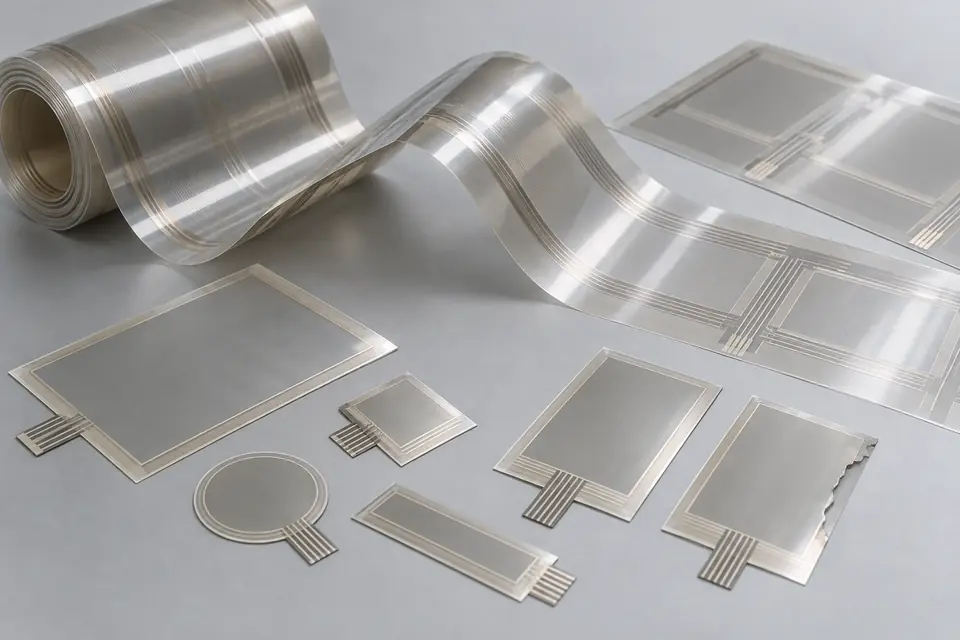
Applications industrielles de cette opération de coupe
Flexible electronics manufacturing production
Stretchable Conductive Film is processed by sheet cutting to support touch sensing, strain measurement, flexible circuits and piezoelectric detection. The finished geometry must remain compatible with downstream handling and assembly.
Cut-quality control
Production teams compare accepted and rejected samples for profile accuracy, edge integrity, trace continuity, layer adhesion and functional-area clearance, then relate the result to support, blade angle, feed registration, compression and adhesive behavior.
Stable material and waste handling
flat support, low strain, clean collection and protection of conductive surfaces help the product and waste leave the cut zone consistently without creating a second defect after separation.
Formulations courantes de ce besoin de coupe
- stretchable conductive film sheet-cutting blades lames de coupe 1
- industrial stretchable conductive film sheet-cutting blades lames de coupe 2
- custom stretchable conductive film blades for sheet cutting lames de coupe 3
- how to improve sheet cutting of stretchable conductive film lames de coupe 4
- stretchable conductive film sheet cutting edge defect analysis lames de coupe 5
- stretchable conductive film sheet cutting dimensional control lames de coupe 6
- Flexible electronics manufacturing stretchable conductive film sheet cutting setup lames de coupe 7
- stretchable conductive film blade RFQ data for sheet cutting lames de coupe 8
Définir le résultat de coupe attendu
- Achieve clean sheets without adhesive stringing or layer shift for stretchable conductive film
- Prevent trace cracking, layer separation, edge burr, conductive debris or loss of flexibility
- Maintain the required geometry for touch sensing, strain measurement, flexible circuits and piezoelectric detection
- Deliver a cut condition accepted by the next flexible electronics manufacturing operation
Points à diagnostiquer avant de remplacer le couteau
The cut edge shows trace cracking, layer separation, edge burr, conductive debris or loss of flexibility
Compare blade condition, support, blade angle, feed registration, compression and adhesive behavior, material lot and accepted versus rejected samples.
Finished dimensions drift during a production run
Check feed registration, tension or hold-down, temperature, support condition, runout and when dimensions are measured.
The workpiece shifts, curls or loses functional surface quality
Review flat support, low strain, clean collection and protection of conductive surfaces, contact-face cleanliness, material direction, support and the first point where deformation appears.
Product and waste do not separate consistently
Check cut completeness, waste width, exit angle, static, extraction, collection tension and downstream transfer.
Formes de couteaux envisageables
| Forme de couteau possible | Quand l’envisager | Éléments à confirmer |
|---|---|---|
| Straight sheet-cutting knife | Considered when sheet cutting requires clean sheets without adhesive stringing or layer shift under stable support and guidance. | Confirm only after reviewing a real stretchable conductive film sample, the equipment interface, mounting drawing, operating direction and an accepted cut reference. |
| Guillotine laminate blade | Considered when the equipment interface and material response require an alternative geometry or cutting motion. | Confirm only after reviewing a real stretchable conductive film sample, the equipment interface, mounting drawing, operating direction and an accepted cut reference. |
Informations nécessaires à l’étude technique
Vous n’avez pas besoin de connaître la désignation exacte du couteau. Transmettez les informations disponibles sur la pièce, la machine, le couteau actuel et le résultat de coupe afin d’étudier l’application à partir d’un plan ou d’un échantillon.
- Stretchable Conductive Film composition, grade, thickness and allowable lot variation
- Layer, coating, porosity, temper, adhesive or surface-function details relevant to sheet cutting
- Input width and target dimensions, tolerances and acceptance drawing
- Line speed, feed mode, tension or hold-down, temperature and cutting frequency
- Current blade or knife drawing, holder interface, mounting dimensions and used sample
- Material direction, support, contact faces and product or waste collection method
- Accepted and rejected samples with limits for profile accuracy, edge integrity, trace continuity, layer adhesion and functional-area clearance
- Trial quantity, inspection method, downstream operation, packing and annual demand
Questions sur cette application de coupe
Why must stretchable conductive film be reviewed as a complete material construction?
Its substrate, coating, interfaces and surface condition can respond differently to pressure, friction and bending, so nominal thickness alone does not predict sheet cutting performance.
Can the blade be selected from the material name alone?
No. Confirm support, blade angle, feed registration, compression and adhesive behavior, the holder interface, production speed, support and accepted samples before fixing the blade geometry.
What commonly causes defects during sheet cutting?
Material variation, unstable support, alignment error, contamination, inappropriate clearance and blade wear can interact to create trace cracking, layer separation, edge burr, conductive debris or loss of flexibility.
When should the finished dimensions be measured?
Record both immediate and conditioned results when recovery, residual stress, temperature, moisture or adhesive flow can change the part after cutting.
What should be recorded during a production trial?
Record the stretchable conductive film lot, setup, speed, support, blade condition, dimensions, edge observations, waste behavior and downstream acceptance.
Informations connexes sur les produits et services
- anisotropic conductive film: sheet cutting lames de coupe - anisotropic conductive film · sheet cutting
- capacitive-touch electrode film: sheet cutting lames de coupe - capacitive-touch electrode film · sheet cutting
- printed strain-sensor laminate: sheet cutting lames de coupe - printed strain-sensor laminate · sheet cutting
Demander l’étude d’un couteau de coupe sur mesure
Envoyez les données de la pièce, les informations sur la machine ou le porte-outil, des photos ou un échantillon du couteau actuel, la quantité requise et des exemples du défaut observé. Les dimensions finales, le matériau, la géométrie du tranchant et les tolérances sont confirmés d’après les exigences approuvées.
Informations connexes sur les produits et services